Lunch Is Infrastructure, Not a Personality Test: Eating With an ADHD Nervous System
At 4:36 p.m., you realise that breakfast was coffee and optimism. Both have left the building.
What follows is not subtle. Irritability arrives first, then the fog, then a headache that makes every decision feel like it requires a committee. By the time you work out that you are hungry, you are also too depleted to prepare anything — which is how a difficult afternoon becomes a skipped dinner.
Why eating is genuinely harder here
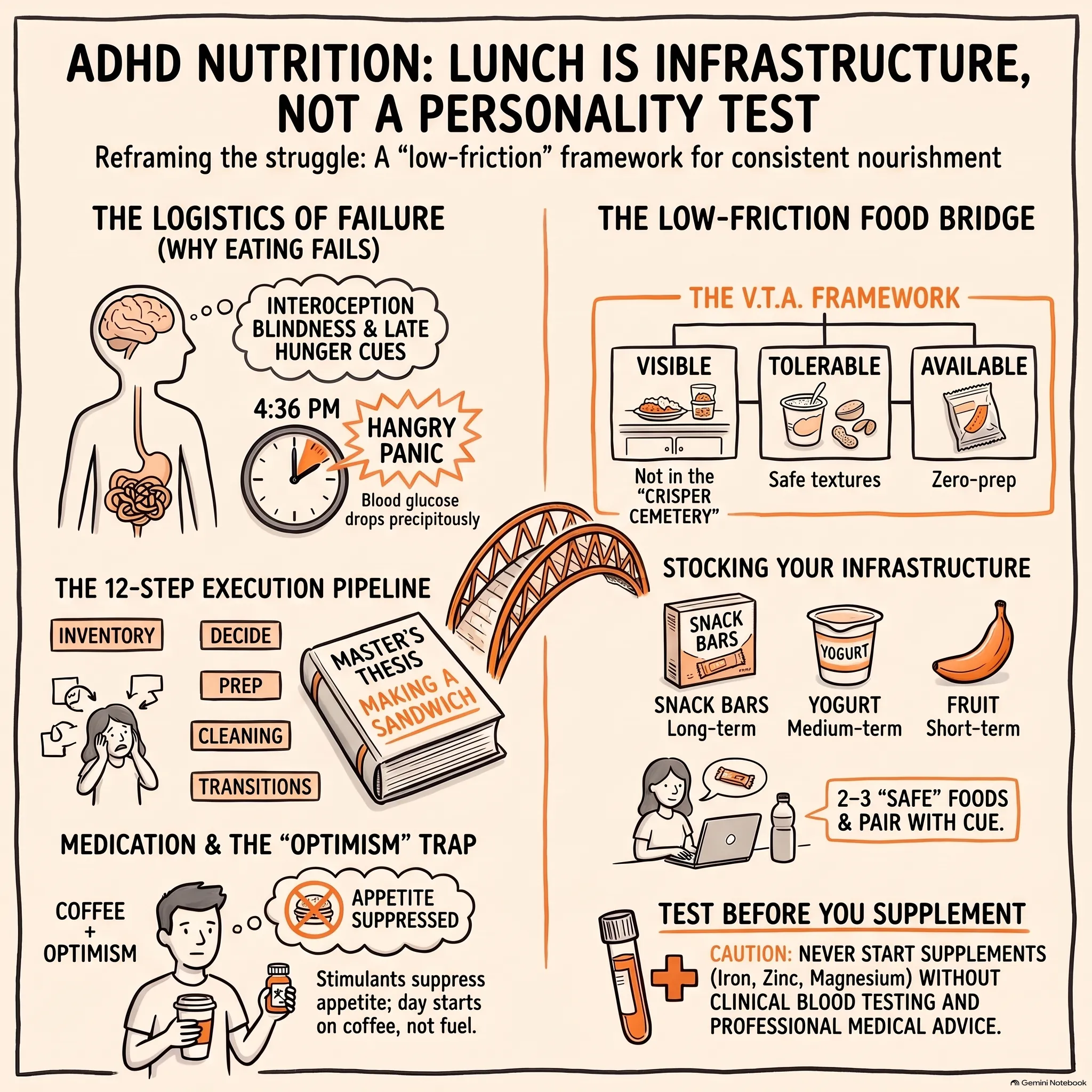
This is rarely about not knowing what good nutrition looks like. Most people who struggle with regular eating can recite the guidance perfectly. The failure happens further upstream, at one of four points:
Hunger cues arrive late. If internal signals are faint or mislabelled, by the time you recognise hunger the window for a calm, sensible decision has already closed.
Medication changes appetite. Stimulant medication in particular can flatten appetite during the hours it is active, so the need for food and the desire for food no longer coincide.
Preparation contains twelve transitions. A sandwich is not one action. It is opening the fridge, assessing what is there, finding a clean surface, locating the knife, deciding what goes on it, and then eating before it goes cold. Each step is a small decision, and decisions cost something.
Sensory preferences narrow the menu. Texture, smell, temperature and familiarity all constrain what is actually edible on a given day. A perfectly nutritious meal that you cannot tolerate is not a meal — it is a standoff.
Recognising these as design constraints rather than character flaws changes what you build. You stop trying to summon discipline and start removing steps.
Food is not a moral grade
A meal does not need to be artisanal, balanced across every food group, or photographed near a linen napkin in order to count.
The immediate problem is not optimisation. It is access: something safe, tolerable, affordable, and reachable before capacity disappears. A plain bowl of cereal eaten at 11 a.m. outperforms an ideal dinner that never gets made.
This matters because the shame spiral usually costs more than the missing nutrients. A difficult eating day becomes evidence that you have failed at wellness, which makes the next eating decision feel heavier, which makes it more likely to be skipped.
Build a low-friction food bridge
The book’s framework fits on three words: visible, tolerable, available.
- Visible — if it is in a cupboard behind two other things, it does not exist at 4:36 p.m.
- Tolerable — safe textures and flavours you will reliably eat, not aspirational foods you buy with good intentions
- Available — requires no shopping, no thawing, and ideally no cooking
In practice, this looks like keeping two or three tolerated foods with different storage lives: something shelf-stable, something refrigerated, and something frozen. Shelf-stable is the one that saves the week, because it cannot go off and it does not require planning.
Pair eating with an existing cue
Waiting for accurate hunger signals is a strategy that fails quietly. If the cue is unreliable, attach eating to something that already happens reliably: the first coffee, the school run, the 1 p.m. meeting ending, the medication alarm.
This is not intuitive eating, and it is not pretending to be. It is accepting that in this nervous system, the signal may need an external anchor.
The supplement question, handled honestly
The internet offers a treasure hunt: iron, zinc, vitamin D, magnesium, omega-3, and a dozen other candidates, each with a compelling explanation for why you feel terrible.
Here is the accurate position. Micronutrients participate in many biological processes, and meta-analyses report group-level differences in some trace-element measures across ADHD studies. Those results are heterogeneous. They do not establish that one deficiency causes ADHD, nor that supplements improve symptoms for every person.
Blood values, dietary intake, absorption, inflammation, menstruation, illness and laboratory methods all complicate interpretation. And more is not automatically better: iron and other supplements can cause harm in excess, interact with medication, or mask a condition when taken without appropriate testing.
If you suspect a deficiency, the useful action is a test and a conversation with a clinician — not a course of supplementation chosen from a forum.
Metaphor check: calling food “fuel” is convenient, but humans are not engines with one empty neurotransmitter tank. Meals support the whole body through many pathways, and the dashboard has more dials than the metaphor suggests.
Try this: design for reliable adequacy
Three moves, all of them about access rather than willpower.
- Keep two or three tolerated foods with different storage lives. At least one shelf-stable.
- Pair eating with an existing cue rather than waiting for perfect hunger signals.
- Discuss persistent appetite loss, weight change, fatigue, or suspected deficiency with a clinician. These are clinical questions, not organisational ones.
If medication suppresses your appetite, ask the prescriber about timing and monitoring rather than changing the dose yourself. That conversation is normal, expected, and worth having.
Seek individualised advice for diabetes, eating disorders, pregnancy, gastrointestinal disease, allergies, or significant weight change — the general framework here is not a substitute for that.
Partner translation: “When eating requires too many steps, reminding me that nutrition matters does not create food. Please help make one acceptable option visible and easy. If appetite or weight changes persist, I need clinical support rather than pressure or commentary about what I should eat.”
Evidence note
Trace-element findings are mixed and group-based. This article recommends access, assessment, and safety — not a nutrient protocol, and not a biochemical cure. There is no supplement stack at the end of this page, and that is deliberate.
One next step: put one shelf-stable tolerated food somewhere you will see it before you are hungry. That is the entire bridge.