Your Body Sent a Memo: What Interoception Looks Like in an ADHD Nervous System
You are furious with the printer, the weather, and the entire concept of email. Everything is intolerable and everyone is being unreasonable.
Then you eat half a sandwich and discover that civilisation may continue after all.
This is not a personality collapse at 3:40 p.m. It is a memo that arrived without a subject line.
What interoception actually is
Interoception is the sensing and interpretation of signals from inside the body. It covers everything from hunger and thirst to heartbeat, temperature, muscle tension, and the general sense that something is wrong or fine.
The important part is that this is not one skill but several, and any of them can fail independently:
- Noticing the signal at all
- Identifying it accurately — is this hunger, anxiety, or a temperature problem?
- Deciding what it means
- Acting on it
You might notice something is off but mislabel it. You might label it correctly but not know what would help. You might know exactly what would help and be unable to interrupt what you are doing in order to do it. These are four distinct failure points, and treating them as one is why the standard advice — “just listen to your body” — lands so badly.
How a signal without a label presents
When the label is missing, the signal does not disappear. It gets expressed through whatever channel is available:
- Hunger appears as fog or difficulty finding words
- Fatigue arrives wearing irritability’s coat
- A full bladder becomes inexplicable restlessness
- Tension is noticed only after your shoulders have applied for permanent residence beside your ears
- Under-stimulation reads as a physical itch you cannot name
This is why the same underlying problem can look like an emotional crisis, a focus problem, or a sensory meltdown depending on which day you get asked.
Signal, story, experiment
The most useful thing you can build is a habit of separating three layers that normally arrive fused.
Signal. Name only what you can observe in your body. Tight jaw. Warm face. Nausea. Buzzing in the legs. A dull ache behind the eyes. No interpretation, no cause — just the observation.
Story. Notice the explanation your brain offered first and hold it loosely. “I’m angry” might be true. It might also be the shape that low blood sugar is currently taking. Most first explanations are stories, not readings.
Experiment. Make one low-risk adjustment and check again. Not a full solution — a test. Drink water, eat something small, add a layer, step outside, change position. Then reassess.
The point is not to conclude that every emotion is secretly dehydration. It is to add one branch to your decision tree before you conclude that your personality has collapsed.
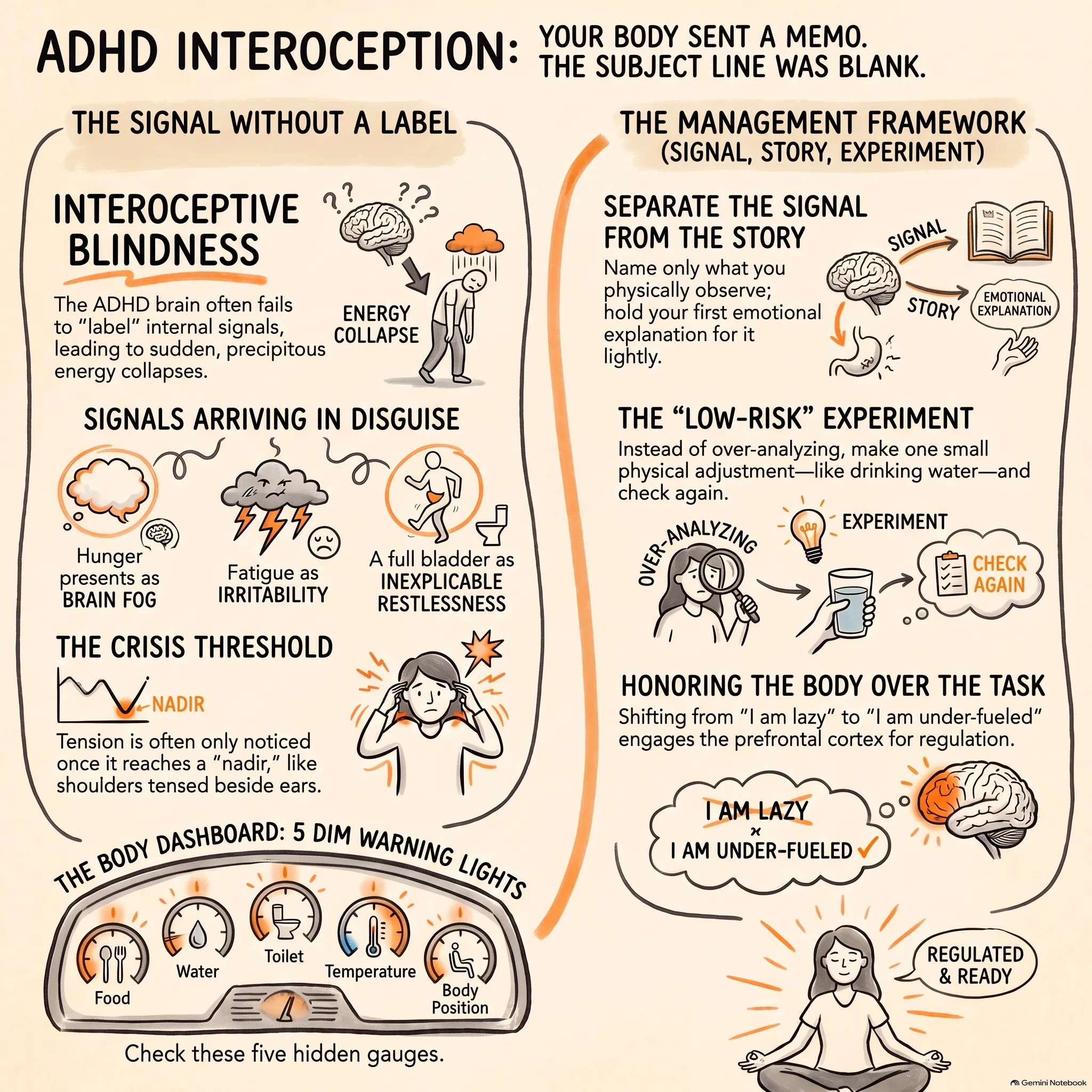
The five dashboard lights
A useful 60-second check, borrowed from the book:
- Food — when did I last eat something that was actually food?
- Water — not caffeine, not a soft drink
- Toilet — more often the answer than anyone admits
- Temperature — too hot, too cold, or wearing the wrong layer for this room
- Position — have I been in this exact shape for three hours?
Pick one safe, ordinary adjustment. Then reassess. You are testing a possibility, not solving yourself.
What may be happening — and what we don’t know
Interoception is a genuine area of neuroscience, involving communication between bodily systems and the brain. The honest position is that the evidence base does not support one clean, universal ADHD interoception profile. It would be premature to claim that all people with ADHD miss hunger, thirst or pain signals for the same neurological reason.
Attention, sensory processing, stress, learned habits, medication effects, pain, illness and whatever you are in the middle of all shape what gets noticed and how it gets interpreted.
You will also encounter Polyvagal Theory used to explain links between perceived safety and bodily state. It is one theoretical framework, and a useful metaphor for many people. It is not settled anatomy, and it should not be used to diagnose ordinary fatigue, freezing, or task difficulty.
Metaphor check: the “body dashboard” is a memory aid. Humans do not have five simple warning lights, and the same sensation can have many causes. Treat the dashboard as a prompt to investigate — not as a diagnostic instrument.
Try this: three steps, one of each
- Name only what you observe. “Tight jaw, warm face.” Not “I’m about to lose it.”
- Hold your first explanation lightly. The first story is allowed to be wrong.
- Make one low-risk adjustment and check again. Then decide whether a second is needed.
When this is not the right tool
A body scan is an orientation tool, not a substitute for medical care. New chest pain, fainting, severe shortness of breath, neurological symptoms, signs of dehydration, sudden or severe pain, or other urgent changes require appropriate medical attention.
A vague signal is not imaginary. It is simply not yet an explanation — and the difference between those two statements is the whole point.
Partner translation: “I may notice a body need late or struggle to name it quickly. Please offer one neutral possibility — food, water, temperature, a break — without insisting that it explains my feelings. If symptoms persist, help me take them seriously.”
Evidence note. The practical check is a low-risk orientation tool, not an ADHD treatment or a diagnostic test. ADHD-specific claims about interoception remain unverified within our source base.
One next step: run the five-point check once today, at a random moment, and notice which light was actually off.