An Explanation Is Not Yet a Repaired Tuesday: How to Actually Make Amends
You missed the appointment, forgot the purchase, or snapped during overload.
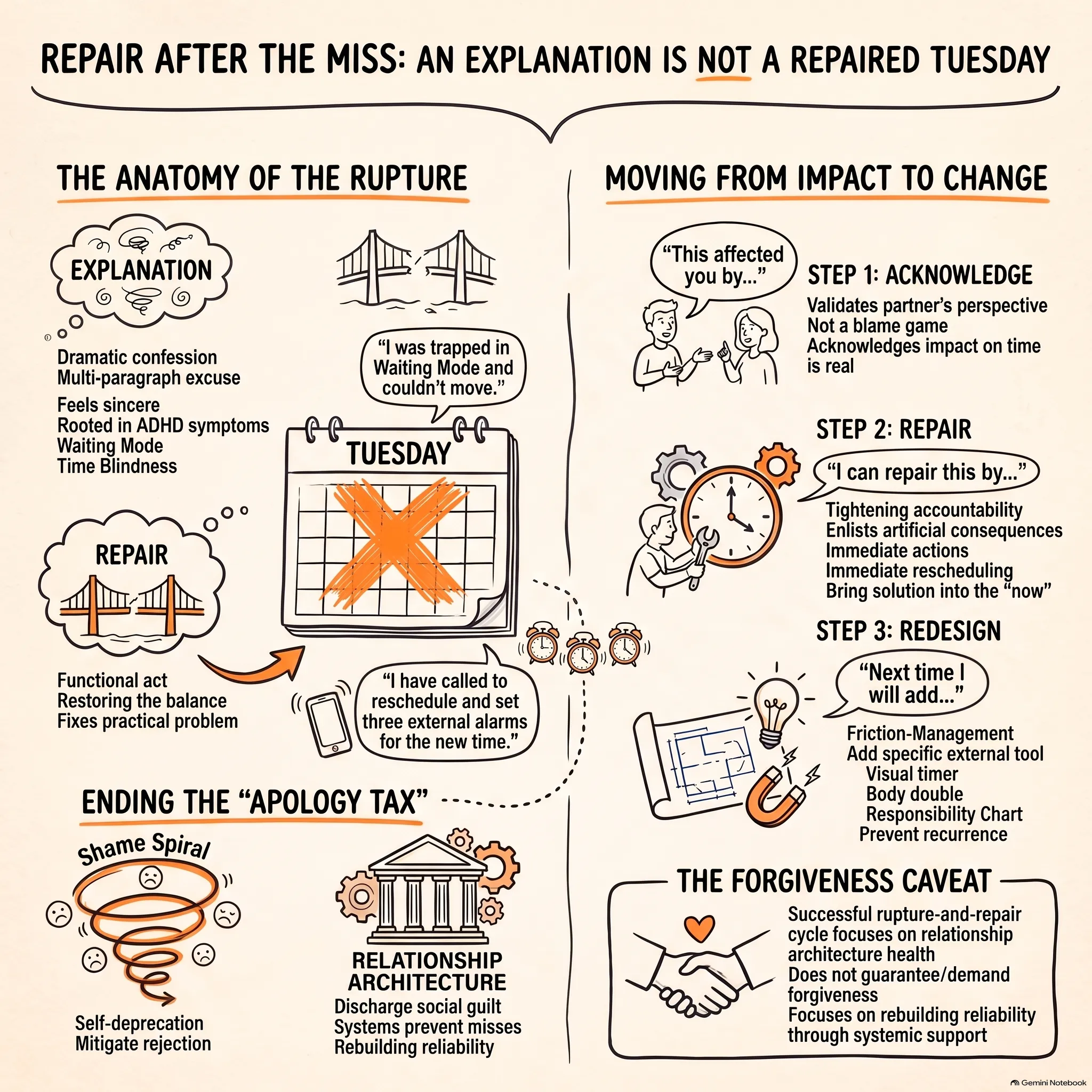
The reason matters. The effect on another person also matters. Both facts can occupy the same kitchen, and most arguments about an ADHD-related miss are really arguments about which of the two is allowed in the room.
The explanation is genuine. It is also not a repair.
The difference between repair and self-punishment
These two get confused constantly, and the confusion is expensive because they lead in opposite directions.
Self-punishment is about the self. It relitigates identity, produces a large emotional display, and often ends with the person who was hurt providing comfort. It can feel intensely sincere while leaving them with exactly the same practical problem as before: the appointment was still missed, and it will be missed again.
Repair is about the impact and the future. It names what happened, takes responsibility for the part you own, offers a concrete action, and — critically — changes the conditions that made repetition likely.
That last element is what separates a real repair from a promise. Without it, you are asking someone to trust the same setup that already failed.
Do not promise that it will never happen again
This is the most common well-intentioned mistake, and it is where trust erodes fastest.
You cannot promise that a symptom will never appear again. Promising it means that the next occurrence becomes a broken promise on top of the original harm — and now there are two injuries to repair.
What you can promise is the next observable safeguard you can actually attempt. Not “I’ll be more organised.” Rather: “The appointment goes in the shared calendar before I hang up.” Not “I’ll remember next time.” Rather: “The parcel goes in the car the moment it arrives.”
Observable beats sincere. Sincere is a feeling; observable is a thing the other person can verify.
What may be happening underneath
Shame narrows attention toward identity defence. When shame is running the conversation, the goal shifts — without you deciding it — from understanding the impact to protecting the self. That is why a discussion about a missed appointment can somehow become a discussion about whether you are a good person.
Accountability directs attention differently: toward impact and future behaviour. It is less dramatic and considerably more useful.
Emotion regulation may genuinely be needed before a useful conversation can happen. A flooded nervous system does not process well. The honest caveat is that regulation must not become indefinite avoidance — “I need to calm down first” is a legitimate need right up until it becomes a permanent postponement.
Metaphor check: a “rupture and repair” frame organises the responsibilities available after harm. It does not guarantee forgiveness. The other person is allowed to need time, and repair is not a transaction that obliges them to feel better on your schedule.
Try this: make the apology operational
Three moves. Each one replaces something that sounds sincere with something that is checkable.
- Name the impact without adding a character trial. “You were left waiting for an hour and you had to explain it to the host” rather than “I’m a terrible partner.”
- Ask what repair would be useful — do not demand reassurance. Asking is different from fishing. The question is genuinely open, and the answer may not be a compliment.
- Change one cue, boundary, ownership rule, or support. One. A single changed condition is worth more than a sweeping commitment.
The three sentences
If the conversation is hard to start, the book offers a scaffold that keeps it honest:
“This affected you by…” “I can repair this by…” “Next time I will add…”
The first sentence names impact. The second names a concrete action. The third names the structural change. Nothing in the sequence requires you to defend your diagnosis, and nothing in it implies the harm did not matter.
Partner translation: “My ADHD may help explain how this happened, but I understand that you experienced the impact. I want to make a specific repair and change the failure point. You do not need to comfort me before we address what happened.”
That last sentence is the one that most often unlocks the room. It removes an obligation the other person did not agree to and usually cannot meet.
When this framework is not the right one
Repeated harm, aggression, coercion, intimidation, or broken safety boundaries require more than a productivity system. This is true regardless of diagnosis, and diagnosis does not function as an explanation for behaviour that frightens or harms someone.
If that describes your situation — from either side — the appropriate next step is professional or safety support, not an adjustment to a calendar.
Evidence note. Repair is a relational practice, not an ADHD-specific treatment. This framework combines emotion-regulation principles with concrete accountability; it is a way of organising responsibility, not a therapeutic protocol.
One next step: take one unresolved miss and draft those three sentences. You do not have to send them yet. Drafting them is enough to find out whether you have an actual repair or only an explanation.