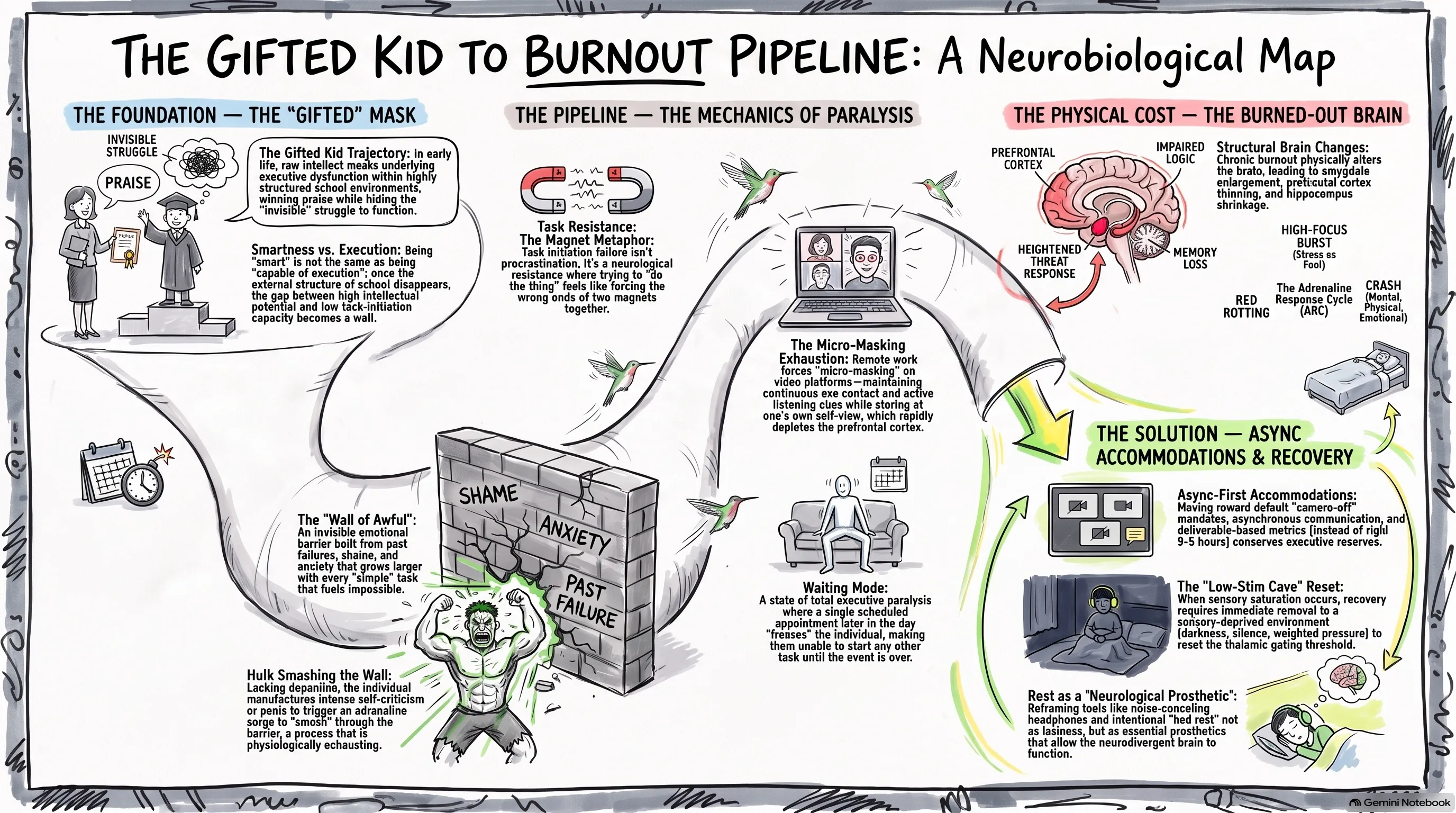
If you are a late-diagnosed AuDHD professional, your late twenties or thirties likely brought a terrifying, unexplainable crash:
Throughout school and early employment, you operated as the archetypal “gifted problem solver.” You wrote ten-page papers at 3 a.m. the night before deadlines and earned top marks. You solved complex technical crises under high-pressure panic. Everyone praised your intellect, resilience, and speed.
Then, seemingly out of nowhere, you hit an invisible concrete wall.
Answering a routine calendar invite triggers visceral nausea. Replying to a Slack message feels like pushing an 800-pound boulder uphill. You sit in front of your dual monitors for seven hours paralyzed, unable to start a single deliverable.
You find yourself wondering: “Did I suffer brain damage? Am I experiencing early dementia? Why can’t I perform tasks that a high school intern can handle?”
You did not lose your intelligence. What collapsed was your compensatory adrenaline system.
When Adrenaline Debt Comes Due
In neurodivergent children and young adults with high IQ, intellectual horsepower is used to mask executive dysfunction. Instead of developing baseline operational habits, the gifted AuDHD brain relies on emergency neurochemistry:
┌────────────────────────────────────────────────────────┐ │ Low Baseline Dopamine & Executive Friction │ │ (Inability to initiate mundane tasks) │ └───────────────────────────┬────────────────────────────┘ │ ▼ ┌────────────────────────────────────────────────────────┐ │ Procrastination Until Crisis Point │ │ (Final 24-48 hours before catastrophic deadline) │ └───────────────────────────┬────────────────────────────┘ │ ▼ ┌────────────────────────────────────────────────────────┐ │ High-Volume Adrenaline & Cortisol Surge │ │ (Sympathetic panic forces prefrontal cortex online) │ └───────────────────────────┬────────────────────────────┘ │ ▼ ┌────────────────────────────────────────────────────────┐ │ Hyperfocus Breakthrough & High-Quality Deliverable │ │ ("They did it again! What a genius!") │ └────────────────────────────────────────────────────────┘
Adrenaline is high-interest debt. When adult life stacks compounding administrative weight—mortgages, health insurance, taxes, relationship upkeep, corporate office politics—the sheer volume of operational tasks exceeds what panic surges can finance.
The adrenal and sympathetic pathways burn out. The compensatory dam breaks, plunging the individual into severe autistic/ADHD burnout.
The Remote Work Trap: Video Call Micro-Masking
Remote work was hailed as the definitive neurodivergent accommodation. In reality, remote knowledge workers are experiencing acute burnout at unprecedented rates.
The primary catalyst is Micro-Masking during video conferencing:
- The Mirror Tax (Self-View Exhaustion): In human evolutionary biology, you have never had to stare at your own reflection while attempting to converse with a peer or superior. When your self-view tile is visible, your brain runs a taxing background thread: policing resting facial expressions, suppressing stims, ensuring you look engaged, and monitoring eye angles.
- Artificial Gaze Simulation: Webcams make authentic eye contact impossible. Looking at the camera lens feels disconnected; looking at the speaker’s eyes makes you appear disinterested. AuDHD brains exhaust huge reserves of working memory trying to manually simulate “active listening” nods.
- Macro-Masking Dissonance: Feigning enthusiasm for corporate jargon, performative team rituals, and hierarchical small talk produces continuous moral and cognitive fatigue.
3 Workplace Accommodations That Actually Work
Standard HR accommodations (like “extra time on deadlines”) usually make ADHD burnout worse by prolonging the torture of Waiting Mode. Instead, implement structural friction-reduction shields:
1. Permanently Hide Self-View
- In Zoom, Google Meet, or Microsoft Teams, immediately right-click your own video window and select “Hide Self-View.”
- Your colleagues can still see you, but you eliminate the exhaustive self-monitoring mirror loop. This single adjustment recovers up to 40% of your daily social energy.
2. Async-First Communication Briefs
- Institute a rule requiring meeting organizers to provide a 3-bullet agenda or 2-minute async Loom video before scheduling a live call.
- Spontaneous “quick syncs” fragment AuDHD working memory into paralyzed “Waiting Mode” blocks. Asynchronous briefs allow neurodivergent brains to process and respond without startle anxiety.
3. Deliverable-Based Output Decoupling
- Negotiate performance evaluation based strictly on completed milestones rather than continuous online Slack presence or desk hours.
- Autonomy over when and how work is completed eliminates performative “green dot” presence-masking.
Field Guides and Video Resources
Download our free Workplace Accommodations Field Guide containing word-for-word email templates to negotiate these adjustments with managers:
- Download: AuDHD Workplace Accommodations Guide (PDF)
- Master Video: Watch our full deep-dive on YouTube: The Gifted Kid to Burnout Pipeline: Surviving Remote Work Micro-Masking.