If you are neurodivergent—ADHD, Autistic, or AuDHD—you have likely spent years wondering why your physical body feels ten to fifteen years older than your chronological age.
You wake up with burning muscle aches in your neck, trapezius, and lower back, identical to the delayed-onset muscle soreness (DOMS) after a brutal gym workout. Yet you spent yesterday seated at a desk. You stand up from the couch and your vision blackens for three seconds while your heart rate hammers at 135 bpm. You experience sudden histamine flares or brain fog from foods you ate yesterday without consequence.
When you seek medical advice, the response is almost universally dismissive: “Your bloodwork, thyroid, and MRI are completely normal. It is just stress and somatic anxiety.”
It is not anxiety. And it is not in your head.
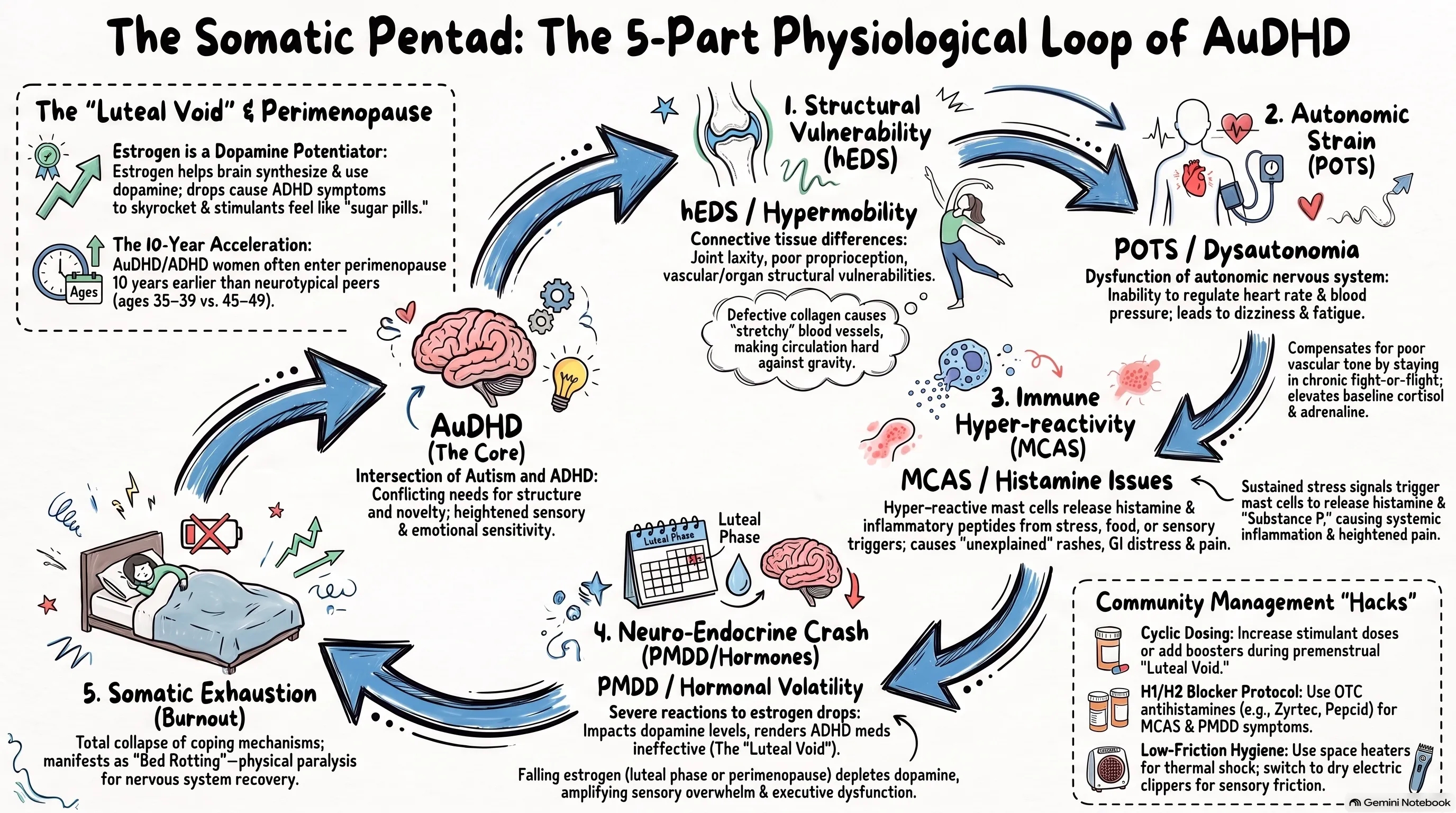
Clinical ethnography and somatic neurodivergent research now identify this interconnected cluster as The Somatic Pentad—a five-tier physiological cascade rooted in genetic collagen differences, autonomic dysregulation, and mast cell hyper-reactivity.
What Is The Somatic Pentad?
In the general population, chronic pain, autonomic dysfunction, and allergic disorders are treated as separate, unrelated specialties. In the neurodivergent community, however, these conditions cluster together at rates five to ten times higher than baseline:
┌───────────────────────────────┐ │ 1. Hypermobility (hEDS/HSD) │ │ Lax collagen & ligaments │ └──────────────┬────────────────┘ │ ┌───────────────────────┴───────────────────────┐ ▼ ▼ ┌───────────────────────────────┐ ┌───────────────────────────────┐ │ 2. Dysautonomia / POTS │ │ 3. Mast Cell Activation (MCAS)│ │ Blood pooling & adrenaline │ │ Histamine & neuro-inflamm. │ └────────┬──────────────────────┘ └───────────────┬───────────────┘ │ │ └───────────────────────┬──────────────────────────────┘ ▼ ┌───────────────────────────────┐ │ 4. ME/CFS & Mitochondrial │ │ Cellular energy crash │ └──────────────┬────────────────┘ ▼ ┌───────────────────────────────┐ │ 5. Hormonal & Sensory Crashes │ │ PMDD & sensory exhaustion │ └───────────────────────────────┘
Let us examine why these five components feed each other in a continuous loop.
1. Hypermobile Ehlers-Danlos Spectrum (hEDS / HSD)
Connective tissue is the structural mortar of the human body. In hypermobile individuals, alterations in collagen synthesis create ligaments and joint capsules that lack structural stiffness.
In a neurotypical body, bone joints are securely locked in place by rigid ligaments, requiring zero conscious muscular effort when standing or sitting.
In a hypermobile AuDHD body, loose ligaments cannot stabilize the skeletal frame. Your skeletal muscles must step in as emergency mechanical scaffolding. Your deep neck stabilizers, traps, paraspinals, and glutes contract 24 hours a day, 7 days a week, in a state of permanent isometric bracing just to prevent your joints from slipping out of alignment.
That unprovoked soreness you feel upon waking isn’t lack of fitness. It is muscular exhaustion from holding your skeleton together while you slept.
2. Postural Orthostatic Tachycardia Syndrome (POTS)
Collagen lines not only your joints, but also the walls of your veins. When blood vessels have lax elasticity, gravity exerts an exaggerated pull when you transition from lying or sitting to standing.
Blood pools rapidly in the venous beds of your abdomen, legs, and feet. Because venous return drops, cardiac output temporarily plummets, starving the brain of cerebral perfusion.
To prevent you from losing consciousness, your sympathetic nervous system fires an emergency blast of norepinephrine (noradrenaline). Your heart rate surges by 30 to 50 beats per minute within seconds of standing. You feel lightheaded, shaky, and short of breath. Traditional medicine misdiagnoses this physical adrenaline surge as a psychological panic attack.
3. Mast Cell Activation Syndrome (MCAS)
Mast cells are immune sentinels strategically positioned at the interface between the outside world and your nervous system (skin, gastrointestinal lining, and perivascular spaces).
In hypermobile connective tissue matrices, mast cells are mechanically unstable. Any significant shift—a spike in cortisol, thermal temperature transitions (like stepping out of a hot shower into cold air), high-histamine leftovers, or sensory overstimulation—triggers mast cell degranulation.
Degranulation releases histamine, prostaglandins, and cytokines directly into surrounding tissues, creating migraines, sudden hives, gut spasms, and cognitive “brain fog” that amplifies executive dysfunction.
4. The Deadly Flaw of Traditional Advice: “Just Stretch and Do Cardio”
When an AuDHD person presents with chronic neck tension and fatigue, conventional practitioners prescribe:
- Aggressive stretching & yoga
- High-intensity cardiovascular exercise
For someone with The Somatic Pentad, this prescription is disastrous:
- Why stretching fails: When muscles are spasming to protect loose joints, aggressively stretching them pulls the joint further into instability. Your nervous system detects an imminent subluxation risk and reflexively clamps the muscle down even tighter 30 minutes later.
- Why upright cardio fails: Forcing an orthostatically compromised vascular system to perform upright cardio triggers immediate anaerobic stress, pooling blood in the extremities and plunging the patient into multi-day post-exertional neuro-immune crashes (PEM).
The Zero-Friction Somatic Stabilization Protocol
Stabilizing The Somatic Pentad does not require extreme workouts or endless doctor visits. It requires mechanical support, blood volume expansion, and strategic pacing:
Step 1: Deep Proprioceptive Compression
Instead of asking your exhausted muscles to do the job of ligaments, supply external mechanical stiffness.
- Wear medical-grade compression garments (20–30 mmHg waist-high tights or firm abdominal binders).
- Compression mechanically squeezes venous pools back into central circulation and feeds intense, calming proprioceptive input to the brain, allowing muscle spasms to release without stretching.
Step 2: High-Sodium Plasma Loading
In dysautonomia, plain water cannot be retained in the vascular space—it simply flushes through the kidneys.
- Take 500–1000 mg of sodium in electrolyte water upon waking, before your feet hit the floor.
- Expanding intravascular fluid volume prevents the catastrophic orthostatic drop upon standing, calming the adrenaline surge.
Step 3: The 12-Minute Horizontal Reset
When cognitive fatigue or sensory overwhelm hits, do not sit upright scrolling your phone.
- Lie flat on the floor with your legs elevated on a couch or wall for 10–15 minutes.
- This eliminates the gravitational orthostatic burden, immediately doubles cerebral blood flow, and signals to the vagus nerve that the body is safe.
Watch the Master Explainer Video & Download the Guide
For a full anatomical walkthrough of exercises that stabilize hypermobile joints without stretching, watch our full masterclass video on YouTube:
- Watch Master Video: The Somatic Pentad: Why Your AuDHD Body Aches Without Exercise (YouTube)
- Download the 1-Page Protocol: Get the free PDF printable guide on our resources portal.