The Intrusive Sleep Attack: Why the ADHD Brain Shuts Down Under Boredom
You are sitting in an important team meeting, a technical lecture, or at a family dinner. You slept a solid eight hours last night. You are not physically exhausted, and you genuinely care about your job.
Then, without warning, your eyelids turn to lead.
Your neck muscles soften, your vision blurs, and an overwhelming, almost violent urge to close your eyes washes over your entire nervous system. You dig your fingernails into your palms, pinch your leg, shake your head, or take deep gulps of air. Nothing works. Your head bobs downward in a humiliating micro-sleep.
To an outside observer, you look lazy, disrespectful, or unmotivated. You leave the room drowning in guilt, asking yourself: Why can’t I just stay awake like everyone else?
This is not ordinary tiredness, and it is certainly not a moral failing.
In clinical neuropsychiatry, this phenomenon is known as Intrusive Sleep. It is a sudden, involuntary neurological shutdown triggered not by physical fatigue, but by severe neurochemical under-stimulation.
1. The Reticular Activating System (RAS): Your Brain’s Power Switch
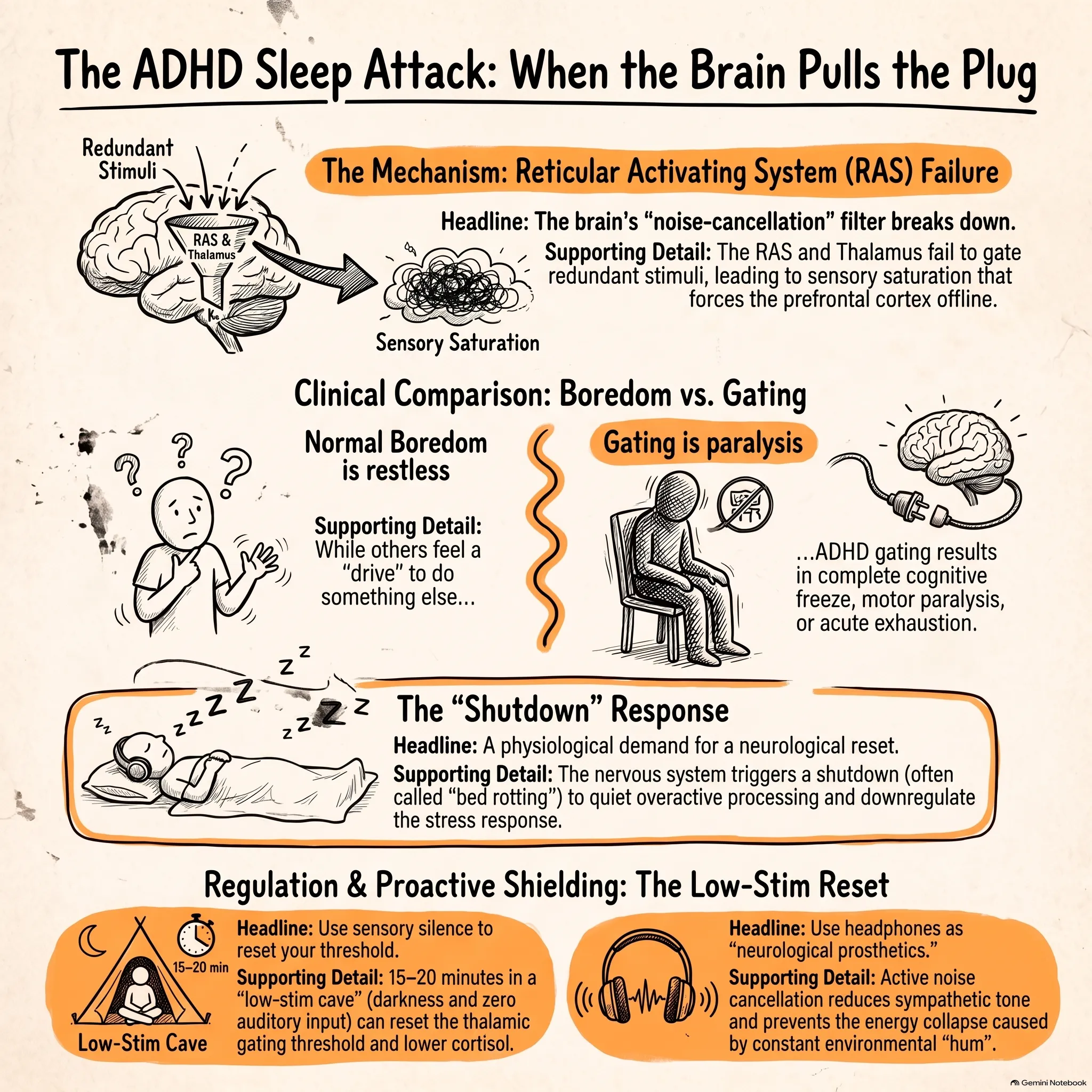
Deep inside your brainstem lies a dense cluster of interconnected neurons called the Reticular Activating System (RAS).
The RAS functions as the master gatekeeper of consciousness and arousal. It controls the electrical transition between sleeping and waking states. When sensory stimuli enter your body, the RAS assesses their relevance and regulates the flow of electrical signals upward to your cerebral cortex.
For the RAS to keep your cerebral cortex awake and alert, it requires a steady baseline stream of two critical catecholamine neurotransmitters:
- Dopamine: Drives interest, salience, and anticipation of reward.
- Norepinephrine (Noradrenaline): Modulates vigilance, cognitive arousal, and autonomic responsiveness.
In neurotypical brains, the RAS can maintain a stable baseline of arousal even during monotonous, mundane, or low-interest tasks through endogenous tonic dopamine firing. A neurotypical person can sit through a dry two-hour presentation and feel bored, but their brain will remain conscious.
In an ADHD brain, however, basal dopamine and norepinephrine levels are chronically dysregulated.
When you are forced into an environment devoid of novelty, urgency, passion, or physical engagement, dopamine transmission drops off a cliff. The RAS perceives this sudden neurochemical drought as an explicit physiological instruction: There is zero environmental salience. Enter low-power sleep mode immediately.
2. Prefrontal Cortex Hypo-Perfusion: The Willpower Illusion
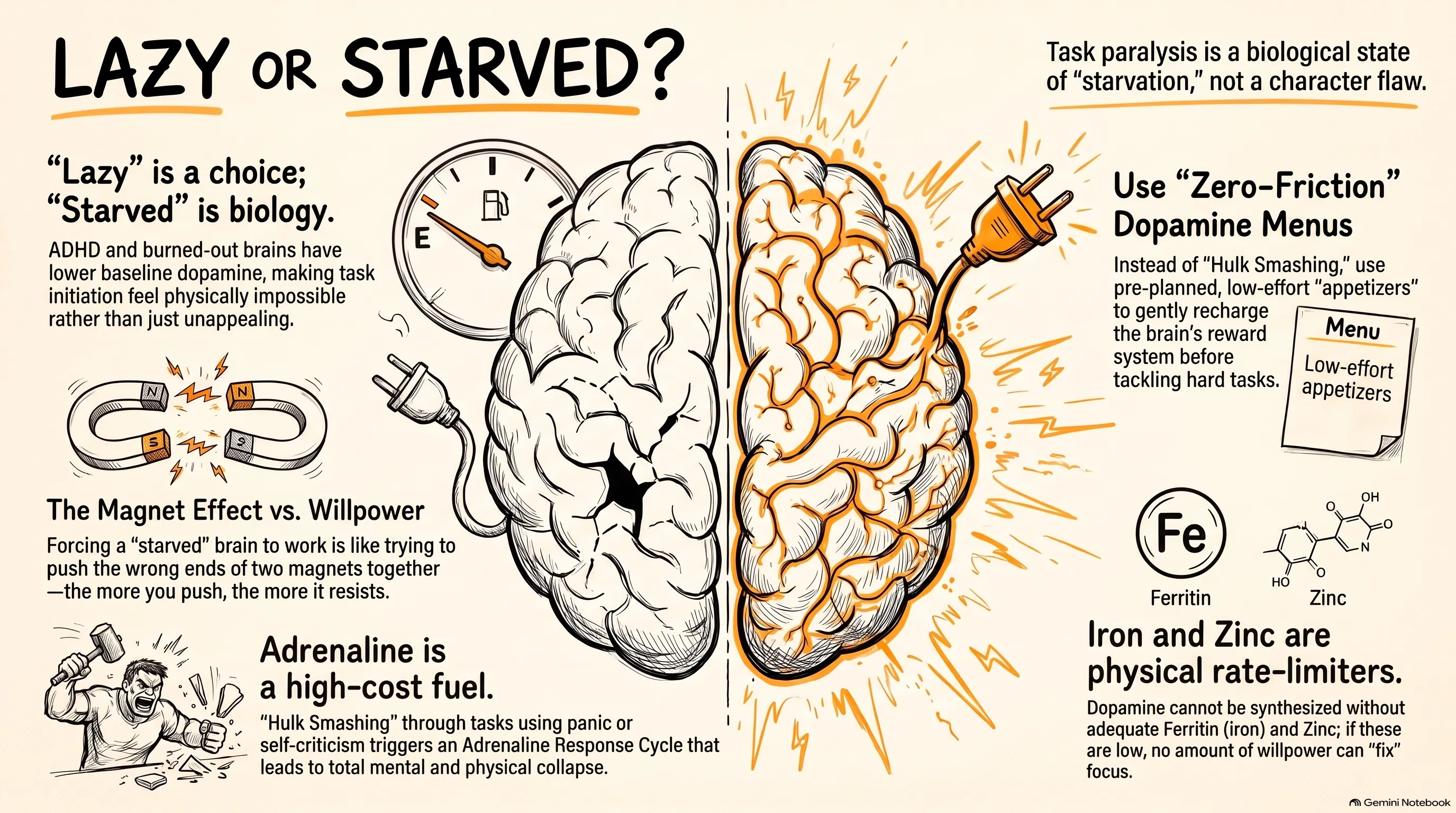
When an Intrusive Sleep attack begins, functional neuroimaging reveals a rapid decrease in regional cerebral blood flow to the dorsolateral prefrontal cortex (DLPFC)—the exact brain region responsible for conscious effort, focus, and self-regulation.
Trying to use “willpower” or “mental discipline” to fight an Intrusive Sleep episode is a physiological paradox. You are attempting to use the prefrontal cortex to command alertness at the very moment the prefrontal cortex is being starved of oxygenated blood and neurotransmitters.
This explains the classic paradox of the ADHD nervous system:
The 10-Minute Reversal: A person who is literally nodding off and unable to keep their eyes open during a spreadsheet review can suddenly become hyper-alert, energized, and sharp the moment a genuine crisis occurs, an engaging video game is launched, or an argument breaks out.
If you were genuinely sleep-deprived in a physical sense, an exciting video game would not reverse your exhaustion. But in Intrusive Sleep, the sudden injection of dopamine or norepinephrine instantly reignites the RAS, restoring cortical perfusion within seconds.
Your brain is not broken; it is an Interest-Based Nervous System operating with an extreme gating threshold.
3. Why Traditional Advice Fails
Standard productivity culture offers advice that actually worsens the shame spiral:
- “Get a planner and take detailed notes.” (Writing notes during severe under-arousal requires prefrontal executive function that is already offline).
- “Drink a massive cup of coffee.” (Caffeine blocks adenosine receptors, but it does not fix dopamine starvation. In many individuals with ADHD, caffeine paradoxically triggers relaxation or heart palpitations without waking up the cortex).
- “Just splash cold water on your face.” (Provides a 30-second shock via the mammalian dive reflex, but does not solve the root neurotransmitter collapse once you sit back down).
To effectively abort an Intrusive Sleep attack, you must bypass the prefrontal cortex entirely and stimulate the brainstem through primitive, subcortical neural pathways.
4. The 3 Non-Willpower Emergency Abort Protocols
When you feel the telltale heaviness of an Intrusive Sleep attack creeping into your eyes and neck, do not negotiate in your head. Implement one of these physical, evidence-based overrides:
Protocol A: Proprioceptive Trigeminal Stimulation (The Jaw Reflex)
The trigeminal nerve (Cranial Nerve V) is the largest cranial nerve, supplying profound sensory and motor innervation to the jaw, teeth, and chewing muscles (masseter and temporalis).
Chewing sends massive proprioceptive afferent feedback directly into the sensory nuclei of the brainstem, immediately adjacent to the RAS.
- Action: Keep intensely hard, jaw-engaging gum, crunchy ice cubes, or intensely sour lozenges (malic acid) readily available. Chewing vigorously with your molars sends mechanical shockwaves directly into the reticular formation, forcing alertness into the cortex without requiring conscious willpower.
Protocol B: Otolith Gravitational Plane Shift
The vestibular apparatus in your inner ear contains the utricle and saccule (otolith organs), which detect gravity and linear acceleration.
- Action: When you feel the shutdown starting, physically shift your head and torso out of the sedentary seated plane. Stand up, pace, or lean your torso forward while flexing your calves. The otolith organs detect postural instability, which automatically fires an evolutionary alarm to the brainstem: If we fall asleep now, we collapse physically. The RAS is forced to abort the shutdown.
Protocol C: Subvocal Auditory Grounding
If you are trapped in a meeting where you cannot stand up or chew gum, switch your focus from passive listening to active motor scribbling (Tactile Doodling).
- Action: Research demonstrates that non-structured tactile doodling increases blood flow to the cerebral cortex by 29% in individuals with executive dysfunction. Doodling acts as an auxiliary motor anchor, providing just enough dopamine stimulation to prevent the RAS from triggering sleep mode.
5. Reframing the Guilt
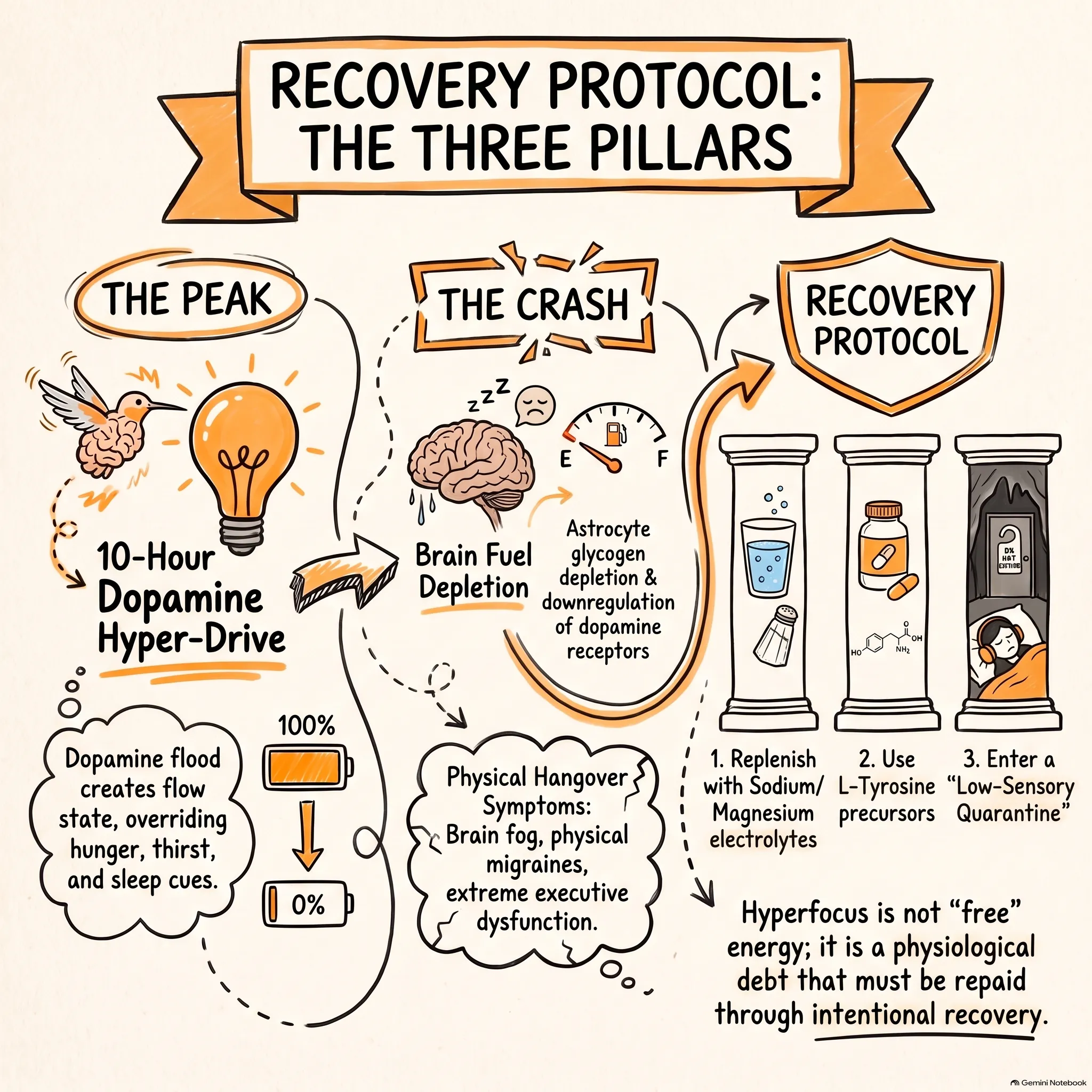
If you have spent your life feeling defective because your body has shut down in meetings, classrooms, or during crucial conversations, release the moral burden.
Your brain is not undisciplined. You are living with a nervous system that requires chemical ignition to maintain basic consciousness. Recognizing Intrusive Sleep as a biological state rather than a character flaw is the first step toward building environments and micro-routines that work with your neurochemistry, not against it.