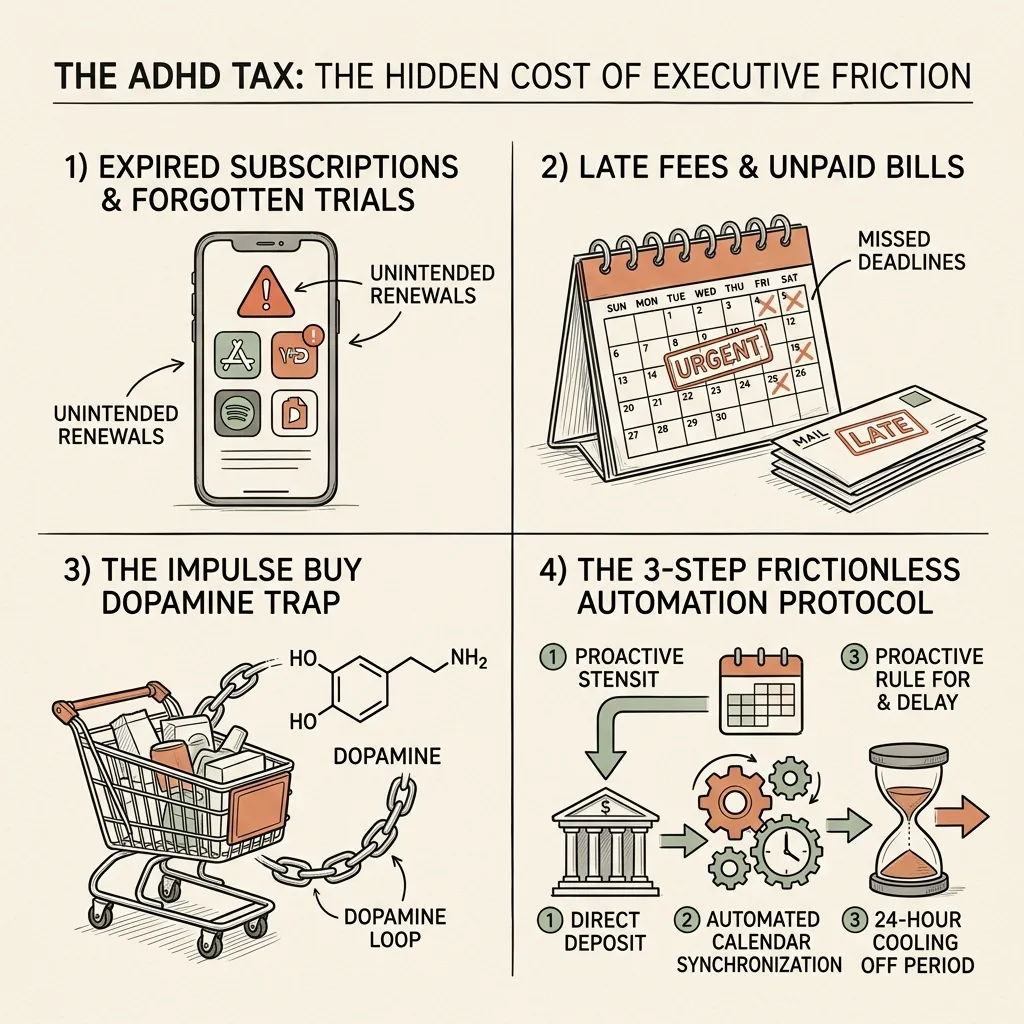
You open your banking app and your stomach instantly drops. A streaming subscription you meant to cancel seven months ago has quietly drained another twenty dollars. An unpaid parking ticket that started at twenty-five dollars now demands a hundred and fifty in penalties. In your hallway sits a return box past its 30-day window. In the crisper drawer of your fridge, forty dollars of organic produce has dissolved into liquid brown guilt.
This is not bad math. You are not reckless, irresponsible, or lazy.
What you are paying is the ADHD Tax — the silent, compounding surcharge of navigating a neurotypical economic world with an interest-based nervous system. Independent financial surveys calculate this recurring executive friction penalty between $2,500 and $4,500 every single year.
The 3 Biological Drivers of Financial Dysregulation
The ADHD Tax is not a character flaw. Decades of neuroimaging and psychiatric research reveal three distinct biological mechanisms that sabotage neurodivergent finances:
1. Temporal Discounting & “Now vs. Not-Now” Myopia
As leading ADHD researcher Dr. Russell Barkley demonstrates, the neurodivergent brain perceives time as binary: Now and Not-Now.
A credit card payment due in 12 days does not register as an upcoming obligation; it is biologically invisible until it enters the 24-hour emergency zone. Distant future outcomes (such as retirement savings or compound interest) carry almost zero chemical salience compared to an immediate tactile reward.
2. The Dopamine Prediction Error Trap
Studies by Dr. Nora Volkow (PubMed 19738093) reveal that ADHD brains exhibit lower baseline tonic dopamine levels.
When you browse an online store or tap “1-Click Checkout”, your nucleus accumbens experiences an acute anticipatory surge of dopamine. The purchase is rarely about the physical item — it is an unconscious neurochemical attempt by an exhausted, under-stimulated brain to raise its internal arousal baseline. Within minutes of delivery, the stimulation vanishes, replaced by buyer’s remorse.
3. Constrained Working Memory & Object Permanence
The prefrontal cortex holds active data in a temporary RAM buffer. In ADHD, this working memory buffer is severely constrained.
If a financial obligation is hidden inside an email receipt, an unopened letter, or an account sub-menu, it physically ceases to exist for your working memory until an overdraft notification sounds the alarm.
Why Conventional Budgeting Advice Fails
Standard personal finance advice is universally designed for neurotypical brains:
- ❌ “Track every coffee in a spreadsheet.”
- ❌ “Check your banking dashboard every morning.”
- ❌ “Just use more discipline and willpower.”
For an ADHD brain, manual tracking adds high cognitive friction with zero dopamine reward. The moment you miss three days of logging, the Wall of Awful triggers an acute shame response. Your amygdala perceives the spreadsheet as an emotional threat, triggering the Ostrich Effect — complete avoidance of your bank account.
The 4-Step Zero-Friction Financial Protocol
To stop the leak, you must stop relying on willpower and start engineering automated environmental friction:
Never run discretionary spending from the same account that pays your mortgage or utility bills. Set up two separate checking accounts with automated direct deposit rules on payday:
- Account A (Fixed Vault): Auto-deposit exactly what is needed for fixed recurring essentials (rent, insurance, phone bill). Destroy the physical debit card for this account so you cannot swipe it impulsively.
- Account B (Daily Sandbox): Receives your remaining discretionary spending allowance. When Account B reaches zero, spending naturally ceases without math, tracking apps, or guilt.
Never enter your primary payment card into free trials or monthly subscription platforms. Use virtual card generators (like Privacy.com or single-use digital burner cards) with spend limits capped at $1.00.
When the 14-day trial ends and the service attempts to rebill, the card automatically declines. The subscription cancels itself without requiring you to remember a calendar date.
Impulse online shopping thrives on zero-click convenience. Delete saved card credentials, Apple Pay shortcuts, and browser auto-fill.
When you want an unbudgeted item, you must physically stand up, find your wallet, and manually type all 16 digits. Place the item in the online cart and enforce a mandatory 72-hour delay. Over 80% of impulsive shopping urges biologically evaporate once baseline dopamine resets.
Packages meant for return rot in closets because out of sight is out of mind. The moment an ill-fitting item arrives, tape the return label to the box and physically set the box on top of your car keys or work laptop.
When an object directly obstructs your physical path of movement, starting friction drops to zero and object permanence works in your favor.
Stop Bleeding Money to Executive Dysfunction
Download our complete clinical field guidebook with printable visual cue cards, the 1-Card Sandbox setup checklist, and the 1-Page Subscription Autopsy Matrix.
📥 Get the Free ADHD Tax Field Guide (PDF)3 Critical Traps to Avoid
- Self-Inducing Panic as Fuel: Generating manufactured panic or anger to force yourself to pay a bill works once or twice, but relying on adrenaline spikes rapidly exhausts your adrenal reserves and plunges you into autistic/ADHD burnout.
- Keeping Emergency Buffers in Sight: If emergency savings sit inside your main banking app dashboard, your dopamine-depleted brain registers those funds as available surplus for novelty purchases. Move emergency reserves to an external high-yield savings account with a mandatory 48-hour transfer delay.
- Punitive Guilt Spirals: Berating yourself for past overdrafts activates Rejection Sensitive Dysphoria (RSD), increasing cortisol and driving you right back toward emotional comfort spending. Treat financial slip-ups as structural diagnostic data, not moral indictments.
The Bottom Line
Financial peace with ADHD is not built on discipline, budgeting apps, or spreadsheets. It is built on environmental architecture. When you eliminate friction from bill payments and add friction to impulse triggers, your bank account recovers automatically.