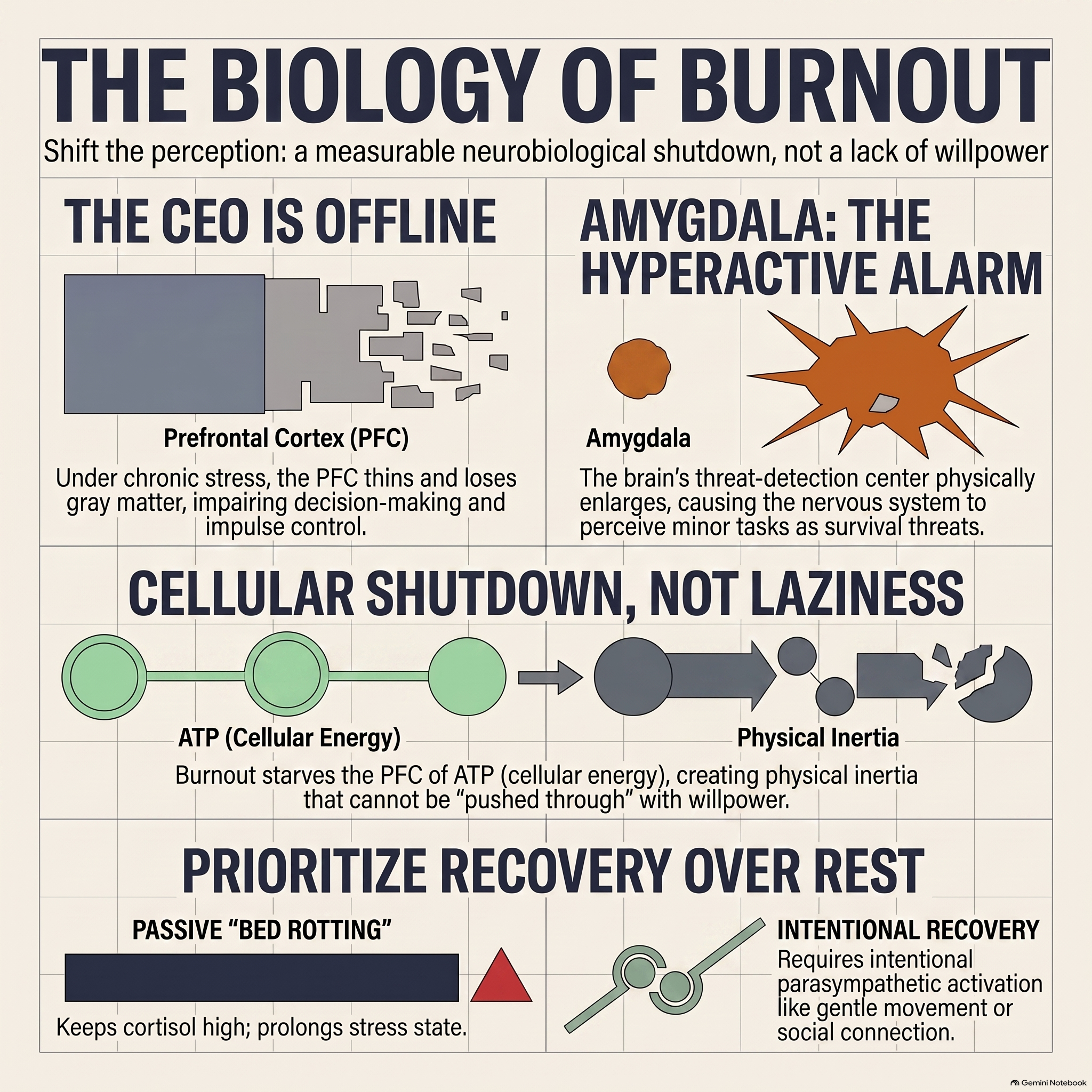
The problem It is Friday night, and you collapse onto your couch after a brutal week of fighting your own brain to get tasks done. You have cancelled all your plans, resolved to do absolutely nothing, and promised yourself that this weekend will be a deep, restorative recharge. You spend the next forty-eight hours in bed or on the sofa, escaping into social media, streaming shows, and sleeping late. Yet on Monday morning, your body feels as heavy as concrete. Your brain is wrapped in a dense, suffocating fog, and the thought of opening your inbox triggers immediate physical dread. You feel just as exhausted, overwhelmed, and paralyzed as you did on Friday night. You stare at your screen in despair, whispering that familiar, toxic accusation: "I am just lazy. If I cannot even recover after two full days of resting, I must have zero discipline." ## Why it happens This persistent exhaustion is not a moral failing. It is a predictable neurobiological reaction. Weekends do not fix burnout because of a profound biological difference between passive **rest** and active **recovery**, and your brain desperately needs recovery to heal. When you are chronically stressed, your body keeps its stress-response system on high alert. Over time, **chronic stress alters brain function** and directly impairs your **mitochondria**—the microscopic powerhouses inside your cells. This cellular energy deficit starves your prefrontal cortex of **cellular energy (ATP)**, leaving you without the fuel required to initiate tasks. For adults with ADHD, this ATP depletion is compounded by low dopamine. Because your brain runs on an **interest-based nervous system**, it does not naturally release **dopamine**—the chemical starting engine—for routine chores. When you try to work with low energy and low dopamine, your threat-detecting **amygdala** becomes hyperactive. It perceives starting friction as an active danger, triggering a physical **freeze response** (task paralysis). When you try to "rest" by lying in bed scrolling social media, a phenomenon called **bed rotting**, you are practicing **somatic avoidance**. This constant digital input keeps your amygdala active and your nervous system in high alert. Your brain works in overdrive to process stimulation, preventing your cells from rebuilding ATP. You are not recovering; you are quietly draining your fuel. ## How to fix it today To break this cycle and actually rebuild your cellular energy, you must stop relying on passive avoidance. Instead, work with your biology to signal safety to your nervous system with these concrete steps today: - **Switch to analog, low-stimulation recovery:** True recovery requires giving your prefrontal cortex a complete break from digital inputs. Set aside blocks of screen-free time. Engage in restorative physical activities that signal safety—such as a brief walk, stretching, or listening to calm music to let your mitochondria rebuild ATP. - **Trigger a 60-second somatic reset:** When task paralysis locks you in place, quiet your reactive amygdala with a physical reset. Try a **physiological sigh**—taking two quick inhales through your nose followed by one long, slow exhale. This breathing pattern activates your parasympathetic nervous system. Alternatively, splash cold water on your face to trigger the mammalian dive reflex and reduce physical anxiety (check with a doctor first if you have underlying health conditions). - **Use the Two-Option Rule to protect your energy:** When your executive energy is low, deciding what to do is exhausting. Hide your entire to-do list and choose between exactly two tiny, concrete options, such as drinking a glass of water or opening a blank notebook. Limiting your choices removes the cognitive load of prioritizing. - **Commit to a 180-second micro-start:** Never look at a task as a massive mountain. Set a visual timer for three minutes and commit to working messily for just 180 seconds, with honest, unconditional permission to stop when the timer rings. By removing the pressure of doing a perfect job, you dismantle the emotional **"Wall of Awful"** and let physical momentum take over. - **Prepare your starting point in advance:** To make starting effortless tomorrow, prepare your workspace tonight. Open the exact file you need and clear your desk. Removing these tiny morning barriers prevents task paralysis. ## Common mistakes to avoid - **Confusing passive digital escape with biological recovery:** Scrolling through short videos or playing mobile games in bed feels like an escape, but the high-speed stimulation keeps your stress pathways active, draining your dopamine and preventing your body from entering a true resting state. - **Using "Hulk smashing" to force focus:** Do not rely on self-induced anger, panic, or urgency to force action. While an adrenaline spike breaks task paralysis, using stress as executive fuel is biologically expensive and leads directly to deeper burnout. - **Shaming yourself for needing recovery:** Beating yourself up for feeling exhausted after a weekend of rest only increases your emotional friction. Shame makes your amygdala more reactive, reinforcing the biological freeze response. Treat your fatigue as valuable physical data, not a character flaw. ## Takeaway Weekends do not fix burnout because passive resting does not restore cellular energy. Your ADHD brain is not broken or lazy; your system is simply running on empty, locked in a protective biological freeze. Stop shaming yourself for feeling exhausted. By calming your physical body with somatic resets, replacing scrolling with active recovery, and preparing your workspace for zero starting friction, you work with your biology instead of fighting it. Lower the starting bar, show yourself compassion, and let calm momentum carry you forward.