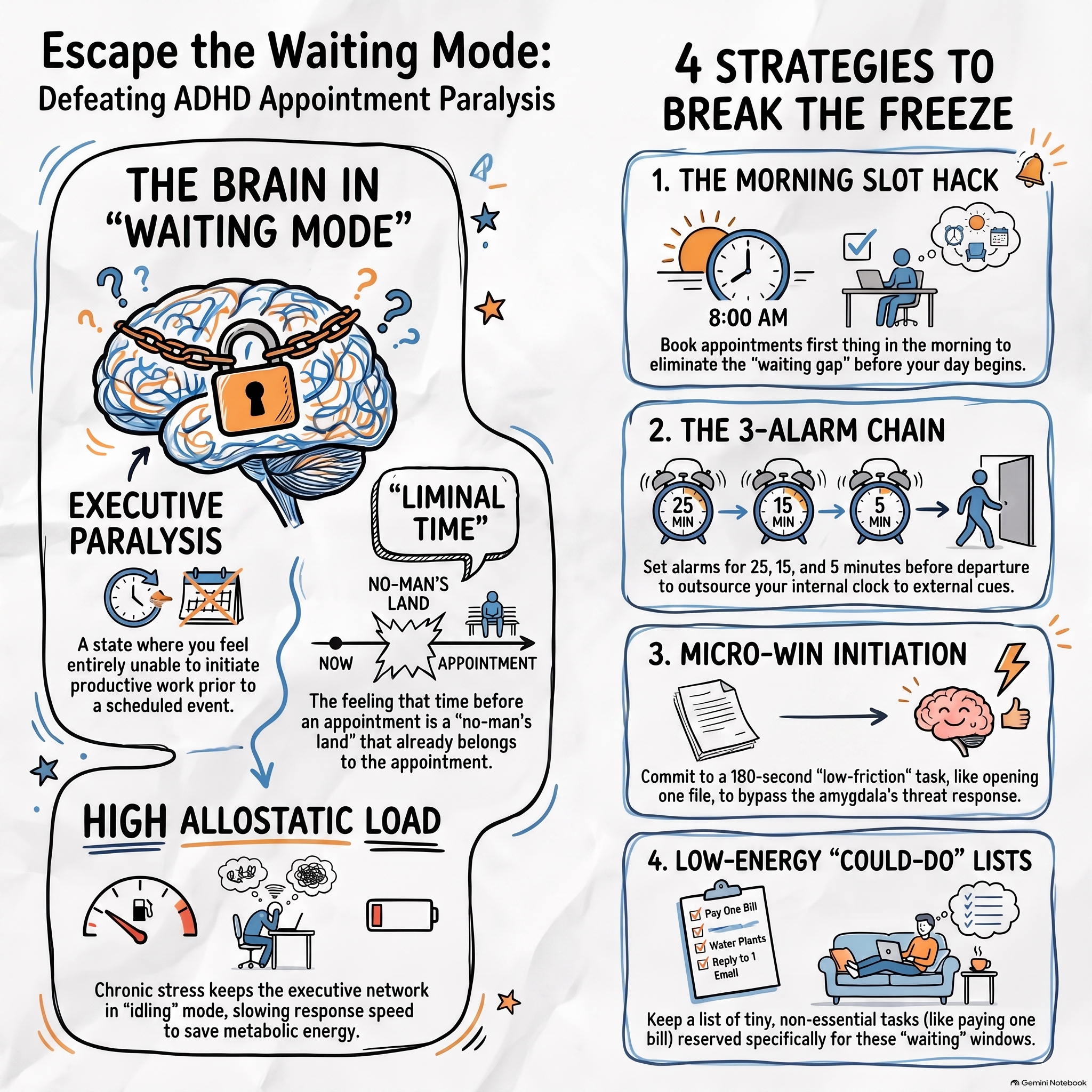
The problem You have an appointment or a Zoom call at 2:00 PM. It is currently 9:30 AM. You have an open block of four hours ahead of you—plenty of time to fold laundry, write an email, or tidy up your workspace. Yet, you find yourself completely unable to start. Instead, you sit on your couch, staring at the clock or scrolling mindlessly. You feel a heavy physical block in your chest, and your mind is trapped in a constant state of anxiety, whispering: "I can't start anything now, because I have that thing at two." You tell yourself you are being lazy. After all, folding laundry takes ten minutes. But as the hours tick away, the paralysis remains unbroken. You are caught in **"waiting mode"**—the involuntary, exhausting mental freeze that locks your executive function before scheduled events. ## Why it happens This paralyzing state is a biological coping mechanism, not a lack of self-discipline. It is a direct result of how the **ADHD brain** is physically wired to process time and transition between states. First, your brain experiences **time blindness**. For someone with ADHD, your internal metronome does not tick steadily due to a baseline deficit in **dopamine** pathways. Your brain recognizes only two temporal zones: **"now"** and **"not now."** Because your brain struggles to estimate how long tasks actually take, you cannot accurately judge if you have enough time to finish a chore before your appointment. To prevent the terrifying risk of losing track of time and being late, your brain's threat detector, the **amygdala**, treats the upcoming transition as an active threat. Your prefrontal cortex—the administrative center that manages planning, prioritizing, and initiating tasks—runs low on **cellular energy (ATP)**. Facing a complex transition, your amygdala triggers a sympathetic nervous system alarm, resulting in a physical **freeze response**. Your body locks you in place to keep you safe and ensure you do not miss the scheduled event. You are not choosing to waste time; your nervous system has engaged its emergency brakes. ## How to fix it today To break free from waiting mode, stop trying to force your internal clock to behave. Instead, work with your neurodivergent biology to signal safety to your nervous system with these steps today: - **Trigger a 60-second somatic reset:** Since task paralysis is a physical freeze, calm your body first. Try a **physiological sigh**—taking two quick, deep inhales through your nose followed by one long, slow exhale. This breathing pattern activates your parasympathetic nervous system, lowering your heart rate and quietening your hyperactive amygdala. Alternatively, splash cold water on your face to trigger the mammalian dive reflex and reduce physical anxiety (check with a doctor first if you have underlying health conditions). - **Use visual countdown timers:** Standard clocks are abstract. Use an analog visual timer—like a **Time Timer**—where a bright colored disk physically disappears as time counts down. Seeing the physical space of time shrink helps your prefrontal cortex visually perceive how much time you actually have, bypassing temporal anxiety. - **Design a low-friction option from your Dopamine Menu:** Do not try to start a complex project while waiting. Instead, choose a low-barrier "Starter" or "Side" from your physical **Dopamine Menu** that raises your dopamine baseline without consuming your remaining ATP. Put on a favorite song, stretch, or do a tiny five-minute task. - **Commit to a 180-second micro-start:** If you want to do a chore, lower the bar to absolute zero. Set a timer for three minutes and commit to working messily for just 180 seconds, with unconditional permission to stop when the timer rings. Overcoming the initial transition friction is often all your brain needs to build momentum. - **Prepare departure tools in advance:** Before you sit down, place your car keys, wallet, phone, and shoes directly in your path by the front door. Removing the need to make search-decisions when it is time to leave eliminates transition anxiety, giving your brain permission to relax during the waiting window. ## Common mistakes to avoid - **Attempting complex projects during the wait:** Forcing yourself to start a task that requires deep focus, like writing a report, will trigger intense task resistance. Your brain knows these tasks have no clear stopping point, which hyper-activates your amygdala's fear of being late. Stick to tiny, concrete tasks with obvious boundaries. - **Using "Hulk smashing" to force focus:** Do not rely on self-directed anger, shame, or panic to create an adrenaline spike to force you to get moving. While this adrenaline surge temporarily breaks task paralysis, relying on stress as executive fuel is biologically expensive and leads directly to chronic **executive burnout**. - **Leaving your schedule entirely blank:** Keeping your entire day unstructured until your appointment increases decision fatigue. Instead, choose between exactly two tiny, defined actions to keep your brain gently anchored without overwhelming your executive functions. ## Takeaway Waiting mode is not a moral failing or a sign of laziness; it is a protective, biological freeze response of a brain that struggles to perceive time and manage transitions. Your nervous system is simply trying to keep you safe and on time. Stop shaming yourself for feeling stuck. By calming your physical body with somatic resets, externalizing time with visual countdowns, and choosing low-friction micro-tasks, you work with your biology instead of fighting it. Lower the starting bar, show yourself compassion, and let calm momentum guide your day.