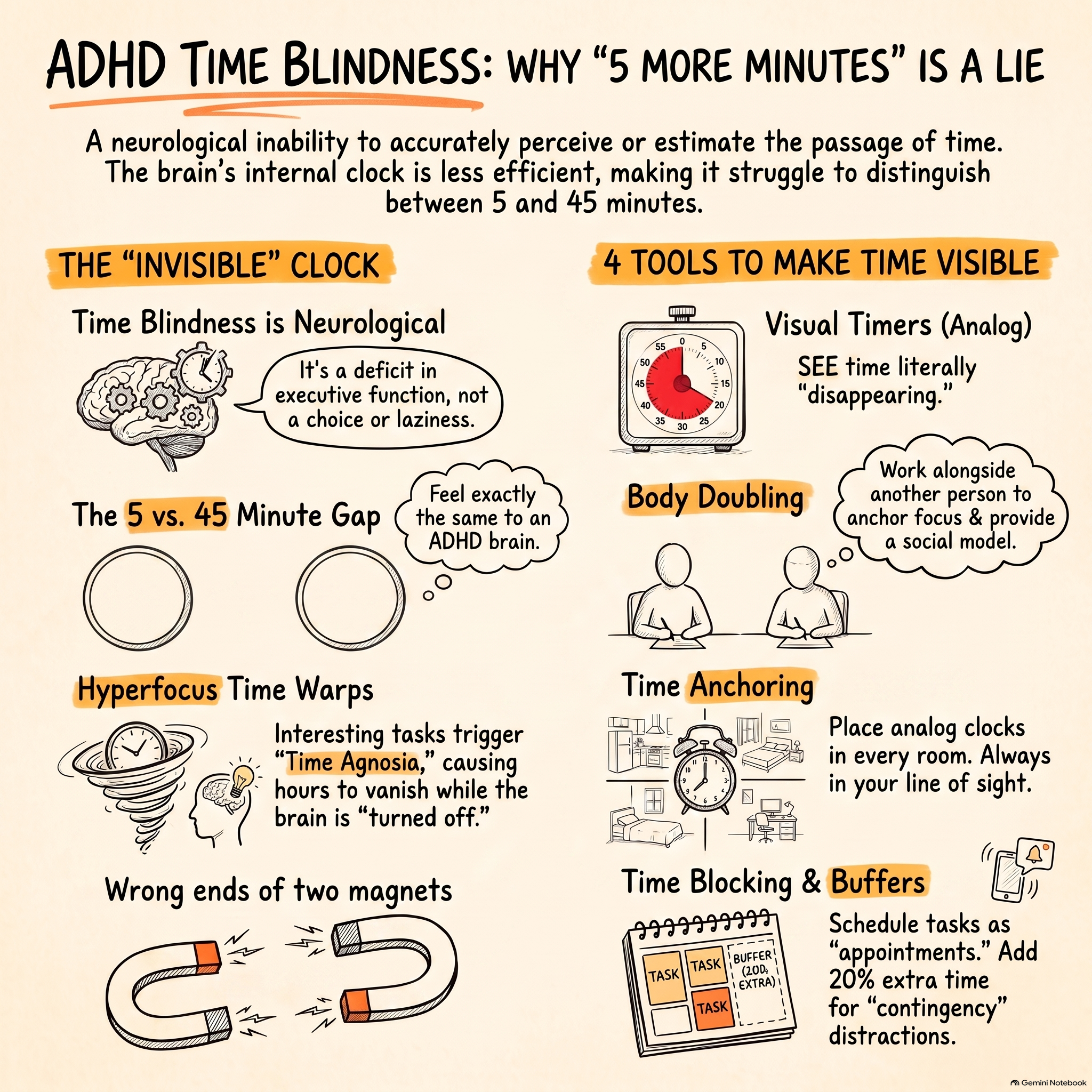
The problem You are sitting on your couch, hyper-focused on an interesting article or a creative project. You glance at the clock and realize you have an appointment across town in thirty minutes. "Just five more minutes," you tell yourself, convinced you can do one quick thing and still make it on time. You submerge back into your task. When you look up again, forty-five minutes have vanished. Panic strikes. You scramble to find your wallet, search frantically for your keys, and sprint to your car. You arrive twenty minutes late, sweating, anxious, and drowning in guilt. You tell yourself that you are just lazy, inconsiderate, or disorganized. But you are actually experiencing a core neurodivergent trait: **time blindness**—the involuntary inability to perceive the passage of time. ## Why it happens Time blindness is not a character flaw or a sign that you do not respect others. It is a well-documented **neurological difference** in how the ADHD brain processes temporal intervals. In a neurotypical brain, the perception of time is managed by the prefrontal cortex and the **suprachiasmatic nucleus** (our biological clock), relying on **dopamine** pathways. Dopamine acts as the brain’s internal metronome, ticking steadily to help you feel the difference between five minutes and forty-five minutes. Because an ADHD brain operates on an **interest-based nervous system** with a baseline deficit in dopamine pathways, your internal metronome does not tick steadily. When you are under-stimulated, your prefrontal cortex runs low on **cellular energy (ATP)**, making five minutes feel like an hour. Conversely, when you are in hyper-focus, dopamine surges, your internal metronome speeds up, and hours fly by in what feels like seconds. For you, time is not a continuous, graduated line. Your brain recognizes only two zones: **"now"** and **"not now."** If an appointment is in the "not now" zone, your threat-detecting **amygdala** remains calm. But the moment "not now" collides with "now," your amygdala sounds a massive alarm, triggering a physical **freeze response** or frantic panic. You only experience the shock of its sudden disappearance. ## How to fix it today To manage time blindness, you must stop trying to rely on your internal clock. Instead, externalize time by turning it into a physical, sensory input. Here is how you can apply a fix today: - **Use a visual countdown timer:** Standard digital clocks only show numbers, which are abstract concepts. Instead, use an analog visual timer—like a **Time Timer**—where a bright colored disk physically disappears as time counts down. Seeing the physical space of time shrink helps your prefrontal cortex visually perceive the passage of time without cognitive strain. - **Calm your body with a somatic reset first:** When the realization of time passing triggers panic, do not try to rush immediately. Calm your reactive nervous system first with a 60-second somatic reset. Try a **physiological sigh**—taking two quick, deep inhales through your nose followed by one long, slow exhale. Alternatively, splash cold water on your face to trigger the mammalian dive reflex and reduce physical anxiety. Check with a doctor first if you have health conditions. - **Build "time cushions" and transition buffers:** When planning to leave, do not just calculate travel time. Create a physical "getting ready" buffer. If driving takes twenty minutes, assign ten minutes for "gathering items" (keys, wallet, shoes) and five minutes for "transitioning to the car." This expands your timeline, preventing the last-minute scramble. - **Establish sensory transition cues:** Set a two-stage alarm system. The first alarm—using a gentle, pleasant sound—is your warning to wind down. The second alarm—with a more urgent tone—is your hard stop to signal that you must transition immediately. - **Set up point-of-performance starting cues:** Before you sit down to relax or hyper-focus, place your car keys, wallet, and shoes directly in your path near the door. Laying out your tools at the **point of performance** eliminates the need to make micro-decisions when you are running late. ## Common mistakes to avoid - **Relying on self-induced panic to move:** Do not use self-directed anger, fear, or panic to create an adrenaline surge to force yourself to get ready. While this adrenaline spike temporarily breaks task paralysis, relying on stress as your primary engine depletes your energy reserves and leads directly to chronic **executive burnout**. - **Overcomplicating your planning systems:** Avoid downloading complex schedule-tracking apps that require detailed calendar integrations. When the initial novelty wears off, maintaining the app becomes another exhausting chore. Keep your timing systems physical, analog, and immediate. - **Shaming yourself for losing track of time:** Beating yourself up for being late only increases your systemic stress, making your amygdala more reactive and reinforcing the biological freeze response. Treat time blindness as a physical trait—like poor eyesight—that simply requires external glasses, not moral punishment. ## Takeaway Time blindness is a structural, biological feature of how your brain perceives the world, not a sign of laziness or a lack of respect. When your internal metronome is silent, trying to "will" yourself to feel time is a losing battle. Stop shaming yourself for a neurodivergent clock. By externalizing time with visual countdowns, calming your physical body with somatic resets, and preparing your physical environment for zero transition friction, you work with your biology instead of fighting it. Lower the starting bar, show yourself compassion, and let sensory cues guide your day.