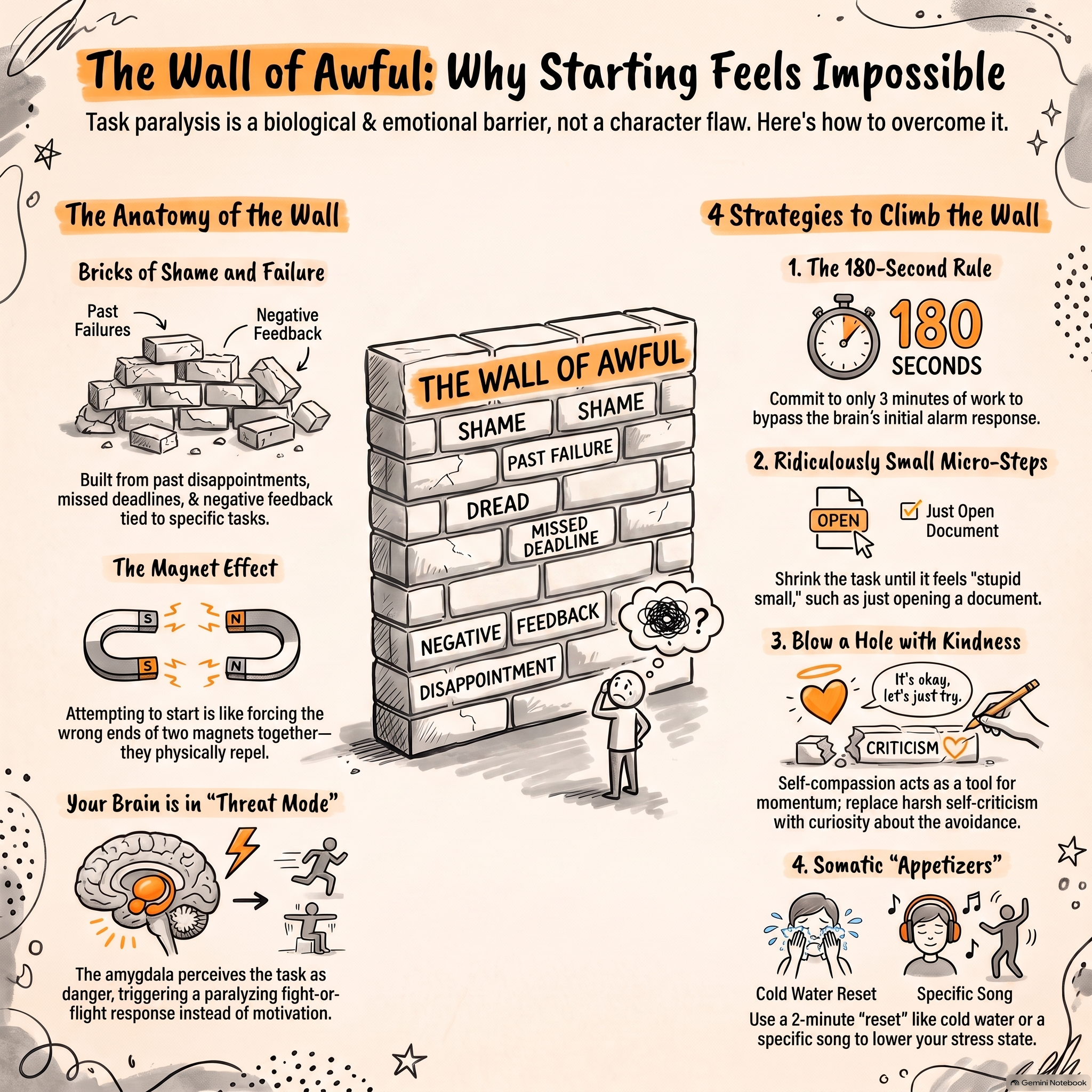
The problem You sit at your kitchen table, staring at an unopened envelope, a half-written email, or a basket of laundry. You know exactly what you need to do, it would take you less than ten minutes, and you are fully aware of the consequences of delaying. Yet, you cannot move. You feel physically locked in place, staring blankly, with an overwhelming wave of physical fatigue washing over you. To escape the crushing weight of this block, you pick up your phone and scroll mindlessly. But you are not enjoying the scroll; you are drowning in anxiety and guilt, whispering: "Why can't I just do this? I must be lazy." For adults with ADHD, this agonizing barrier is not a lack of willpower. It is what parenting and ADHD expert Brendan Mahan terms the **"Wall of Awful."** It is a giant, invisible emotional barrier built between you and your tasks, making even the simplest chores feel completely impossible to start. ## Why it happens The Wall of Awful is not a metaphor; it is a physical representation of how your **ADHD brain** processes past emotional pain. Every time you have failed a task, missed a deadline, disappointed someone, or criticized yourself, your brain added a "brick" to your workspace. These bricks are made of **shame, fear, anxiety, and guilt**. When you look at a simple chore, your brain does not just see the task; it sees the entire, towering wall of your past failures. Because you have an **interest-based nervous system**, your prefrontal cortex—the brain's command center—struggles to release **dopamine** for routine, boring, or non-urgent activities. Without dopamine, you lack the chemical starting spark needed for action. Compounding this neurochemical deficit, your threat-detecting **amygdala** becomes hyperactive. It associates the task with the emotional distress of your past "bricks" and perceives the upcoming friction as an active threat. To protect you, your amygdala triggers a **physiological freeze response**. Your body physically halts because your nervous system has entered survival mode. Trying to force yourself to start when your body is in freeze is like stepping on the gas pedal with the emergency brake engaged. ## How to fix it today To bypass the Wall of Awful, you must stop trying to climb it with sheer willpower. Instead, you need to signal physical safety to your nervous system and reduce starting friction to absolute zero. Here are four concrete steps to apply today: - **Trigger a 60-second somatic reset:** Since task paralysis is a physical freeze response, calm your body first. Try a **physiological sigh**—taking two quick, deep inhales through your nose followed by one long, slow exhale. This breathing pattern activates your parasympathetic nervous system, lowering your heart rate. Alternatively, splash cold water on your face to trigger the mammalian dive reflex and instantly reduce physical anxiety. Check with a doctor if you have underlying health conditions. - **Apply the Two-Option Rule:** Choice overload drains your limited executive energy and builds the Wall of Awful higher. Hide your massive to-do list and choose between exactly two tiny, concrete actions. Ask yourself: "Am I going to write one sentence of this report, or am I going to put away three shirts?" Limiting your choices removes the cognitive load of prioritizing. - **Commit to a 180-second micro-start:** Set a visual timer for exactly three minutes. Give yourself unconditional, honest permission to stop and walk away when the timer rings. Lower your standards of performance to absolute zero and start messily. By removing the pressure of doing a perfect job, you dismantle the wall's power. Often, once you cross the starting line, the physical friction disappears and natural momentum takes over. - **Prepare your starting point in advance:** Transitioning from rest to work is the hardest part. To make starting tomorrow effortless, set up your workspace the night before. Open the exact file you need, clear your desk, and lay your tools out. This removes the morning executive tax, allowing your brain to glide straight into motion without planning. ## Common mistakes to avoid - **Using "Hulk smashing" to force focus:** Do not rely on self-induced anger, panic, or urgency to force yourself over the wall. While this stress-induced adrenaline surge temporarily breaks task paralysis, relying on stress as executive fuel is biologically expensive, alters brain function, and leads directly to deep **executive burnout**. - **Staring at the wall hoping for motivation:** Stop waiting for a sudden wave of natural motivation to hit you. Motivation does not create action; action builds motivation. Accept that your brain needs external, physical systems to get started. - **Using complex productivity apps:** Many digital planners require extensive organizing and scheduling. For a low-dopamine brain, this adds an extra layer of administrative friction. Keep your systems physical, low-tech, and immediately visible. ## Takeaway The Wall of Awful is a real, biological barrier, not a character flaw. Your inability to start a task is a protective physical shutdown, not a lack of caring or discipline. Stop beating yourself up for struggling to do simple things. By calming your physical body with somatic resets, reducing your choices, and committing to just three minutes of messy starting, you work with your biology instead of fighting it. Lower the starting bar, show yourself compassion, and let calm momentum carry you forward.