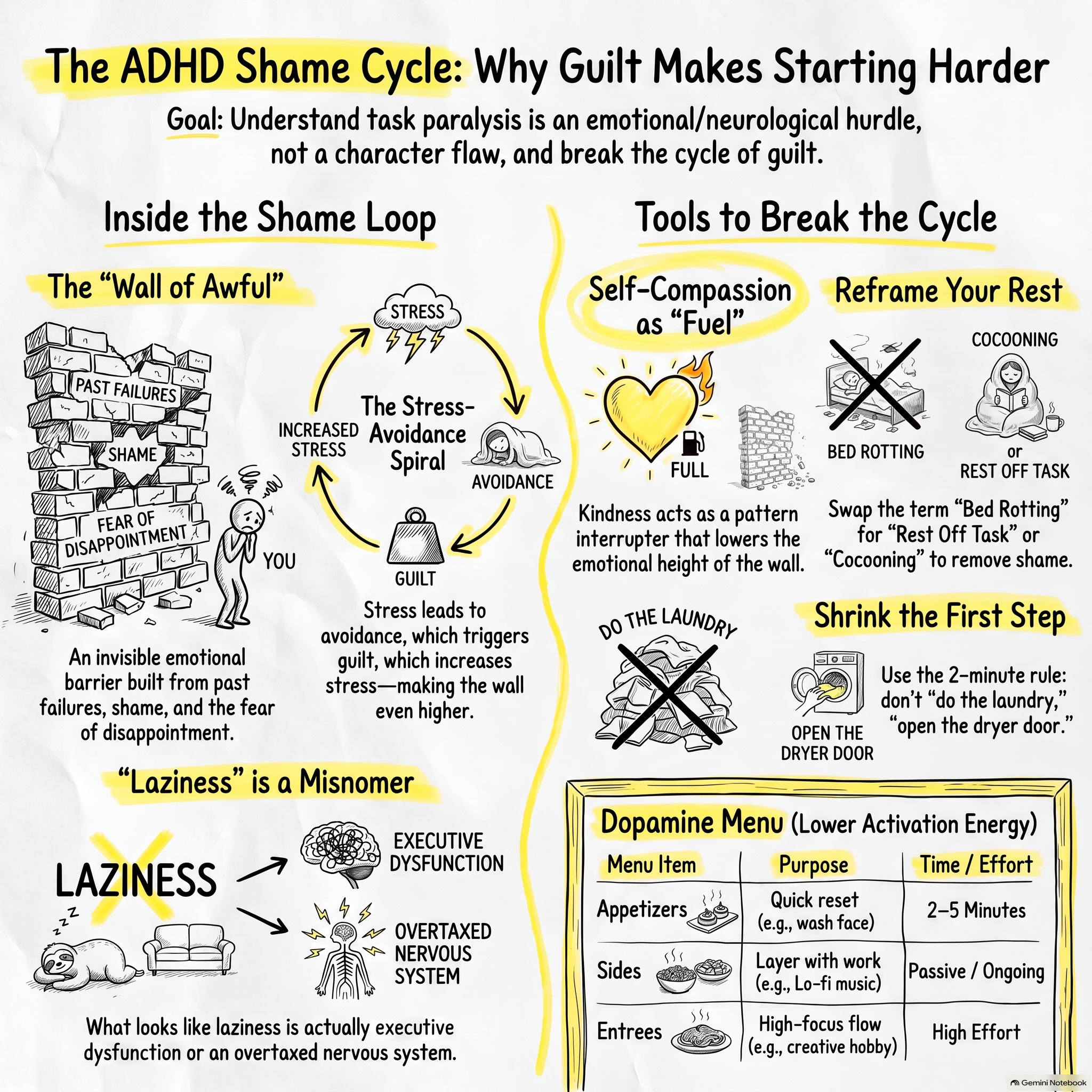
The problem You stand in your kitchen, staring at a stack of dirty dishes that has been growing for three days. You want to wash them, but your body feels entirely frozen. As you walk away to escape the discomfort, a harsh inner voice starts whispering: "Why can't you just do this? It takes ten minutes. You are so lazy. You are letting everyone down." Deeply ashamed, you retreat to your bed and pull up your phone, scrolling social media to drown out the self-criticism. But you aren't enjoying yourself. Instead, a heavy knot of anxiety sits in your stomach. The more you blame yourself, the harder it becomes to get up. You are caught in the **shame cycle**—a painful loop where self-directed guilt, instead of motivating you to do better, physically locks your brain in task paralysis. ## Why it happens This paralyzing loop is a biological trap, not a moral failing. To understand why guilt makes task paralysis worse, we have to look at how your brain processes attention and threat. Your prefrontal cortex—the brain's executive command center—manages planning, organizing, and initiating actions. To turn your intentions into physical movement, your brain relies on a steady stream of **dopamine**—the chemical messenger of anticipation and motivation. However, the **ADHD brain** has a baseline deficit in dopamine pathways and operates on an **interest-based nervous system**. Your brain does not naturally release dopamine based on a task’s abstract importance; it requires immediate interest, novelty, challenge, or urgency. When you try to force yourself to do a boring task, your prefrontal cortex runs low on **cellular energy (ATP)**. When you criticize yourself, your brain doesn't register it as "tough love." Your threat-detecting **amygdala** perceives your self-critical thoughts as an active emotional threat to your safety. To protect you, your amygdala triggers a sympathetic nervous system alarm, flooding your body with stress hormones. Since you cannot run away from your own thoughts, your body defaults to a physical **freeze response**. Your heart rate climbs, your breathing becomes shallow, and your motor pathways lock up. Shame literally builds the emotional **"Wall of Awful"** higher, reinforcing the biological lock that keeps you paralyzed. ## How to fix it today To break the shame cycle, you must stop trying to beat yourself into submission. Instead, work with your neurodivergent biology to restore safety and lower starting friction. Here are four concrete steps you can apply today: - **Trigger a 60-second somatic reset:** Since task paralysis is a physical freeze response, calm your body to signal safety. Try a **physiological sigh**—taking two quick, deep inhales through your nose followed by one long, slow exhale. This pattern instantly activates your parasympathetic nervous system, slowing your heart rate and dampening physical anxiety. Alternatively, splash cold water on your face to trigger the mammalian dive reflex. Check with a doctor first if you have underlying health conditions. - **Consult your physical Dopamine Menu:** When you are trapped in an emotional slump, your brain’s dopamine reserves crash, making your amygdala even more hyper-reactive. Rebuild your baseline motivation by selecting an intentional, healthy stimulant from your physical **Dopamine Menu**. Take two minutes to drink a cold glass of fizzy water, do a quick stretch, or play a single favorite high-energy song. - **Apply the Two-Option Rule:** Choice overload drains your prefrontal cortex's limited energy. Hide your massive to-do list and choose between exactly two tiny, concrete actions, such as putting away one cup or opening one folder. Limiting the options removes the cognitive load of prioritizing. - **Commit to a 180-second micro-start:** Never look at a project as a massive mountain. Set a visual timer for three minutes and commit to working messily for just 180 seconds. Give yourself honest, unconditional permission to stop when the timer rings. Lowering your performance standards to zero dismantles the threat trigger, allowing natural momentum to take over. ## Common mistakes to avoid - **Using "Hulk smashing" to force focus:** Do not rely on self-induced anger, panic, or shame to create a sudden adrenaline spike to force you over the Wall of Awful. While this adrenaline surge temporarily breaks task paralysis, utilizing stress as executive fuel is biologically expensive and leads directly to chronic **executive burnout**. - **Confusing scrolling with recovery:** Lying in bed scrolling social media feels like an escape, but the constant digital input keeps your stress pathways active. This drains your remaining dopamine without letting your mitochondria rebuild ATP. Replace digital escapes with low-stimulation, analog recovery, like lying in a dim room or walking. - **Labeling a biological shutdown as laziness:** Believing you are lazy only increases your emotional friction, making your amygdala more reactive and reinforcing the freeze. Accept your fatigue as valuable physical data, not a character flaw. ## Takeaway The shame cycle is not a sign of weakness or a lack of discipline; it is a protective, survival-driven freeze of an under-stimulated brain. Self-criticism is physically counterproductive because it floods your body with stress hormones and locks you in place. Stop shaming yourself for struggling to start simple chores. By calming your physical body with somatic resets, feeding your brain healthy stimulation from your Dopamine Menu, and reducing your choices, you work with your biology instead of fighting it. Lower the bar to absolute zero, show yourself compassion, and let calm momentum carry you forward.