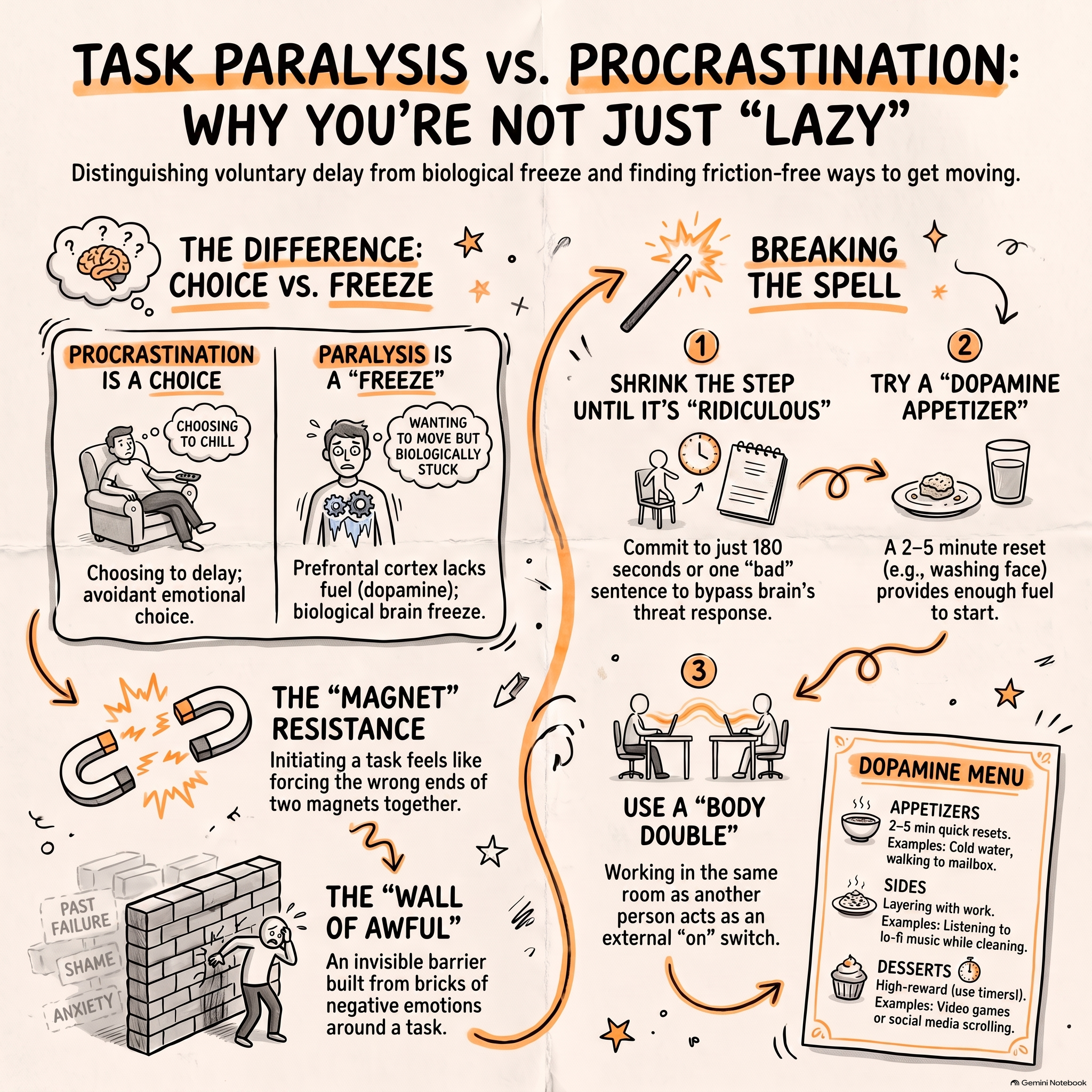
The problem You are sitting at your desk, staring at a blank document. The deadline is looming, and you know exactly what you need to do, how to do it, and what will happen if you do not. Your logical mind is screaming at you to just get up and start. Yet, you cannot move. You feel physically locked in place, staring blankly, or escaping into your phone. To cope with this agonizing internal tension, you pick up your phone and escape into a mindless scroll. But as you scroll, you do not enjoy it. You feel a heavy knot of anxiety in your stomach, blaming your lack of discipline. For adults with ADHD, this terrifying state is not procrastination—it is **task paralysis**. While procrastination is a choice to delay a task, task paralysis is an involuntary physiological freeze. You want to work, but your brain has physically shut down the pathways required to begin. ## Why it happens This paralyzing lock is not a moral failing or a lack of self-discipline. It is a protective, survival-driven response from an overwhelmed **ADHD brain**. Your prefrontal cortex—the administrative center that manages planning and task initiation—relies on a steady supply of **dopamine** and **cellular energy (ATP)** to function. Because you have an **interest-based nervous system**, your brain does not naturally release dopamine based on a task's abstract or long-term importance. It requires immediate interest, novelty, challenge, or urgency to generate that starting spark. When facing a boring, complex task, your prefrontal cortex runs low on cellular fuel, struggling to prioritize or decide on the first step. This decision fatigue and mental friction trigger your threat-detecting **amygdala** to go into overdrive. Because past failures and shame have built a physical **"Wall of Awful"** around your tasks, your amygdala perceives this mental friction as an active threat to your safety. To protect you, it triggers your sympathetic nervous system's fight-or-flight pathway. Since you cannot physically run from a spreadsheet, your body defaults to a **physiological freeze response**. Your heart rate climbs, your breathing becomes shallow, and your motor pathways are temporarily locked. Trying to force yourself to start when your body is in survival mode is biologically impossible. ## How to fix it today To break this freeze, you must stop trying to think your way out and work with your biology. Here is how to restore safety and reduce starting friction to zero today: - **Trigger a 60-second somatic reset:** Since task paralysis is a physical freeze, calm your body first. Try a **physiological sigh**—taking two quick, deep inhales through your nose followed by one long, slow exhale. This breathing pattern instantly activates your parasympathetic nervous system, lowering your heart rate and signaling safety to your reactive amygdala. Alternatively, splash cold water on your face to trigger the mammalian dive reflex and reduce physical anxiety. Check with a doctor first if you have underlying health conditions. - **Apply the Two-Option Rule:** Choice overload is a major trigger for task paralysis. When your executive energy is low, deciding what to do drains your remaining prefrontal fuel. Choose between exactly two tiny, concrete options, such as typing one sentence or putting away three folders. Limiting the choices removes the cognitive load of prioritizing. - **Commit to a 180-second micro-start:** Set a visual timer for exactly three minutes. Commit to working for just 180 seconds, with unconditional permission to stop when it rings. Lower your standards of performance to zero and start messily. Removing the pressure of doing a perfect job dismantles the Wall of Awful, letting momentum take over. - **Prepare a zero-friction starting point in advance:** To make starting effortless, prepare your environment in advance. Before you finish your day, open the exact file you need, clear your desk, and lay your tools out. This removes the need to plan tomorrow, allowing you to glide straight into action. ## Common mistakes to avoid - **Using "Hulk smashing" to force focus:** Do not rely on self-induced panic, anger, or shame to create a sudden adrenaline spike to force you over the Wall of Awful. While this adrenaline spike temporarily breaks task paralysis, using stress as executive fuel is biologically expensive and leads directly to deep **executive burnout**. - **Assuming you are procrastinating on purpose:** Treating a biological freeze as laziness increases emotional friction. Shame makes your amygdala more reactive, reinforcing the freeze response. Accept paralysis as physical data, not a character flaw. - **Trying to force a perfect start:** Do not wait for a wave of motivation or try to plan the entire project perfectly first. Motivation does not create action; action builds motivation. Accept a messy start and lower the bar until you can move. ## Takeaway Procrastination is a choice to delay; task paralysis is a protective biological shutdown of an under-stimulated nervous system. When your prefrontal cortex is starved of cellular energy, trying to force focus with willpower or self-criticism is a losing battle. Stop shaming yourself for struggling to start simple tasks. By calming your physical body with somatic resets, reducing choices, and committing to just three minutes of messy starting, you work with your biology. Lower the starting bar, show yourself compassion, and let momentum carry you forward.