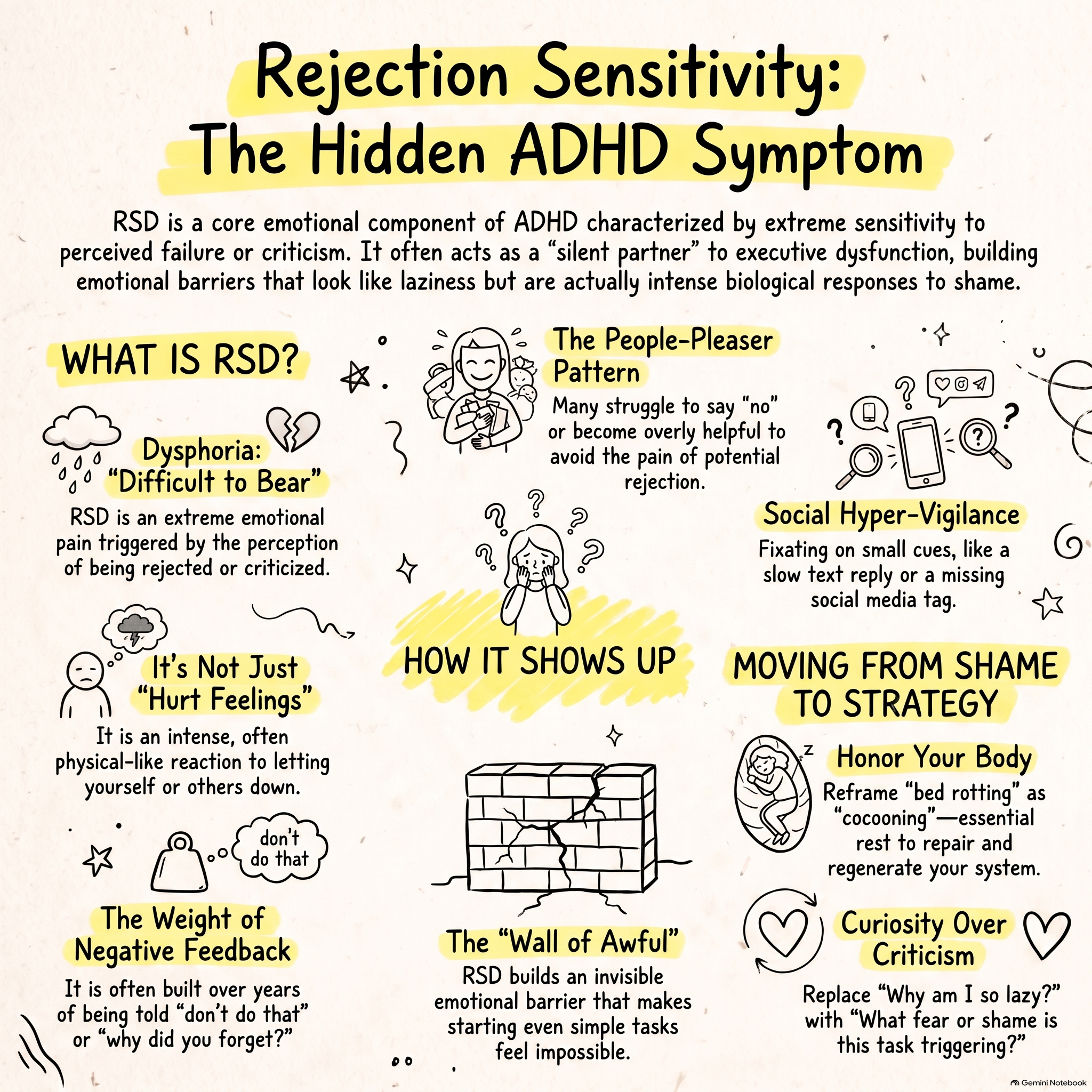
The problem You send a brief, casual text to a close friend or colleague: "Hey, do you have ten minutes to chat today?" An hour passes. Then two. No response. Immediately, your chest tightens, and a wave of intense anxiety washes over you. Your mind starts spinning a catastrophic narrative: *They are mad at me. I said something wrong. They are slowly phasing me out of their life.* By hour three, you are completely paralyzed. You cannot focus on your work, you cannot start your daily chores, and you feel physically sick. When they finally reply with a warm, "Sure! Sorry, got caught in a meeting," the relief is sweet, but you are left physically and emotionally exhausted. This overwhelming, agonizing response to perceived disapproval is called **rejection sensitive dysphoria (RSD)**. For adults with ADHD, it is a hidden, highly destructive symptom that triggers sudden emotional crashes and locks you in severe task paralysis. ## Why it happens Rejection sensitivity is not a sign of emotional immaturity, weakness, or "being too sensitive." It is a structural and biological feature of how your **ADHD brain** is wired. Your prefrontal cortex—the administrative center that manages focus, planning, and emotional regulation—relies on a steady baseline of **dopamine** to function. Because you have an **interest-based nervous system**, your brain has a baseline deficit in dopamine pathways, leaving your executive controls under-fueled. In a neurotypical brain, the prefrontal cortex acts as a volume dial, dampening strong emotional signals from the lower brain. In an ADHD brain, that volume dial is broken. When you perceive even a tiny hint of rejection, criticism, or exclusion, your threat-detecting **amygdala** becomes instantly hyperactive. Because your prefrontal cortex lacks the **cellular energy (ATP)** to quiet this alarm, the emotional signal floods your nervous system. Your brain registers the psychological pain of perceived rejection in the exact same neural pathways as physical pain. This sudden flood of distress triggers an immediate physical **freeze response**, locking your executive function and forcing your body into a protective task paralysis. ## How to fix it today To manage rejection sensitivity and protect your executive energy, you must stop trying to argue with your feelings and start working with your biology. Here is how you can regain control today: - **Apply a 60-second somatic reset:** Since RSD triggers a physical freeze response, you must signal physical safety to your nervous system. Try a **physiological sigh**—taking two quick, deep inhales through your nose followed by one long, slow exhale to activate your parasympathetic nervous system. Alternatively, splash cold water on your face to trigger the mammalian dive reflex and instantly lower physical anxiety. Check with a doctor first if you have underlying health conditions. - **Consult your Dopamine Menu:** When your brain is in an emotional slump, its dopamine levels crash, making you more vulnerable to RSD. Rebuild your baseline by selecting a low-barrier, healthy option from your physical **Dopamine Menu**. Spend two minutes drinking cold fizzy water, stretching, or listening to an upbeat song. Raising your baseline dopamine restores fuel to your prefrontal cortex. - **Use the Two-Option Rule to pivot:** When you are locked in emotional paralysis, deciding what to do next feels overwhelming. Hide your massive to-do list and choose between exactly two tiny, concrete actions, such as putting away one glass or opening one folder. Reducing the choices removes the cognitive load of prioritizing. - **Commit to a 180-second micro-start:** Do not try to do a perfect job when you are emotionally exhausted. Set a visual timer for three minutes and commit to working messily on your chosen micro-task. Give yourself unconditional, honest permission to stop when the timer rings. Overcoming the initial transition friction is often all your brain needs to build momentum. ## Common mistakes to avoid - **Trying to talk yourself out of the feeling:** When you are in an RSD spiral, your amygdala has hijacked your thinking brain. Trying to logically analyze the situation or berate yourself for "overreacting" only increases emotional friction, building your **"Wall of Awful"** higher and reinforcing the freeze response. - **Using self-induced panic to force focus:** Do not rely on "Hulk smashing"—using self-directed anger, shame, or urgency to force yourself over the Wall of Awful. While an adrenaline spike gets you moving, using stress as executive fuel is biologically expensive and leads directly to deep **executive burnout**. - **Isolating yourself in absolute silence:** Forcing yourself to sit alone in a quiet room when you are emotionally vulnerable only allows your mind to run catastrophic loops. If you struggle to work alone, try **body doubling**—working quietly alongside a partner, friend, or a virtual co-working stream to anchor your focus. ## Takeaway Rejection sensitivity is not a character flaw or a moral failing; it is a physical, biological reality of how your neurodivergent brain regulates emotion. When your amygdala sounds the alarm, trying to force productivity with sheer willpower or shame is a losing battle. Stop blaming yourself for feeling too much. By calming your physical body with somatic resets, feeding your brain healthy stimulation, and lowering your starting barriers to absolute zero, you work with your biology instead of fighting it. Show yourself compassion, keep your steps tiny, and let calm momentum carry you forward.