Rejection Sensitive Dysphoria: Why Criticism Feels Physical (And What Helps)
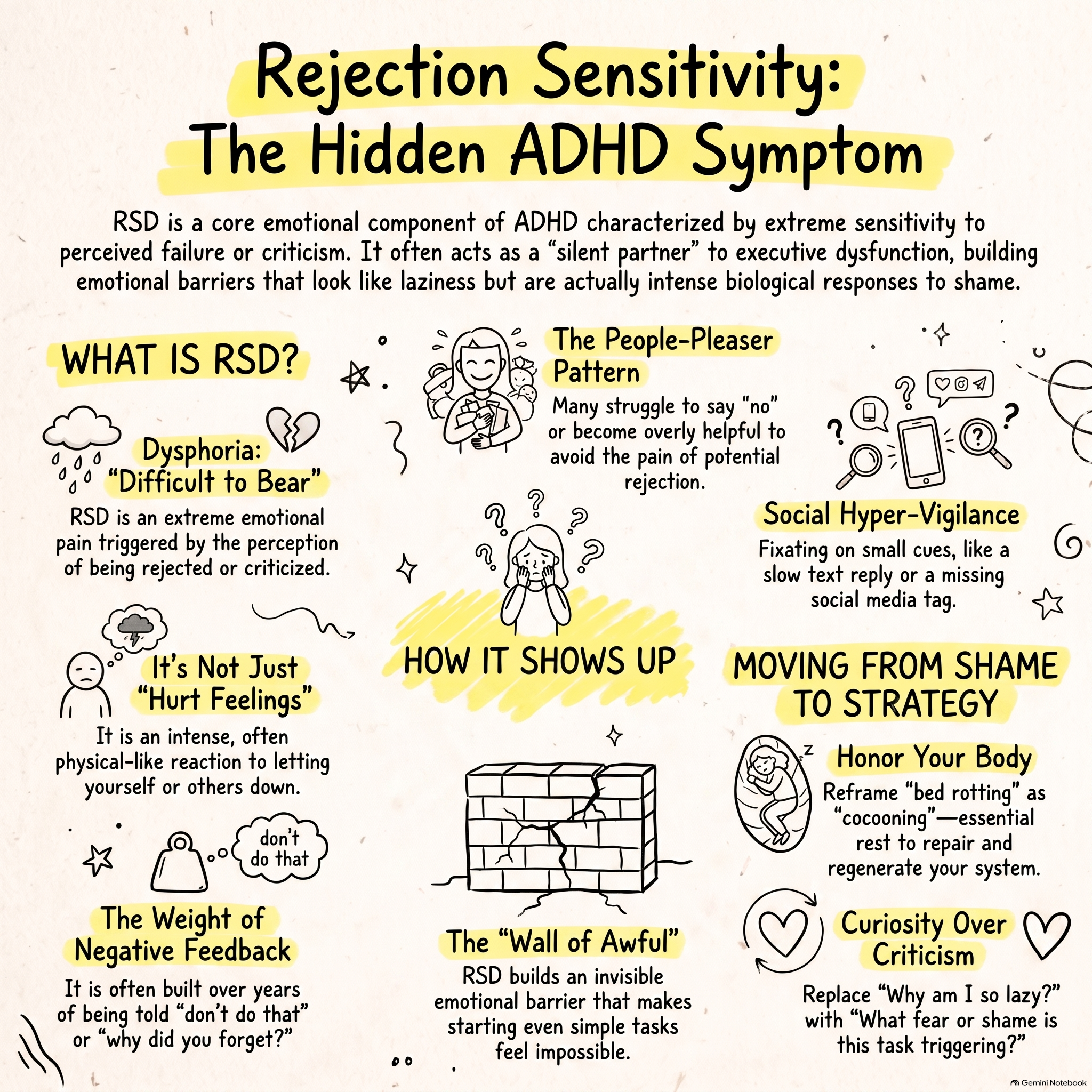
You send a message. No reply for two hours. Your stomach drops. Your brain says: "They hate you. You're annoying. Everyone is better off without you." A single neutral comment — or even a misinterpreted emoji — triggers a wave of pain so intense it feels physical. If this sounds familiar, you might be experiencing Rejection Sensitive Dysphoria (RSD), one of the most misunderstood symptoms of ADHD.
What Is Rejection Sensitive Dysphoria?
RSD is an extreme, highly impairing emotional reaction to real or perceived rejection, criticism, or failure. The word "dysphoria" comes from Greek and means "difficult to bear" — and that's exactly what it feels like: emotional pain so crushing that many people describe it as a physical blow.
Here's the key distinction: a neurotypical person feels sad or disappointed when rejected. Someone with ADHD and RSD experiences a rapid, severe emotional collapse that bypasses rational thinking entirely. It's not "being dramatic." It's a neurological response, not a character flaw.
Why Does Rejection Feel Physical?
The brain processes social pain in the same regions it processes physical pain. When you're rejected, the same neural circuits that register a broken bone light up — the dorsal anterior cingulate cortex and the anterior insula. This is why RSD feels like a punch to the gut: to your brain, it literally is one.
In ADHD, this is amplified by a prefrontal-limbic imbalance. The amygdala (your emotional alarm) fires fast and loud, while the prefrontal cortex (your rational brake) is slower and weaker in the ADHD brain. The result: emotion bypasses logic. You feel catastrophic rejection before you can even think "wait, maybe they're just busy."
RSD Is Not "Too Sensitive"
This is the most important reframe. Being "too sensitive" implies a choice — that you could toughen up if you tried. RSD is not a choice. It's a wiring difference:
- It's instantaneous — no time to rationalize. - It's physical — chest tightness, heat, nausea. - It's all-or-nothing — one small slight can feel like total rejection. - It's self-perpetuating — the fear of rejection leads to people-pleasing or avoiding connection entirely.
When someone with RSD says "it hurts," they mean it hurts like a wound, not like an insult.
The Hidden Cost of RSD
RSD doesn't just hurt in the moment. It shapes entire lives:
- You stop sharing your work to avoid criticism. - You over-apologize and over-explain. - You abandon projects the moment they feel judged. - You become a perfectionist — because "perfect" can't be rejected. - You people-please until you burn out.
This is why RSD is so damaging: it doesn't just cause pain, it causes avoidance. And avoidance kills the things you care about.
5 Practical Strategies That Actually Help
### 1. Name it in the moment When the wave hits, say to yourself: "This is RSD, not reality." Labelling the response activates your prefrontal cortex and begins to brake the amygdala. It's the fastest circuit-breaker you have.
### 2. Delay the response — use the 10-minute rule Never respond to a perceived rejection in the first 10 minutes. Write the angry reply, then wait. RSD spikes fast and decays fast. Almost always, the intensity drops by half within an hour — and you'll be glad you didn't send that message.
### 3. Check the facts, not the feeling RSD interprets ambiguity as rejection. Train yourself to ask: "What's the neutral explanation?" A delayed reply could mean they're driving, asleep, or overwhelmed — not that they hate you. Write down the three most neutral explanations before you react.
### 4. Build a "rejection reality-check" ritual Ask a trusted person. When RSD tells you "everyone is annoyed by you," pick one safe person and ask: "Does this seem like rejection to you?" Outsourcing perspective is a legitimate skill — your internal gauge is calibrated wrong, so use someone else's.
### 5. Reset your nervous system, not your thoughts RSD is a body state. When it hits, your body is in threat mode. Use somatic resets: cold water on the face, slow exhale breathing (4 in, 6 out), or a few minutes of movement. You cannot think your way out of a nervous-system state — you have to regulate your body first.
Common Mistakes (Avoid These)
- Trying to "logic" your way out mid-wave. It won't work — emotion is already past your rational gate. - Isolating to avoid rejection. Avoidance feeds the fear loop. - Expecting RSD to disappear. It won't — but you can shorten the wave and reduce its power. - Self-medicating with people-pleasing. It buys temporary safety and costs your identity.
The Bottom Line
Rejection Sensitive Dysphoria is not weakness. It's your brain treating social threat like physical danger — and with ADHD, that alarm is louder and the brake is slower. You can't turn off the alarm, but you can learn to reach for the brake, name the wave, and wait it out. Over time, the waves get smaller. The pain becomes manageable. And you get your life — and your self-worth — back.
---
*This is part of the Zero Friction ADHD series. Science-backed strategies for neurodivergent minds.*