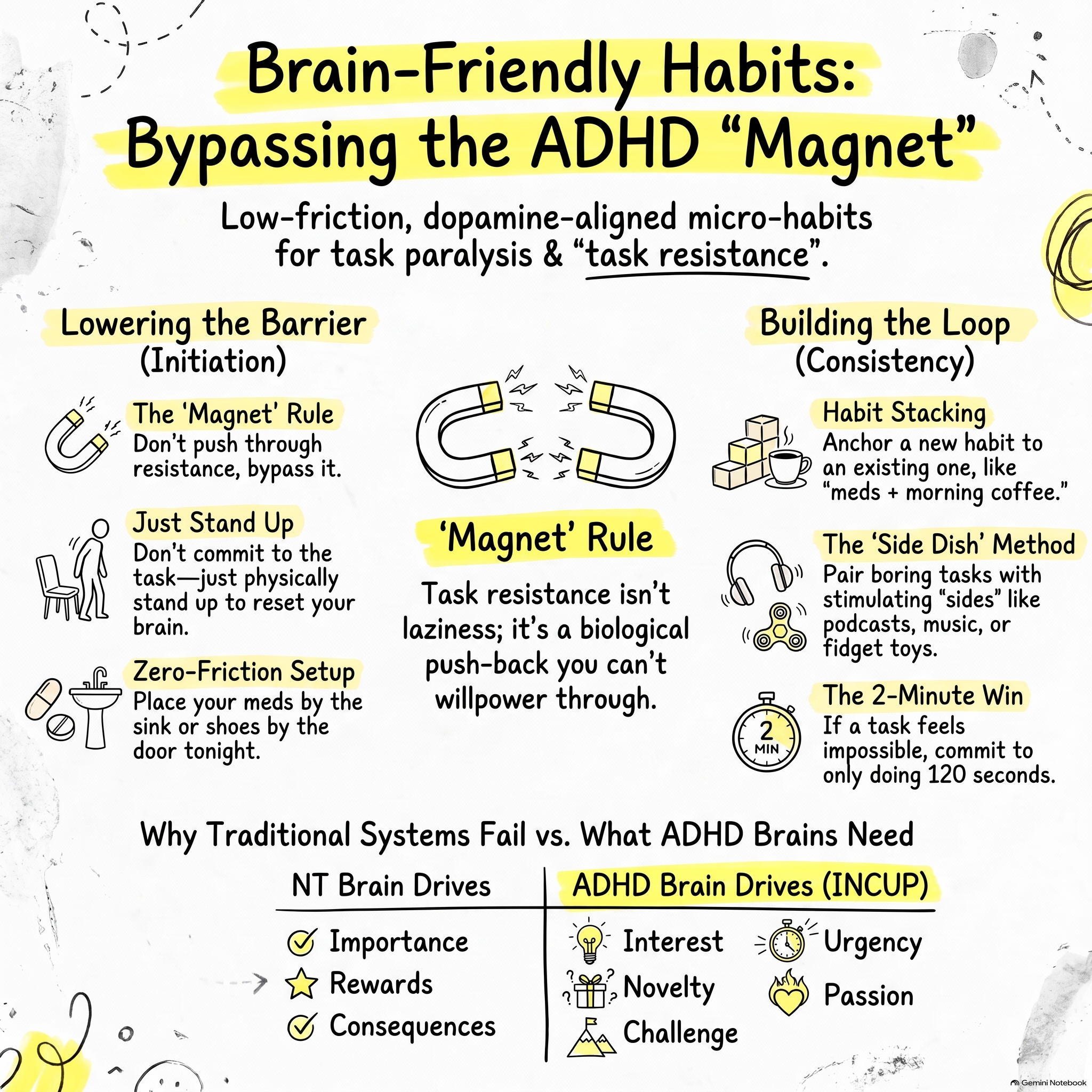
The problem You decide that today is the day you finally establish a healthy routine. You resolve to meditate, run, and keep the kitchen spotless daily. Monday goes perfectly, and Tuesday is manageable. But by Wednesday, the starting energy vanishes. The thought of cleaning or meditating feels exhausting. Your brain resists, locking you in task paralysis. You escape into your phone, miss a day, and drown in shame, blaming your lack of discipline. If you have ADHD, this cycle of abandoned resolutions is all too familiar. You want to build positive routines, but standard habits seem to slip through your fingers, leaving you feeling frustrated and defeated. ## Why it happens This struggle is a biological clash between standard advice and your **ADHD brain**. Typical strategies rely on an importance-based nervous system, which releases a steady baseline of **dopamine** for long-term goals. However, you have an **interest-based nervous system** with a baseline deficit in dopamine pathways. Your brain requires immediate interest, novelty, challenge, or urgency to release the starting spark. Starting a new routine forces your prefrontal cortex—the brain's administrative center—to manually execute each step, demanding immense **cellular energy (ATP)**. Without dopamine, starting boring tasks is a biological bottleneck. Additionally, past failures build an emotional **"Wall of Awful."** When you contemplate the habit, your threat-detecting **amygdala** becomes reactive, associating the task with shame and triggering a physical **freeze response**. Standard habits fail because the starting barrier is too high. ## How to fix it today To build routines that stick, you must reduce starting friction to absolute zero. Here is how to work with your chemistry today: - **Shrink the habit to a micro-step:** Never commit to a massive goal. Reduce the action until your reactive amygdala no longer perceives it as a threat. Instead of "read for thirty minutes," commit to "open the book." Instead of "tidy up," commit to "put away one item." - **Attach the habit to a physical cue:** Do not rely on working memory. Anchor your micro-habit to an existing physical routine at the point of performance. Place your vitamins directly on top of your coffee mug the night before. Putting cues directly in your path eliminates the mental strain of remembering. - **Calm your body with a somatic reset:** When you feel task resistance, calm your body first. Try a **physiological sigh**—two quick, deep inhales through your nose and one long, slow exhale to activate your parasympathetic system. Alternatively, splash cold water on your face to trigger the mammalian dive reflex and reduce anxiety. Check with a doctor if you have health conditions. - **Commit to a 180-second micro-start:** Set a visual timer for exactly three minutes and commit to working for just 180 seconds. Give yourself honest permission to stop when it rings. Lower your standards to zero and start messily. Overcoming that initial transition friction allows natural momentum to take over. ## Common mistakes to avoid - **Letting micro-habits grow too fast:** The biggest mistake is turning a micro-habit back into a large chore. If your goal is to write one sentence, do that and celebrate. If you force yourself to write three pages because "you are already there," your brain will detect the trap and trigger task resistance next time. - **Relying on digital tracking apps:** Complex apps with notifications and categories add massive administrative friction. When novelty fades, app upkeep becomes a chore. Keep systems physical and immediate—use a whiteboard or a notepad open on your desk. - **Using "Hulk smashing" to force focus:** Do not use self-induced panic, anger, or urgency to force actions. While this adrenaline spike temporarily breaks task paralysis, relying on stress as executive fuel alters brain function and causes chronic **executive burnout**. ## Takeaway Routines do not stick through willpower or shame. Your brain is not broken; it simply requires a different set of operating rules to transition from rest to action. Stop shaming yourself for struggling with neurotypical standards. By shrinking habits to micro-steps, placing physical cues in your path, and calming your body with somatic resets, you work with your biology. Lower the starting bar, show yourself compassion, and let calm momentum build your routines.