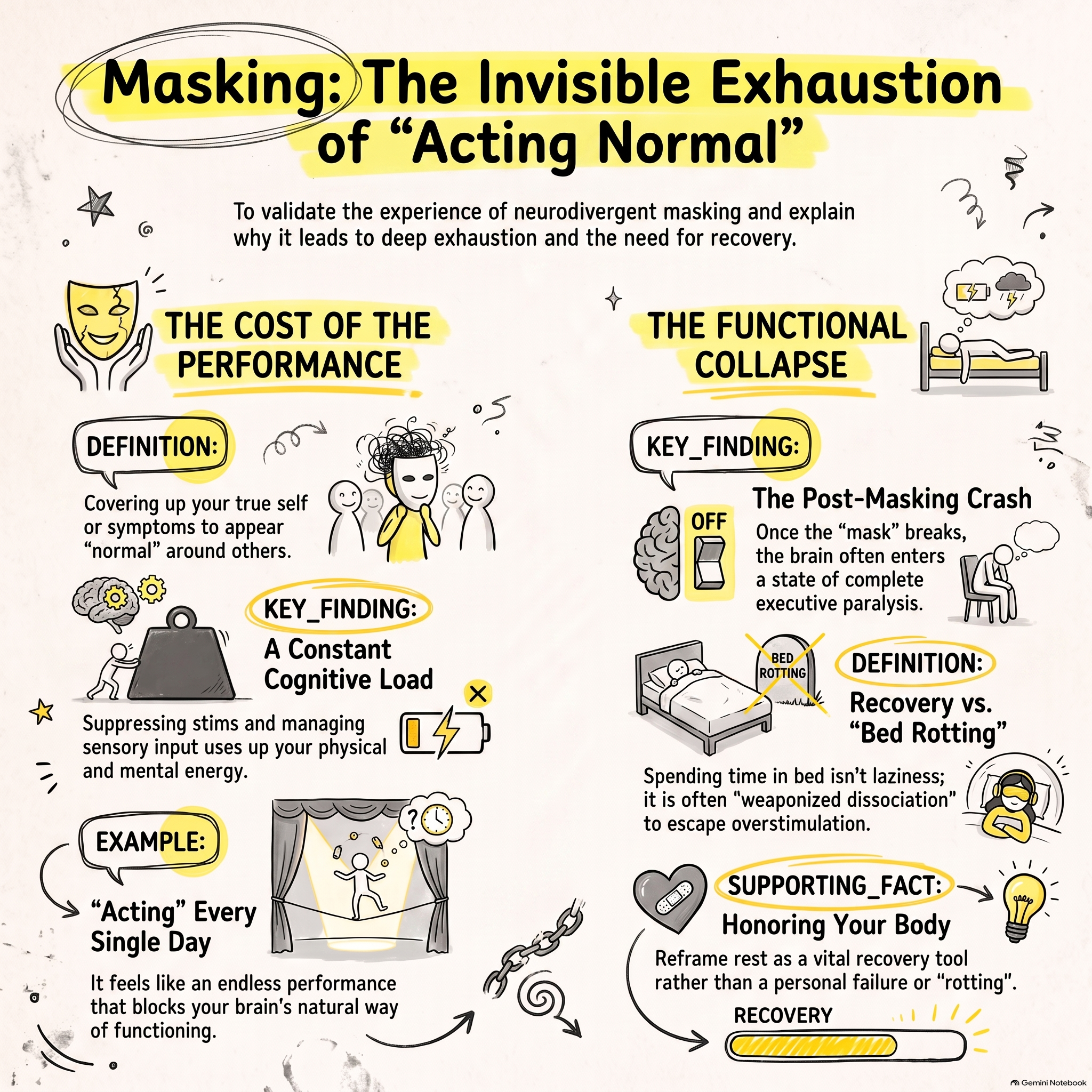
The problem You are at a work meeting or social gathering, looking completely fine. You are smiling, nodding, making eye contact, and sitting perfectly still. But inside, your brain is running a marathon. You are manually calculating when to speak, reminding yourself not to fidget, suppressing the urge to interrupt, and trying to follow a conversation while your mind wants to wander in five different directions. By the time you get home, you feel completely drained. You collapse onto the couch, unable to cook, answer a simple text, or put away your keys. You feel a profound physical and mental exhaustion, yet you tell yourself, "All I did was sit in a room and talk. Why is this so hard? I must be lazy." This invisible, exhausting labor is called **masking**—the constant, manual effort to suppress your natural neurodivergent traits to fit into a neurotypical world. ## Why it happens This deep exhaustion is a direct result of how **cognitive masking** drains your brain's metabolic resources. In a neurotypical brain, social behaviors like reading body language, maintaining eye contact, and managing attention are mostly automated. But for an ADHD brain, these social dynamics must be processed manually by the prefrontal cortex—the brain’s executive center. Your prefrontal cortex relies on **dopamine** and **cellular energy (ATP)** to plan, organize, and filter sensory inputs. Because you have an **interest-based nervous system**, your brain has a baseline deficit in dopamine pathways. When you mask, you force your prefrontal cortex to run complex, manual programs to mimic "normal" behavior. Suppressing fidgeting, translating social cues, and forcing focus on under-stimulating conversations consumes immense amounts of ATP. By the end of a social interaction, your prefrontal cortex is completely starved of cellular energy. When your executive fuel is gone, your brain's threat detector, the **amygdala**, becomes highly reactive. It perceives the minor friction of everyday chores—like washing a dish or opening mail—as an active threat, triggering a physical **freeze response** or task paralysis. You aren't lazy; you have simply spent all your cellular fuel on the exhausting performance of acting normal. ## How to fix it today To break this cycle of masking fatigue, you must stop trying to force your brain to run on empty. Here is how you can manage your energy and signal safety to your nervous system today: - **Schedule conscious "unmasking" blocks:** Just like physical exercise requires rest, social performance requires recovery. Schedule 15 to 30 minutes of daily "unmasking time." During this block, give yourself unconditional permission to do exactly what your body wants: fidget, pace, stare at the ceiling, or sit in silence. Removing this demand allows your nervous system to return to a calm baseline. - **Trigger a 60-second somatic reset:** When masking fatigue leaves you feeling paralyzed, calm your physical body first. Try a **physiological sigh**—taking two quick, deep inhales through your nose followed by one long, slow exhale. This breathing pattern activates your calming parasympathetic response, lowering your heart rate. Alternatively, splash cold water on your face to trigger the mammalian dive reflex and reduce physical anxiety. Check with a doctor if you have underlying health conditions before using cold water exposure. - **Introduce healthy physical stimming:** Fidgeting is not a distraction; it is a vital self-regulation tool. Instead of suppressing your need to move, find quiet, socially acceptable stims. Use a textured ring, a quiet desk fidget toy, or bounce your leg. Feeding your brain kinetic stimulation reduces the cognitive load of trying to sit perfectly still. - **Prepare your starting point in advance:** Since your prefrontal cortex is low on cellular energy after masking, reduce tomorrow's starting friction to absolute zero. Before you finish your day, clear your desk, lay out your tools, and open the exact file you need. This eliminates the morning executive tax, allowing you to glide straight into action. ## Common mistakes to avoid - **Using self-criticism as a motivator:** Shaming yourself for feeling exhausted after social interactions only increases your emotional friction. Shame makes your amygdala more reactive, reinforcing the biological freeze response. Treat your fatigue as real physical data, not a character flaw. - **Escaping into high-stimulation scrolling:** Mindless scrolling on your phone feels like an escape, but the constant digital input keeps your nervous system in a state of high alert. It drains your remaining dopamine without letting your mitochondria rebuild ATP. Replace digital scrolling with low-stimulation active recovery, like listening to music or lying in a dim room. - **Hulk smashing through task paralysis:** Do not rely on self-induced panic, anger, or urgency to force yourself to start chores when you are exhausted. While an adrenaline spike gets you over the Wall of Awful, using stress as executive fuel is incredibly expensive and leads directly to chronic **executive burnout**. ## Takeaway Masking is not a character flaw; it is a survival strategy that neurodivergent individuals use to navigate a world not built for them. But running your brain on manual control is incredibly expensive, draining the cellular energy your prefrontal cortex needs for daily tasks. Stop shaming yourself for feeling exhausted after acting normal. By scheduling conscious unmasking blocks, calming your physical body with somatic resets, and preparing your environment for zero starting friction, you work with your biology instead of fighting it. Show yourself compassion, lower the starting bar, and let calm momentum carry you forward.