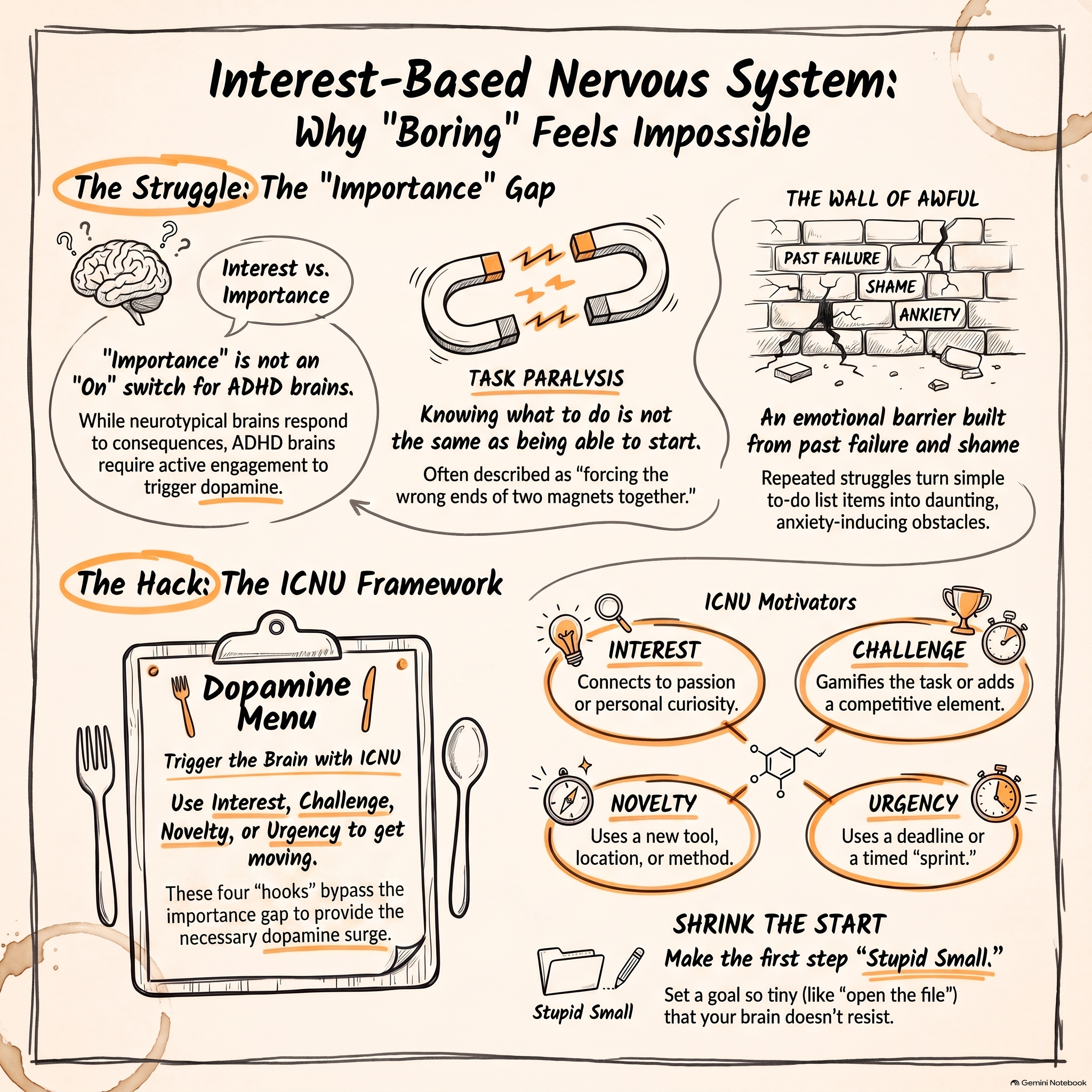
Interest Based Nervous System Why Boring Impossible
Zero Friction ADHD · 2026-08-26
The problem You sit at your desk with a simple, routine task in front of you—perhaps filling out a basic expense report, responding to a couple of emails, or clearing off your kitchen counter. It is a task that would take a neurotypical person ten minutes. You know it is important, and you know there will be consequences if you do not do it. Yet, your brain flatly refuses to cooperate. It feels as though a heavy, invisible wall has been built between you and the task. You try to force yourself to start, but your mental engine will not turn over. To escape the agonizing discomfort of this block, you instinctively pick up your phone. You end the day exhausted, guilt-ridden, and deeply ashamed, convinced that your inability to do "simple" things is a sign of laziness or a broken character. ## Why it happens This frustrating barrier is not a moral failing or a lack of discipline. It is a direct result of how the **ADHD brain** is physically wired. While neurotypical individuals have an **importance-based nervous system**, people with ADHD possess an **interest-based nervous system**. A neurotypical brain can naturally release a steady baseline of **dopamine**—the chemical messenger responsible for motivation and task initiation—simply because a task is deemed important or has a deadline. For an ADHD brain, the rules are entirely different. Your brain does not naturally release dopamine based on abstract importance. It requires immediate **interest, novelty, challenge, or urgency** to spark the neurochemical engine. When you try to force yourself to do a task that your brain finds boring, your prefrontal cortex suffers from a literal **cellular energy (ATP) deficit**. Because your brain lacks the dopamine required to plan and initiate the action, your threat-detecting **amygdala** becomes highly reactive. It registers the mental friction of the boring task as an active threat, triggering a physical **freeze response** that locks you in task paralysis. For your unique neurochemistry, boring is not just annoying—it is biologically impossible to start without a spark. ## How to fix it today To break the freeze, you must stop trying to force your interest-based nervous system to act like an importance-based one. Instead, you need to work with your biology to generate healthy stimulation and lower starting barriers today: - **Calm your reactive body first:** Because task paralysis is a physical freeze response, you must signal safety to your nervous system. Try a 60-second somatic reset like the **physiological sigh**—taking two quick, deep inhales through your nose followed by one long, slow exhale. You can also splash cold water on your face to trigger the mammalian dive reflex and reduce physical anxiety. Check with a doctor first if you have underlying health conditions. - **Layer your "Sides" for dopamine:** Do not perform boring chores in a quiet, under-stimulating vacuum. Raise your baseline dopamine by layering background stimulation directly over the task. Put on an instrumental lo-fi playlist, use a physical fidget toy with your free hand, or work alongside a partner using the **body doubling** method. - **Apply the Two-Option Rule:** Choice overload drains your limited executive energy. Never look at a massive, unstructured list of chores. Instead, choose between exactly two micro-tasks, such as filing one document or putting away three folders. Reducing the choices removes the cognitive load of prioritizing. - **Commit to a 180-second micro-start:** Set a visual timer for exactly three minutes. Give yourself honest, unconditional permission to stop when it rings. Lower your standards of performance to zero and simply start messily. By removing the pressure of doing a perfect job, you dismantle the **"Wall of Awful"** and let physical momentum take over. - **Prepare a zero-friction starting point in advance:** Transitioning from rest to work is the hardest part. To make starting effortless, prepare your environment the night before. Open the exact file you need, clear your desktop, and lay out your tools. This eliminates the need to plan tomorrow, allowing you to glide straight into motion. ## Common mistakes to avoid - **Using "Hulk smashing" to force focus:** Do not rely on self-induced stress, panic, or anger to create a sudden adrenaline spike to push you over the Wall of Awful. Bypassing task paralysis with chronic stress is biologically expensive, alters brain function, and leads directly to deep **executive burnout**. - **Assuming you should "just do it":** Stop waiting for a sudden wave of natural motivation to hit you. Motivation does not create action; action builds motivation. Accept that your brain needs external, physical systems to get started. - **Overcomplicating your setup:** Avoid downloading complex productivity apps that require extensive planning and color-coding. If a system takes more than ten seconds to maintain, your low-dopamine brain will quickly reject it. Keep your systems low-tech, physical, and immediately visible. ## Takeaway An interest-based nervous system is not a damaged version of a neurotypical brain; it is simply a different operating system. Trying to force focus on a boring task with sheer willpower or shame is a losing biological battle. Stop beating yourself up for a lack of discipline. By calming your physical body with somatic resets, feeding your brain healthy stimulation, and preparing your environment for a zero-friction start, you work with your biology instead of fighting it. Lower the starting bar, show yourself compassion, and let momentum do the rest.