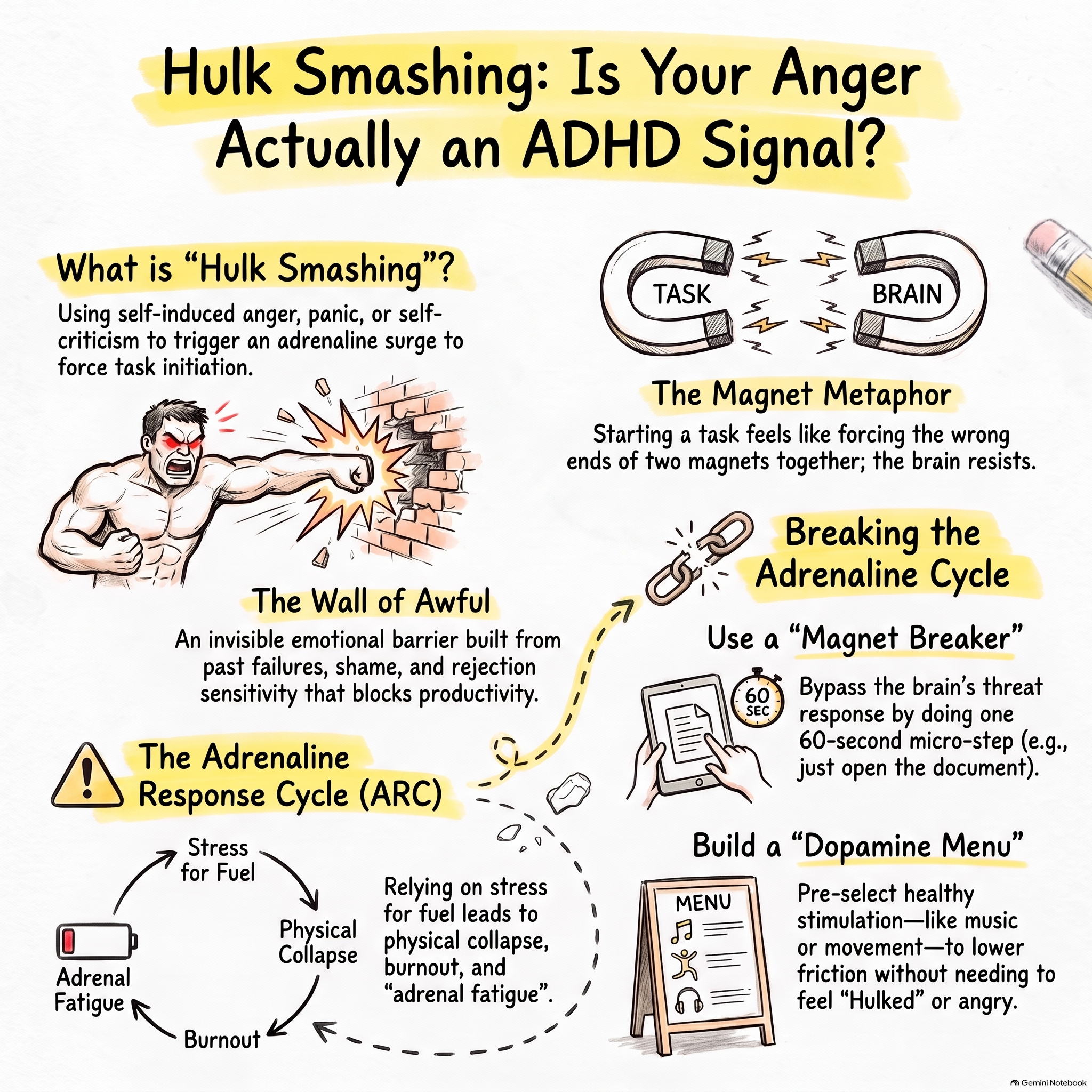
The problem You sit in front of your laptop, trying to start a complex project. You have put it off for days, and now the deadline is hours away. You feel a suffocating weight in your chest. You want to start, but you are completely frozen. Suddenly, as you stare at the screen, a wave of intense irritation washes over you. You slam your hand on the desk, or curse at your computer. Strangely, immediately after this outburst of anger, you feel a sudden jolt of energy. Your focus sharpens, your paralysis vanishes, and you finally hammer out the work. You tell yourself that you are just a hostile, impatient person. But you are actually caught in a hidden neurodivergent loop: **"Hulk smashing"**—using self-induced anger or irritation as an emergency battery to force your brain out of task paralysis. ## Why it happens This sudden surge of rage is not a flaw. It is a desperate, unconscious survival strategy deployed by an under-stimulated **ADHD brain**. Your prefrontal cortex—the administrative center that manages focus—relies on a steady stream of **dopamine** to function. Because you have an **interest-based nervous system**, your brain does not naturally release dopamine for mundane, complex, or routine tasks. When you sit down to work, your prefrontal cortex runs low on **cellular energy (ATP)**. Your brain's threat detector, the **amygdala**, becomes highly reactive. It perceives the cognitive friction of starting as an active threat, triggering a physical **freeze response** that locks you in place. To break this freeze, your subconscious has learned a workaround: generating irritation or anger. Anger instantly triggers a massive surge of **adrenaline and cortisol**. This stress response acts like a high-octane chemical fuel, temporarily exciting your prefrontal cortex and overriding the biological lock of task paralysis. You are simply using stress hormones as a chemical substitute for a starting spark. But while this adrenaline spike gets you over the **"Wall of Awful,"** relying on it as your primary engine is biologically expensive, alters brain function, and leads directly to chronic **executive burnout**. ## How to fix it today To break the cycle of anger-driven productivity and transition to a sustainable way of working, you must learn to signal safety to your nervous system. Here is how you can do it today: - **Calm your reactive body first:** When irritation builds, signal physical safety to your nervous system with a quick 60-second somatic reset. Try a **physiological sigh**—taking two quick, deep inhales through your nose followed by one long, slow exhale to activate your calming parasympathetic response. Alternatively, splash cold water on your face to trigger the mammalian dive reflex and lower physical anxiety. Remember to check with a doctor if you have underlying health conditions. - **Consult your Dopamine Menu:** Feed your brain healthy, intentional stimulation. Build a physical **Dopamine Menu** and place it in your workspace. When you feel a block, choose a quick 2-minute "Starter" like drinking a glass of cold, fizzy water, stretching, or listening to one high-energy song to raise your dopamine baseline naturally. - **Lower the starting bar to a micro-start:** Anger often spikes because your brain feels overwhelmed. Commit to a tiny, low-pressure **180-second micro-start**. Set a timer for three minutes and give yourself unconditional permission to stop when it rings. Lower your standards of performance to absolute zero and start messily. Overcoming the initial transition friction is often all your brain needs to build momentum. - **Prepare a zero-friction starting point in advance:** To prevent task paralysis, design your workspace ahead of time. Before you stop working, open the exact document you need and clear your desk. This removes the need for active planning, allowing you to glide into action without hitting a starting block. ## Common mistakes to avoid - **Accepting irritation as a healthy motivator:** Do not tell yourself that getting mad is just how you get things done. While Hulk smashing works in the short term, utilizing chronic stress hormones as executive fuel keeps your nervous system in a state of constant alert, rapidly draining your cellular energy and leading to deep exhaustion. - **Isolating yourself to "force" focus:** Forcing yourself to sit in a quiet, empty room when your brain is under-stimulated only increases emotional friction. It builds the Wall of Awful higher and makes your amygdala more reactive. If you are stuck, try "body doubling"—working quietly alongside a partner, friend, or video stream to anchor your focus. - **Beating yourself up for losing your temper:** Meeting anger with shame only increases your systemic stress. Self-criticism is physically counterproductive because it reinforces the biological threat response. Treat your irritation not as a moral failing, but as a clear biological signal that your nervous system is exhausted and under-stimulated. ## Takeaway Hulk smashing is not a sign that you are an angry person; it is a protective, survival-driven workaround of an under-stimulated brain trying to bypass task paralysis. Adrenaline is a powerful fuel, but it is meant for emergencies, not for daily chores. To heal your burnout and find sustainable focus, you must retire the adrenaline engine. By calming your physical body with somatic resets, feeding your brain healthy stimulation from your Dopamine Menu, and preparing your physical environment for zero friction, you work with your biology instead of fighting it. Lower the starting bar, show yourself compassion, and let calm momentum carry you forward.