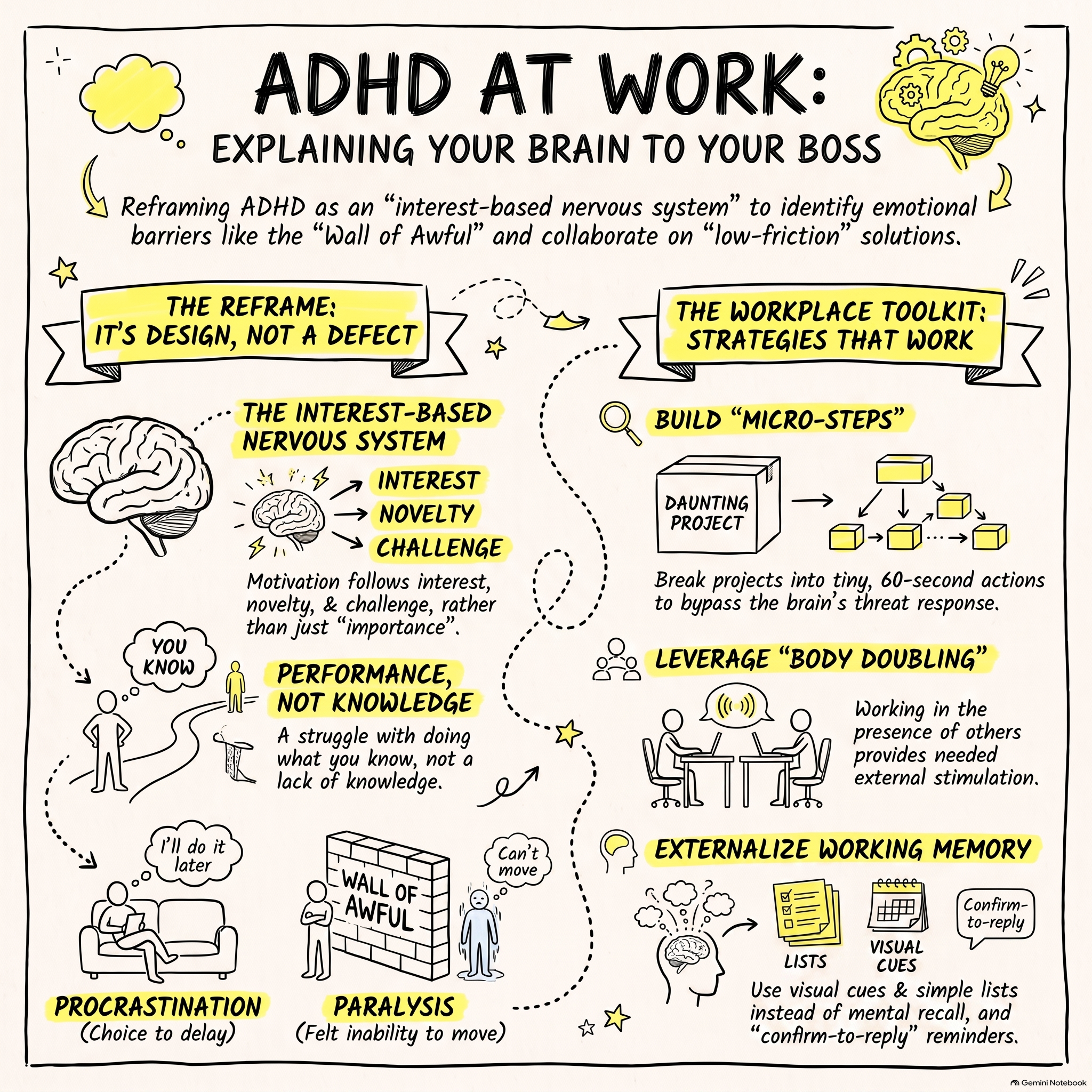
The problem You sit in your annual performance review or a weekly check-in, feeling a familiar knot tighten in your stomach. Your boss points to a project that was delivered late or a missed email. They say, "You have so much potential, but you need to manage your time better and just focus." You nod, murmur an apology, and promise to do better. But inside, you are spiraling. You want to explain that you aren't lazy—that you spent six hours yesterday staring at a blank document wanting to start but feeling physically frozen. You want to tell them that your brain works differently, but you are terrified. You worry that if you say the letters "ADHD," they will view you as incompetent or looking for excuses. You end the meeting in silence, carrying a heavy burden of shame, wondering how to ask for the support you need to do your job. ## Why it happens This paralyzing freeze state is a biological difference in how your brain handles executive function. The prefrontal cortex—the administrative center of your brain—relies on a steady supply of **dopamine** to plan, prioritize, and initiate actions. While a neurotypical brain can easily focus on tasks based on long-term importance, your brain runs on an **interest-based nervous system**. An ADHD brain requires immediate interest, novelty, challenge, or urgency to release the dopamine necessary to start. Without this chemical spark, your prefrontal cortex runs low on **cellular energy (ATP)**, and your brain's threat detector, the **amygdala**, becomes highly reactive. When you face a routine task, your amygdala registers the cognitive friction as an active threat, triggering a physical **freeze response** that locks you in task paralysis. Simply declaring "I have ADHD" often fails to get results. Your boss might hold outdated stereotypes and not understand how executive dysfunction, working memory deficits, or **time blindness** impact your daily workflow. To get the support you need, you must translate the neuroscience of your brain into practical, professional language that focuses on solutions rather than limitations. ## How to fix it today You do not need to disclose your medical diagnosis to get the support you need. Instead of focusing on the label, focus on your operational requirements. Here are four concrete steps to reframe your challenges and request effective workplace adjustments today: - **Focus on solutions, not symptoms:** Reframe your needs as strategies that optimize your productivity. Instead of saying, "My ADHD makes me forget deadlines," try: "I work best when we establish clear milestones. Having mini-deadlines helps me maintain momentum and ensures we stay on track." - **Request a written point-of-performance cue:** Verbal instructions quickly strain a neurodivergent brain's limited working memory. If your boss gives you a complex task in a meeting, ask for a quick summary in writing. Try saying: "To make sure I capture all the details and execute this accurately, could you send over a brief email with the key deliverables? Having a physical reference reduces starting friction." - **Implement parallel work sessions:** If you are struggling with a complex project, suggest a "body doubling" or co-working session with a colleague. You can say: "I've found that doing collaborative, parallel work blocks for complex tasks dramatically increases our speed and alignment. Can we set up a 30-minute co-working session to get this draft started?" - **Create zero-friction starting points:** Take control of your daily workflow by preparing your environment in advance. Before you log off each evening, open the exact files you need for the morning, clear your desktop, and choose your first two options. This eliminates the morning executive tax, allowing you to glide straight into action when you sit down. ## Common mistakes to avoid - **Using your diagnosis as a shield:** Never use ADHD as an explanation for why a task cannot be done. Your boss's primary concern is performance and deliverables. Frame your neurodiversity not as an inability to perform, but as a specific set of operating requirements that unlock your highest quality work. - **Overcomplicating your requests:** Do not ask for a massive overhaul of company policy or demand complex accommodations right away. If your request takes too much administrative effort for your boss to approve, they may resist. Keep your requests small, practical, and directly tied to your immediate daily tasks. - **Relying on crisis mode to start:** Do not wait for a looming deadline to trigger an adrenaline spike to force you over the Wall of Awful. Bypassing task paralysis with self-induced panic is exhausting, alters brain function, and leads directly to deep, long-term burnout. ## Takeaway Explaining your needs to your boss is not about asking for pity or making excuses; it is about managing your professional environment so you can deliver your best work. Your brain is not broken; it simply has a different set of biological requirements for task initiation and focus. Stop carrying the weight of workplace shame. By focusing on practical, low-friction solutions, requesting written cues at the point of performance, and preparing your workspace in advance, you work with your biology instead of fighting it. Advocate for your operating system, lower the starting barriers, and let your natural talent shine through.