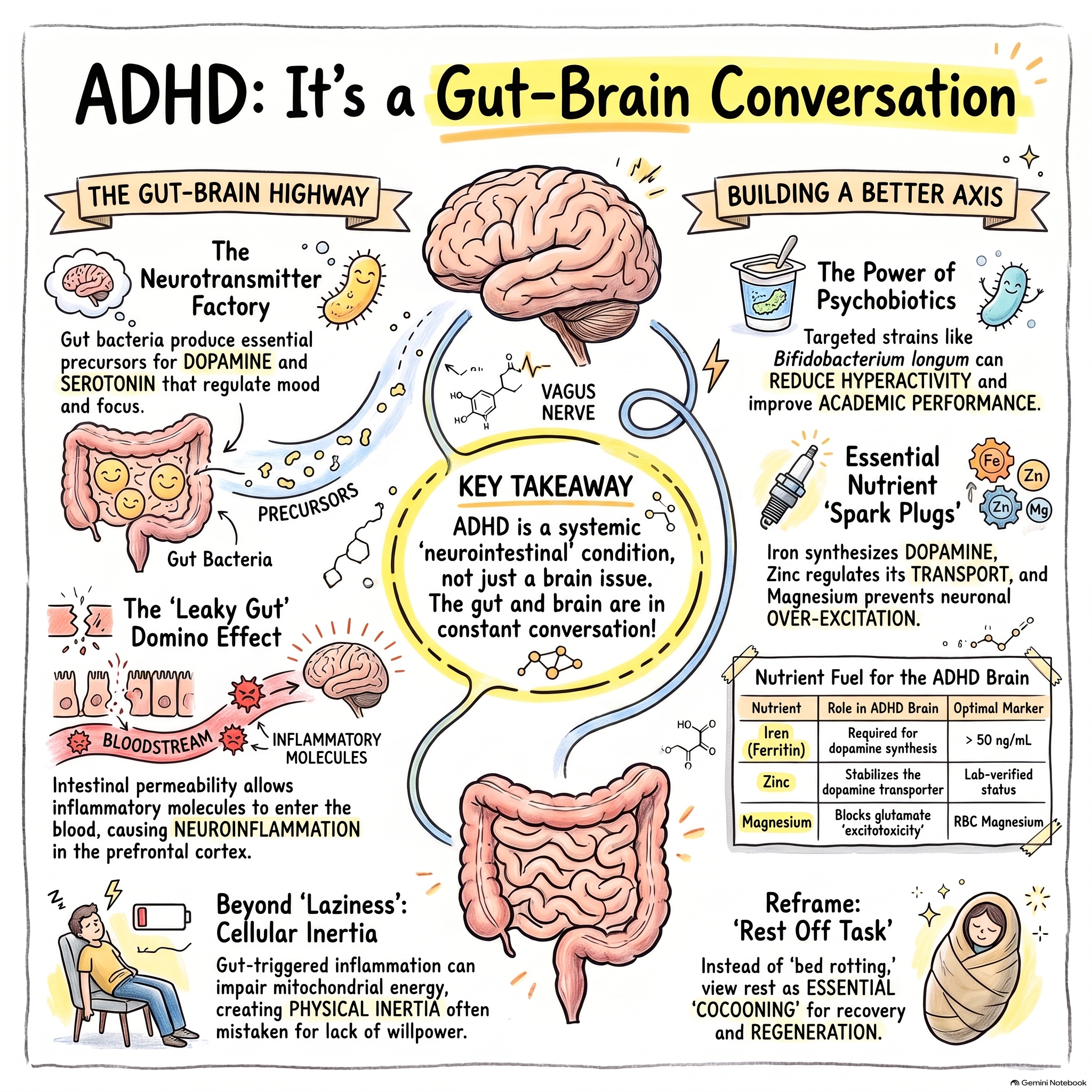
The problem You wake up on a weekday morning with a brain fog so dense it feels like physical mud. You stare at your computer or your kitchen counter, wanting to start your day, but you cannot make yourself move. At the same time, your stomach feels uneasy—perhaps bloated, crampy, or just full of nervous tension. You blame yourself for lacking willpower, assuming your mental paralysis and your digestive issues are two completely separate problems. You treat your chronic inability to start tasks as a mental defect, and your stomach issues as a diet problem. But what if these two struggles are actually two sides of the very same coin? For adults with ADHD, the profound physical fatigue and task paralysis you experience are deeply connected to a hidden biological highway: the gut-brain axis. ## Why it happens Your brain does not exist in a vacuum. It is in constant, bi-directional communication with your gastrointestinal tract via the vagus nerve and chemical messengers. In fact, emerging scientific literature suggests that we should rethink ADHD not just as a brain disorder, but as a **neurointestinal syndrome**. When your gut microbiome is out of balance—a state known as **dysbiosis**—the protective lining of your intestinal wall can become compromised, leading to increased gut permeability, or "leaky gut." This allows bacterial toxins, such as lipopolysaccharides (LPS), to escape into your bloodstream. Your immune system reacts to these toxins by releasing pro-inflammatory signals called cytokines (such as IL-1beta and TNF-alpha). These cytokines travel to the brain, triggering low-grade **neuroinflammation**. This inflammatory cascade directly disrupts mitochondrial function, starving your prefrontal cortex of **cellular energy (ATP)**. Because your prefrontal cortex lacks the energy to initiate actions, your threat-detecting **amygdala** becomes highly reactive. It perceives the cognitive friction of daily tasks as an active danger, triggering a physical **freeze response** that locks you in task paralysis. Your "laziness" is actually a cellular energy crisis triggered by an inflamed gut. Furthermore, your gut microbes are responsible for producing neurotransmitter precursors and modulating the hypothalamic-pituitary-adrenal (HPA) axis. When your gut is inflamed, your stress-hormone curve flattens into chronic exhaustion, making task initiation feel practically impossible. ## How to fix it today To heal your brain, you must support your gut. You can start calming your neurointestinal pathway today with these practical, low-friction steps: - **Introduce targeted psychobiotics:** Psychobiotics are specific probiotic strains clinically shown to support mental health via the gut-brain axis. Strains like **Bifidobacterium longum** and **Lactobacillus rhamnosus** help normalize cortisol levels and reduce the reactivity of your amygdala. Look for high-quality supplements containing these specific strains to quiet your physical anxiety. - **Feed your beneficial microbes prebiotics:** Your helpful gut bacteria feed on prebiotic fibers. Introduce simple, ADHD-friendly prebiotic foods into your daily routine, such as bananas, oats, garlic, or onions. Feeding your beneficial microbes helps them produce short-chain fatty acids that reduce systemic inflammation and protect your brain's energy levels. - **Calm your vagus nerve with somatic resets:** Since the vagus nerve is the physical highway between your gut and your brain, you can use physical resets to send a signal of safety. Try a 60-second **physiological sigh**—two quick inhales through your nose followed by one long, slow exhale. You can also splash cold water on your face to activate your parasympathetic nervous system. Check with a doctor first if you have underlying health conditions. - **Prepare your starting point in advance:** Because your prefrontal cortex is running on low cellular energy, reduce your starting friction to absolute zero. Before you finish your day, open the exact file you need or lay out your physical tools. Removing the need to make micro-decisions tomorrow protects your limited executive energy. - **Commit to a 180-second micro-start:** When task paralysis hits, do not look at the whole project. Set a timer for three minutes and commit to working messily. Lowering the bar to a 3-minute commitment calms your reactive amygdala, letting you glide past the starting block. ## Common mistakes to avoid - **Adopting an overcomplicated, stressful diet:** Trying to overhaul your entire diet overnight triggers immediate executive fatigue. If a dietary change requires hours of meal prepping, your low-energy brain will reject it. Focus on adding one healthy food rather than restricting everything. - **Using adrenaline and panic as fuel:** Do not rely on self-induced stress or panic to force yourself to start. Bypassing task paralysis with an adrenaline spike is incredibly expensive for your cells and worsens mitochondrial depletion, keeping you trapped in a cycle of burnout. - **Ignoring digestive distress as a mental health factor:** Stop treating your stomach issues as minor inconveniences. A bloated, inflamed gut is actively signaling your brain to freeze. Address gut irritation as a critical component of your ADHD management. ## Takeaway ADHD is not just a struggle of the mind; it is a physical, systemic condition deeply rooted in your gut-brain axis. When your cellular energy is depleted by neuroinflammation, trying to force focus with sheer willpower is a losing battle. Stop shaming yourself for a lack of discipline. By feeding your microbiome, calming your vagus nerve with somatic resets, and preparing your physical environment for a zero-friction start, you work with your biology instead of fighting it. Nourish your gut, lower the starting bar, and let your body regain its natural momentum.