Ferritin And Motivation The Blood Test That Matters
Zero Friction ADHD · 2026-08-26
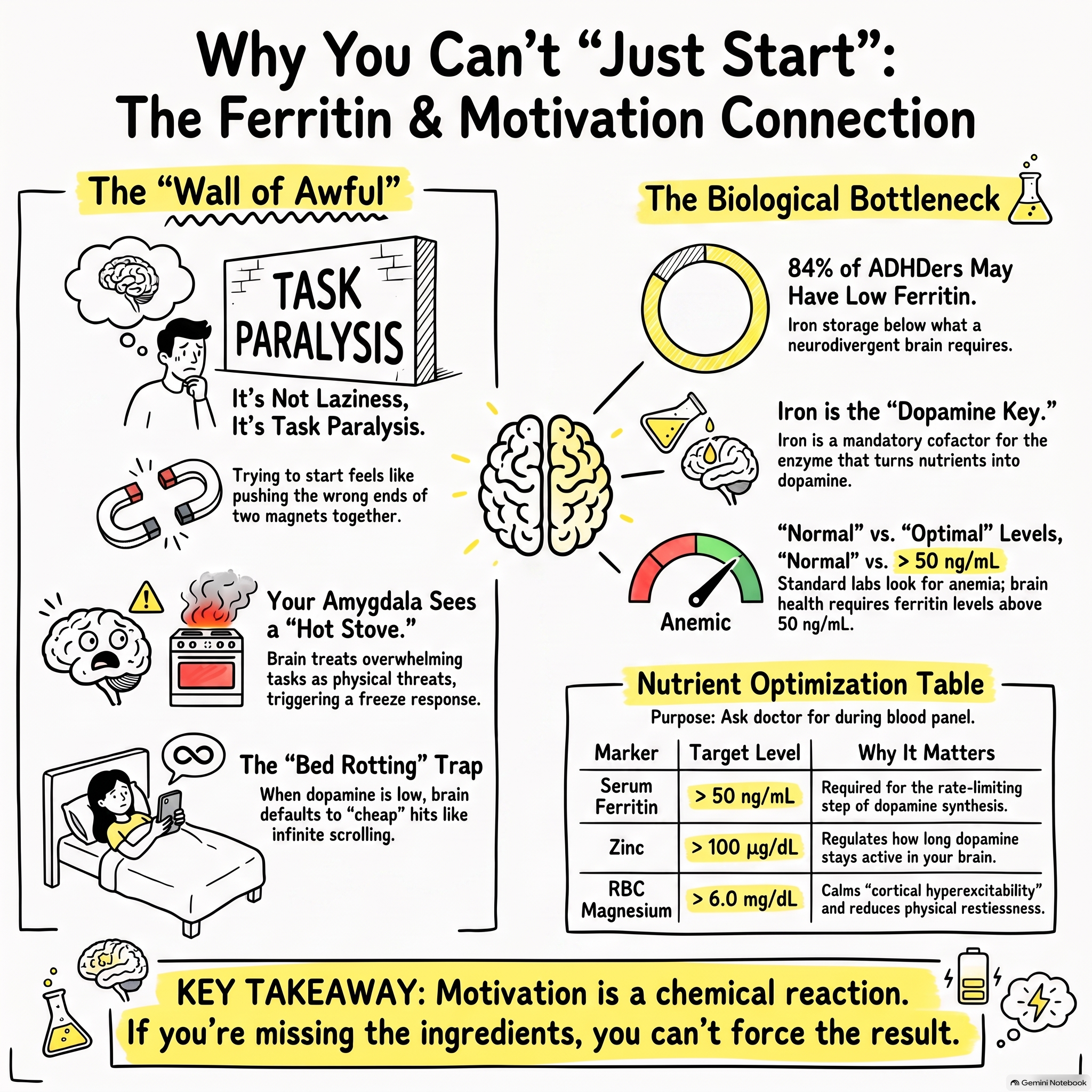
The problem You sit at your desk, staring at a simple task you have been avoiding for weeks. You have eaten well, slept reasonably, and set up your workspace perfectly. Yet, your brain feels like an engine with no spark. You try to force yourself to start, but there is simply no physical drive or mental energy behind your actions. It feels as though your motivation has been completely drained, leaving you with a hollow sense of exhaustion. You default to the same painful self-criticism, blaming your lack of willpower. You might have tried every productivity app, planner, and organizational hack in the book, yet the starting block remains completely impassable. But what if the key to your missing motivation isn't in your mind at all? What if the physical barrier locking your executive function in place is hiding in a simple, overlooked value on a standard blood test panel? ## Why it happens This paralyzing lack of drive is often rooted in a hidden biological bottleneck: **low iron stores**, measured specifically as **serum ferritin**. While most people associate iron deficiency with physical fatigue (anemia), iron plays a far more critical role in the daily function of your brain's neurotransmitter pathways. To understand why, we must look at how the brain manufactures **dopamine**—the chemical messenger responsible for anticipation, focus, and task initiation. Your brain operates on an **interest-based nervous system**. It requires a steady supply of dopamine to unlock executive function and help you transition from rest to action. To convert tyrosine into L-DOPA (the precursor to dopamine), your brain relies on a highly specialized, rate-limiting enzyme called **tyrosine hydroxylase**. This enzyme cannot function without a vital co-factor: iron. If your **serum ferritin**—representing your body's stored iron—is low, your brain cannot produce enough dopamine. Your prefrontal cortex is starved of the chemical fuel it needs to plan and initiate actions. This metabolic deficit makes your threat-detecting **amygdala** highly reactive, triggering a physical **freeze response**. You can have completely normal hemoglobin and no signs of anemia, yet suffer from severe, iron-deprived cognitive paralysis. ## How to fix it today To reclaim your biological drive and support your dopamine pathways, you must optimize your physical chemistry. Here are four practical, science-backed steps you can take today: - **Request a Serum Ferritin test:** The next time you see your doctor, do not just ask for a standard Complete Blood Count (CBC) or a basic iron test. Specifically request a **serum ferritin test**. While standard lab ranges often list anything above 15 ng/mL as "normal," research in ADHD neurobiology reveals that a target level **above 50 ng/mL** is optimal for supporting dopamine synthesis and reducing executive dysfunction. - **Support absorption with Vitamin C:** If you and your doctor decide that iron supplementation is right for you, never take your iron supplement alone. Always pair it with **Vitamin C**, which significantly enhances iron absorption in your gut. Avoid taking your iron supplement with calcium, coffee, or tea, as these compounds actively block your body's ability to absorb the mineral. - **Incorporate iron-rich foods:** Boost your dietary iron intake by focusing on bioavailable heme iron found in grass-fed beef, poultry, and seafood. If you follow a plant-based diet, prioritize non-heme iron sources like lentils, spinach, and pumpkin seeds, and always pair them with citric acid or vitamin C to maximize their absorption. - **Reduce starting friction in advance:** While you work on rebuilding your physical iron stores, protect your limited executive energy. Never approach a task without a plan. Prepare a clear, low-friction starting point the night before by opening the exact file you need, laying out your physical tools, and committing to a tiny **180-second micro-start** to build natural momentum. ## Common mistakes to avoid - **Assuming "normal" means optimal:** The most common mistake is accepting a doctor's reassurance that your iron levels are "normal" when your ferritin is sitting below 30 or 40 ng/mL. Insist on seeing your actual lab results and aim for a target of **50 ng/mL** to support your brain's unique neurochemistry. - **Self-medicating without testing:** Never start taking high-dose iron supplements without getting a blood test first. Unlike water-soluble vitamins, excess iron is not easily excreted by the body and can build up to toxic levels. Always test first and monitor your levels under medical supervision. - **Using self-criticism as motivation:** Beating yourself up for task paralysis only increases your brain's emotional friction. Shame makes your amygdala more reactive, reinforcing the biological freeze. Treat your freeze as a signal that your system needs biological support, not behavioral punishment. ## Takeaway Your motivation is a physical, biological resource, not an abstract test of character. If your body lacks the essential raw materials required to synthesize dopamine, no amount of willpower can force your prefrontal cortex to initiate action. Stop calling yourself lazy when your brain is simply running on empty. By checking your serum ferritin, pairing supplements correctly, and preparing your physical environment for a zero-friction start, you work with your biology instead of fighting it. Keep your steps simple, honor your body's chemical needs, and let natural momentum carry you forward.