Executive Dysfunction: Why It's Not Laziness (and What Actually Helps)
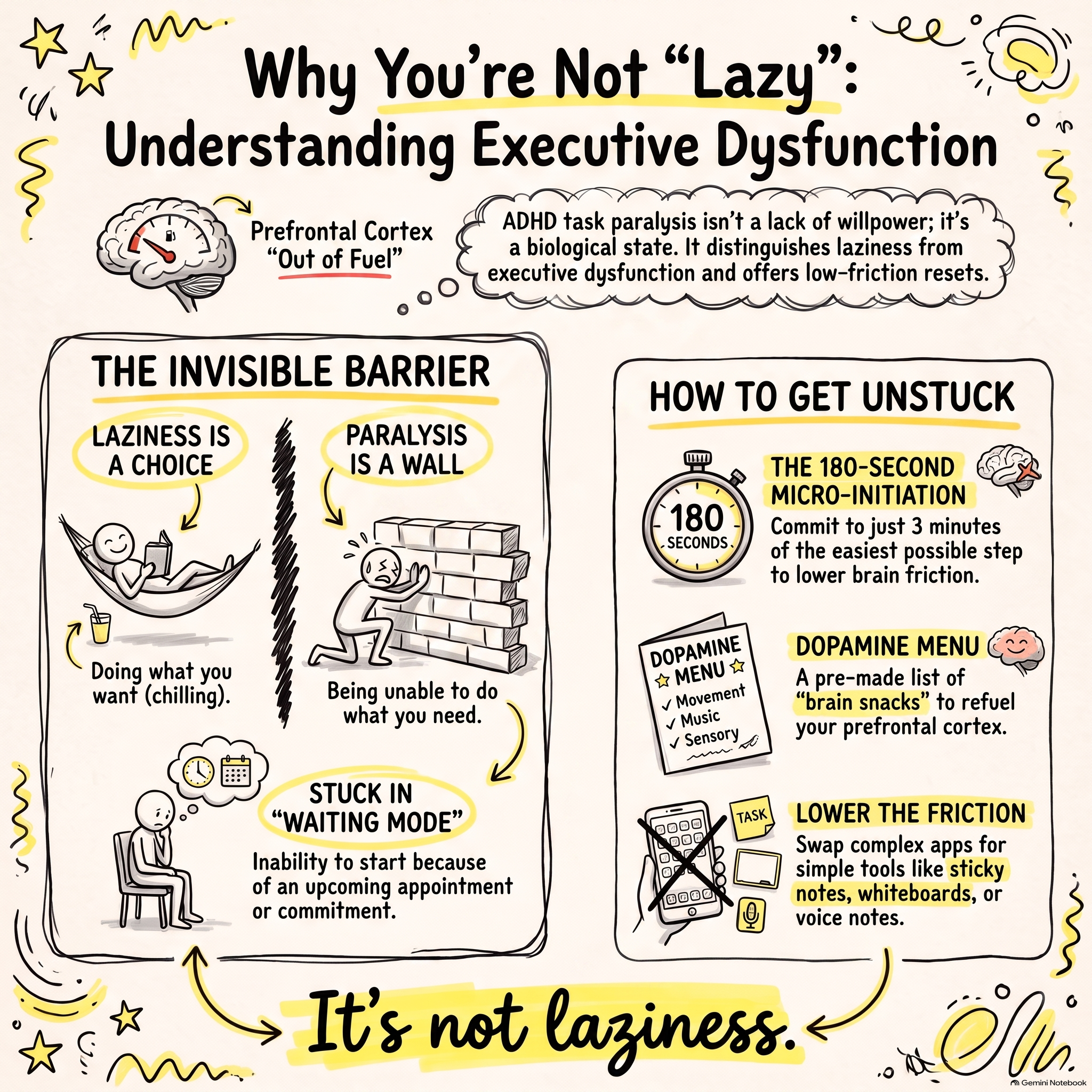
Executive Dysfunction: It is Not Laziness You are sitting at your desk staring at a to-do list that has been mocking you for days. You know exactly what you need to do, how to do it, and what will happen if you do not get it done. Every logical cell in your body is screaming at you to just start. Yet, you cannot move. You feel physically locked in place, staring blankly, or escaping into your phone for another hour of guilt-ridden scrolling. When the day ends with nothing checked off, you default to the same painful self-criticism: "I am just lazy. I have no willpower. I am wasting my potential." If you have ADHD or experience executive dysfunction, you have likely repeated this cycle hundreds of times. But here is the life-changing truth: you are not lazy. What you are experiencing is a genuine biological block. Your brain's transmission is temporarily locked, and trying to force it to move with shame is like stepping on the gas pedal while the emergency brake is fully engaged. The Neuroscience of the Freeze To understand why you cannot just start, we have to look at the physical brain. Executive function is the brain's command center, managed primarily by the prefrontal cortex. It is responsible for planning, organizing, keeping track of time, and, most importantly, task initiation. In a neurotypical brain, a high-priority task triggers a steady release of dopamine. This chemical acts as a key that unlocks executive function, providing the starting spark of energy. However, an ADHD brain operates on an interest-based nervous system. It does not naturally release dopamine based on the abstract "importance" of a task. It requires immediate novelty, interest, challenge, or urgency to generate that starting spark. When you try to start a routine, boring, or complex task, your prefrontal cortex reaches for dopamine and finds empty reserves. This cellular-level energy deficit means your brain lacks the adenosine triphosphate, or ATP, needed to plan and initiate the task. Compounding this deficit is what psychologists call the Wall of Awful. Past failures, missed deadlines, and shame associated with that task add an invisible brick of anxiety to your workspace. When you contemplate starting, your amygdala—your brain's threat detector—becomes highly reactive. It associates the task with emotional distress and perceives it as an active danger. To protect you, your amygdala triggers a physiological freeze response. Your body physically halts because your nervous system is in survival mode. The Solution: How to Unlock Your Brain Today Because executive dysfunction is a biological freeze, you cannot think your way out of it. You must work with your nervous system to restore safety and reduce starting friction to absolute zero. Here are four concrete steps to apply today: First, calm your reactive amygdala. Since task paralysis is a physical freeze response, you must signal safety to your body before your thinking brain can come back online. You can do this with a quick 60-second somatic reset. Try a physiological sigh—taking two quick inhales through your nose followed by one long, slow exhale. This breathing pattern activates the calming parasympathetic response, lowering your heart rate. Alternatively, splash cold water on your face to trigger the mammalian dive reflex, which instantly dampens physical anxiety. Remember to check with a doctor if you have underlying health conditions before using cold water exposure. Second, reduce starting friction in advance. When executive energy is low, making dozens of tiny decisions before you begin working—like finding your notepad, opening tabs, or clearing your desk—drains your limited prefrontal fuel. Eliminate this administrative friction by preparing a clear, low-friction starting point in advance. Open the exact document you need the night before and leave your laptop in your direct line of sight. By making the task immediately visible, you allow your brain to glide into action without planning. Third, apply the Two-Option Rule. Choice overload is a major trigger for task paralysis. Never look at a massive, unstructured list of chores. Instead, hide the list and choose between exactly two micro-tasks. For example, decide: "Am I going to write one sentence of this report, or am I going to put three shirts in the closet?" Reducing the decision pool to only two simple choices removes the cognitive load of prioritizing, allowing your brain to choose and move. Fourth, commit to a 180-second micro-start. Set a visual timer for exactly three minutes. Give yourself unconditional, honest permission to stop and walk away once the timer rings. The goal is to lower the standard of performance to zero. Write a terrible sentence, wash just one dish, or put away a single file. By removing the pressure of doing a perfect job, you dismantle the Wall of Awful. Often, once you cross the starting line, the physical friction disappears, and natural momentum takes over. Common Mistakes to Avoid The most common trap is a pattern called "Hulk smashing"—intentionally generating panic, shame, or anger to force an adrenaline spike. While this stress-induced surge temporarily bypasses task paralysis, relying on this adrenaline response cycle is unsustainable, alters brain function, and leads directly to deep burnout. Another mistake is relying on productivity apps that feel like chores. Many digital planners require extensive organizing, scheduling, and customizing. For a low-dopamine brain, this adds an extra layer of administrative friction. If an app requires more energy to maintain than the tasks themselves, discard it. Keep your systems low-tech, physical, and immediately visible. The Takeaway Executive dysfunction is a physiological hurdle, not a character flaw. Your inability to start a task is a protective biological shutdown, not a lack of caring or discipline. Stop waiting for a sudden wave of motivation. Motivation does not create action; action builds motivation. By calming your nervous system, reducing environmental friction, and committing to just three minutes of messy starting, you work with your biology instead of fighting it. Lower the bar, show yourself compassion, and let momentum do the rest.