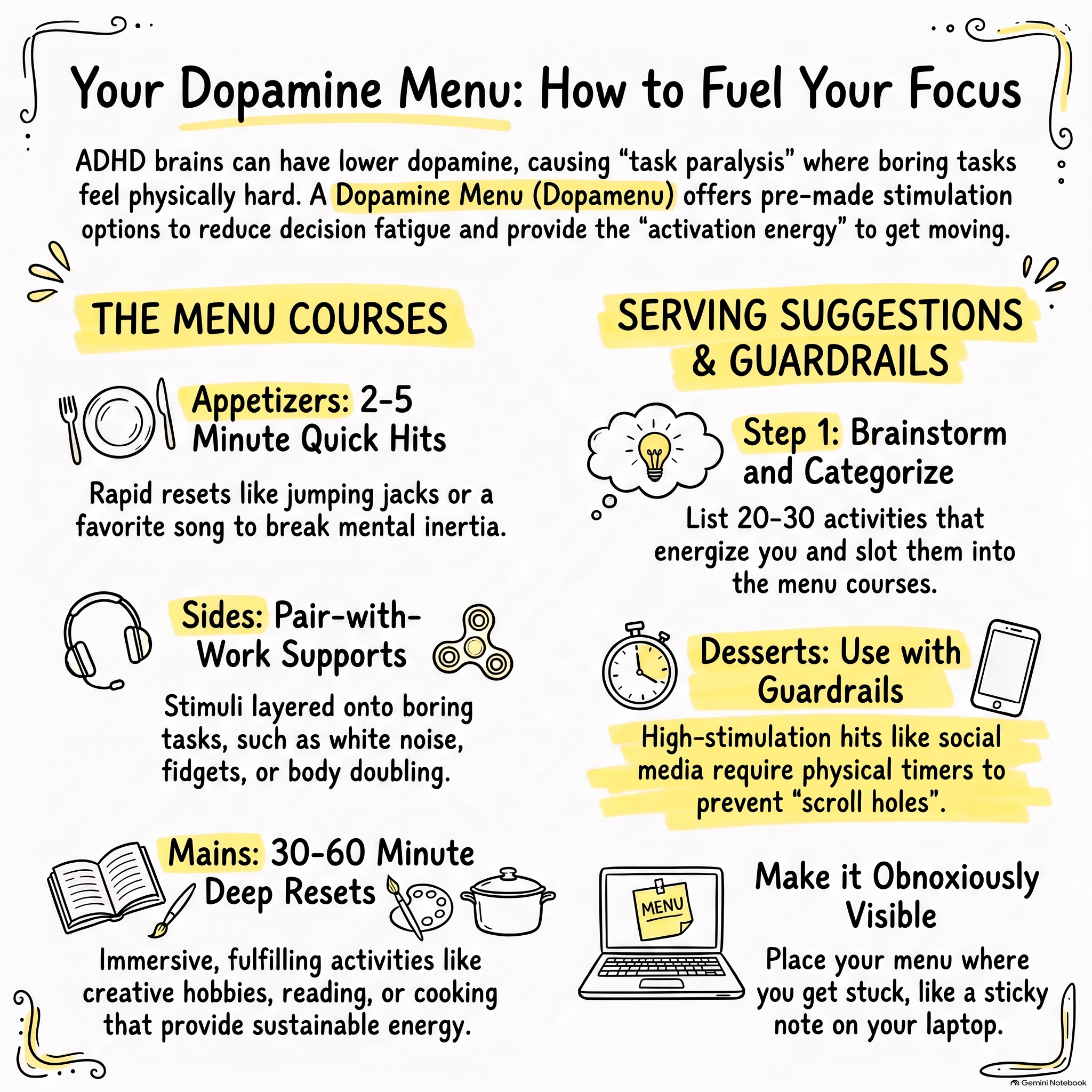
The problem You sit at your desk, staring at a mountain of small, mundane tasks. You need to answer emails, sort through mail, and tidy up your workspace. Your brain is desperately screaming for a quick break—a tiny spark of energy to push through the fog. Without a clear plan, you instinctively reach for your smartphone, telling yourself you will scroll for just five minutes to recharge. Fast forward two hours. You are still on the couch, trapped in a mindless scrolling loop. Your eyes are dry, your head is throbbing from overstimulation, and a heavy blanket of guilt has settled over your chest. You wanted a refreshing pause, but instead, you fell into a digital black hole that left you completely drained. This is the **dopamine deficit trap**—a vicious cycle where your brain desperately seeks motivation but ends up in an endless loop of cheap, passive stimulation that fuels task paralysis. ## Why it happens This paralyzing loop is a direct result of how the **interest-based nervous system** of ADHD operates. In a neurotypical brain, dopamine pathways naturally release a steady baseline of motivation based on a task's abstract, long-term importance. In an ADHD brain, there is a baseline deficit in these pathways. Dopamine is not a "pleasure" chemical; it is the neurotransmitter of anticipation, motivation, and task initiation—your brain's chemical starting engine. When executive energy is low, your prefrontal cortex is depleted of **cellular energy (ATP)**. Your brain desperately craves a hit of dopamine to wake itself up. If you do not have a pre-decided plan for how to get that stimulation, your brain will default to the easiest, most stimulating option available: your phone, video games, or sugary snacks. These high-yield, low-effort digital inputs flood your receptors with cheap dopamine. But because they are highly stimulating, they keep your threat-detecting **amygdala** active and your nervous system in a state of high alert. You are not actually resting; you are in a state of **somatic avoidance**. This chronic overstimulation alters brain function, making your receptors less sensitive to everyday, low-stimulation tasks. A **Dopamine Menu** solves this by providing a physical, pre-curated directory of healthy stimulation, reducing the cognitive load of deciding how to recharge. ## How to fix it today To break the cycle of overstimulation and rebuild your motivation, you can design a personalized Dopamine Menu today. Divide your menu into distinct categories to fit your daily energy levels: - **Prepare your Starters (2-5 minutes):** These are quick, low-barrier physical actions designed to wake up an under-stimulated brain without sucking you into a time warp. Examples include doing ten jumping jacks, drinking a cold glass of fizzy water, or putting on a single favorite high-energy song. - **Define your Mains (10-30 minutes):** These are deeply restorative, low-stimulation activities that require real engagement and help your mitochondria rebuild ATP. These must be offline and analog, such as taking a short walk outside, taking a warm shower, sketching, or reading a physical book. - **Mix in your Sides (Background stimulation):** These are passive stimulators you can layer directly over boring chores to raise your baseline dopamine. Examples include listening to instrumental lo-fi playlists while writing, using a physical fidget toy, or working at a standing desk. - **Set boundaries for Desserts:** These are highly stimulating, addictive digital loops like social media, mobile games, or television. You do not have to ban them, but you must establish **physical boundaries**—such as setting a 15-minute visual timer and physically placing your phone in another room when the timer rings. - **Design a physical menu board:** Do not hide your menu in a digital app. Write your menu on a physical whiteboard, a colorful poster, or a small index card. Place it directly at your **point of performance**—such as your desk or your refrigerator—where you can physically see it when you feel the urge to scroll. ## Common mistakes to avoid - **Using digital apps to host your menu:** Saving your menu inside a smartphone app is a recipe for distraction. Unlocking your screen to check your menu exposes your prefrontal cortex to notifications and social media, triggering immediate task resistance. Keep your system completely analog. - **Including chores as restorative breaks:** If you list "clean the kitchen" as a Main dish because you think you should find it rewarding, your brain will reject the system. Your menu must consist of activities that genuinely nourish you and bring you calm. - **Forgetting to prepare a starting point:** When you step away for a restorative break, always prepare a clear, low-friction starting point for your work before you leave. Open the exact file you need, clear off your desk, or lay out your tools. This prevents your brain from hitting a massive starting block when your break ends. ## Takeaway Your neurodivergent brain is not broken or lazy; it is simply hungry for dopamine. Trying to force yourself to focus when your cellular energy is completely depleted is a losing biological battle. Stop relying on self-criticism to climb over the Wall of Awful. Instead, show yourself compassion by creating a physical Dopamine Menu. By pre-deciding how to feed your brain, calming your physical body with healthy stimulation, and preparing your environment for a zero-friction start, you work with your biology instead of fighting it. Keep your menu visible, keep your steps simple, and let natural momentum do the rest.