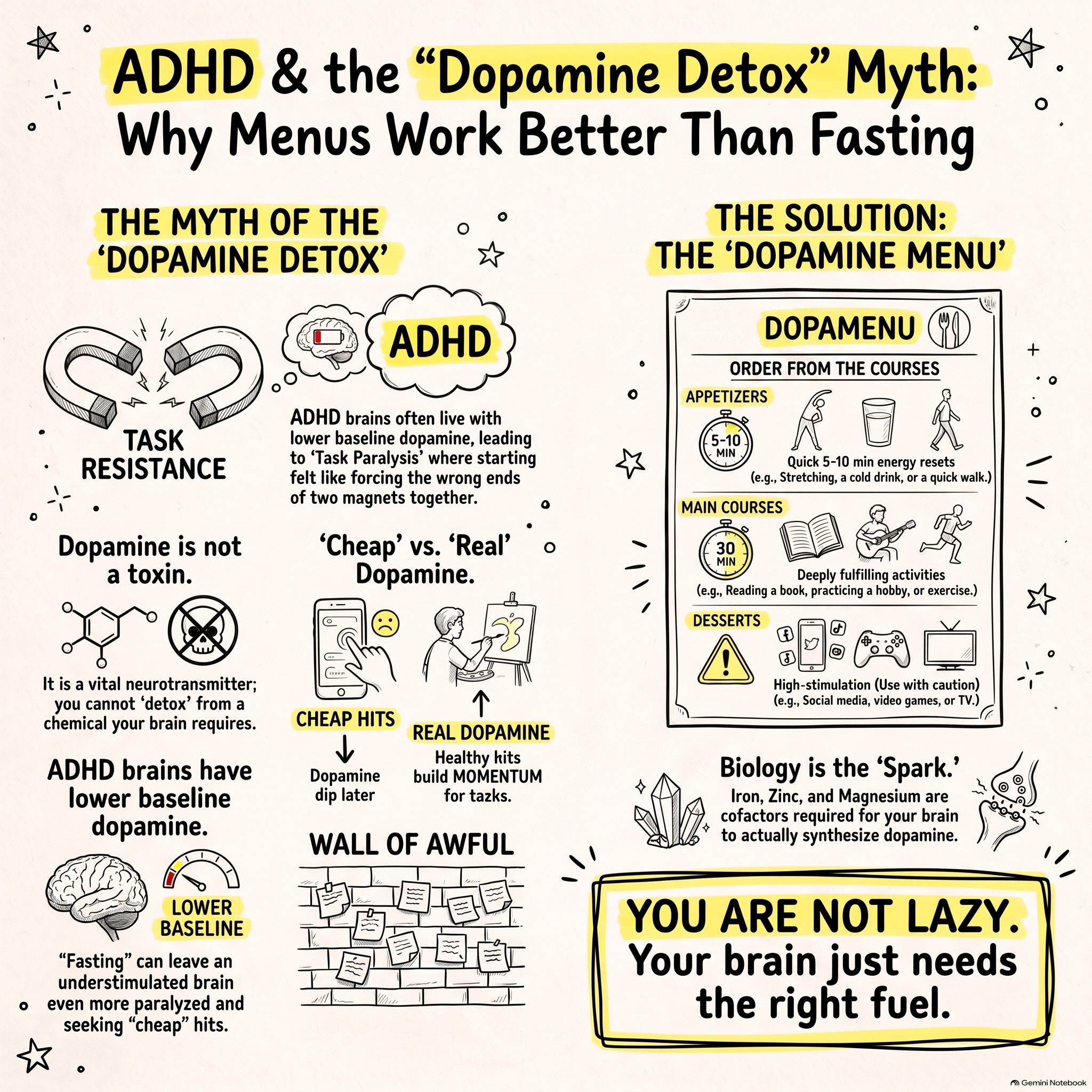
The problem You are sitting on your couch, surrounded by unfinished tasks. Your inbox is overflowing, your laundry basket is piled high, and your desk is a chaotic mess. You know you need to get up, but you are locked in a mindless scroll on your phone. You have been swiping through short videos for hours for a fresh hit of entertainment. You feel overstimulated, exhausted, and anxious, yet you cannot swipe away. You decide that what you need is a trendy **"dopamine detox."** You swear to lock your phone in a drawer, turn off the internet, and spend twenty-four hours in absolute silence. But within two hours, the crushing boredom becomes unbearable. Your physical anxiety spikes, your mind begins to race, and you grab your phone for a massive rebound scroll. You end the day feeling like a failure, convinced your self-discipline is broken. ## Why it happens This painful loop happens because the popular concept of a "dopamine detox" is built on a biological misunderstanding. You cannot actually "detox" from **dopamine** because it is a natural neurotransmitter that your brain constantly produces. It is not a pleasure chemical; it is the neurotransmitter of anticipation, motivation, and task initiation. An ADHD brain has a baseline deficit in dopamine pathways and runs on an **interest-based nervous system**. Unlike neurotypical brains that can initiate routine tasks based on abstract, long-term importance, your brain requires immediate novelty, interest, challenge, or urgency to release the starting spark of dopamine. When you inundate your brain with low-effort, high-reward digital stimulation—like scrolling social media—you flood your receptors. Over time, **chronic overstimulation alters brain function**, making your dopamine receptors less sensitive to everyday, low-stimulation tasks. Trying an extreme, sudden "detox" by cutting out all stimulation is like starving an engine of fuel. Because your brain is already running on a baseline dopamine deficit, extreme deprivation causes your threat-detecting **amygdala** to become highly reactive. The sudden silence is registered as a threat, triggering a physical **freeze response** or task paralysis. You do not need a complete deprivation detox; you need to manage your stimulation baseline and build healthy dopamine alternatives. ## How to fix it today To reset your baseline and make daily tasks achievable, you must work with your neurodivergent biology. Here is a practical, science-backed protocol you can apply today: - **Create a Dopamine Menu:** Instead of starving your brain, feed it intentional, healthy dopamine. Build a "Dopamine Menu" with five categories. "Starters" are quick, low-barrier 2-minute tasks like drinking cold fizzy water or putting on a favorite song. "Mains" are highly restorative 15-minute activities like a walk in nature or drawing. "Sides" are background stimulants you layer over boring tasks, like playing an instrumental lo-fi playlist. "Desserts" are highly stimulating digital loops (which must have strict time limits), and "Specials" are occasional events like a weekend trip. - **Lower the starting barrier with a somatic reset:** Before you attempt a boring chore, calm your reactive nervous system. Try a 60-second somatic reset like the **physiological sigh**—taking two quick, deep inhales through your nose followed by a long, slow exhale. This breathing pattern activates the calming parasympathetic response, lowering your heart rate. Alternatively, splash cold water on your face to trigger the mammalian dive reflex and reduce physical anxiety. Remember to check with a doctor if you have underlying health conditions before using cold water exposure. - **Prepare your starting point in advance:** Transitioning from rest to work is the point of maximum cognitive friction. To make starting effortless, set up your physical environment ahead of time. Open the exact file you need, clear off your desk, and lay out your tools the night before. Removing these tiny administrative barriers reduces the executive energy needed to initiate. - **Commit to a 180-second micro-start:** Never look at a massive, complex project all at once. Set a visual timer for exactly three minutes and give yourself unconditional permission to stop when it rings. Lower your standard of performance to zero and simply start messily. Once you overcome the initial transition friction, natural momentum will often take over. ## Common mistakes to avoid - **Attempting extreme stimulation deprivation:** Forcing yourself into complete silence or isolating yourself from all technology is unsustainable for an interest-based nervous system. It triggers intense anxiety and leads to a massive rebound binge on digital devices. - **Using self-criticism as a motivator:** Beating yourself up for scrolling is physically counterproductive. Shame increases emotional friction and makes your amygdala more reactive, reinforcing the biological freeze response that locks you in task paralysis. - **Leaving tasks disorganized when you stop:** If you stop a task after your micro-start, do not leave it in a chaotic state. Always prepare a clear starting point for your next session so you do not hit another starting block when you return. ## Takeaway You do not need to starve your brain of dopamine to find focus. Your ADHD brain is not broken; it is simply under-stimulated and overwhelmed by digital noise. True recovery does not come from extreme, unsustainable deprivation. It comes from replacing cheap, mindless scrolling with **active somatic recovery** and intentional stimulation. By structuring a personalized Dopamine Menu, calming your physical body with somatic resets, and preparing your physical environment for a zero-friction start, you work with your biology instead of fighting it. Lower the bar, show yourself compassion, and let momentum do the rest.