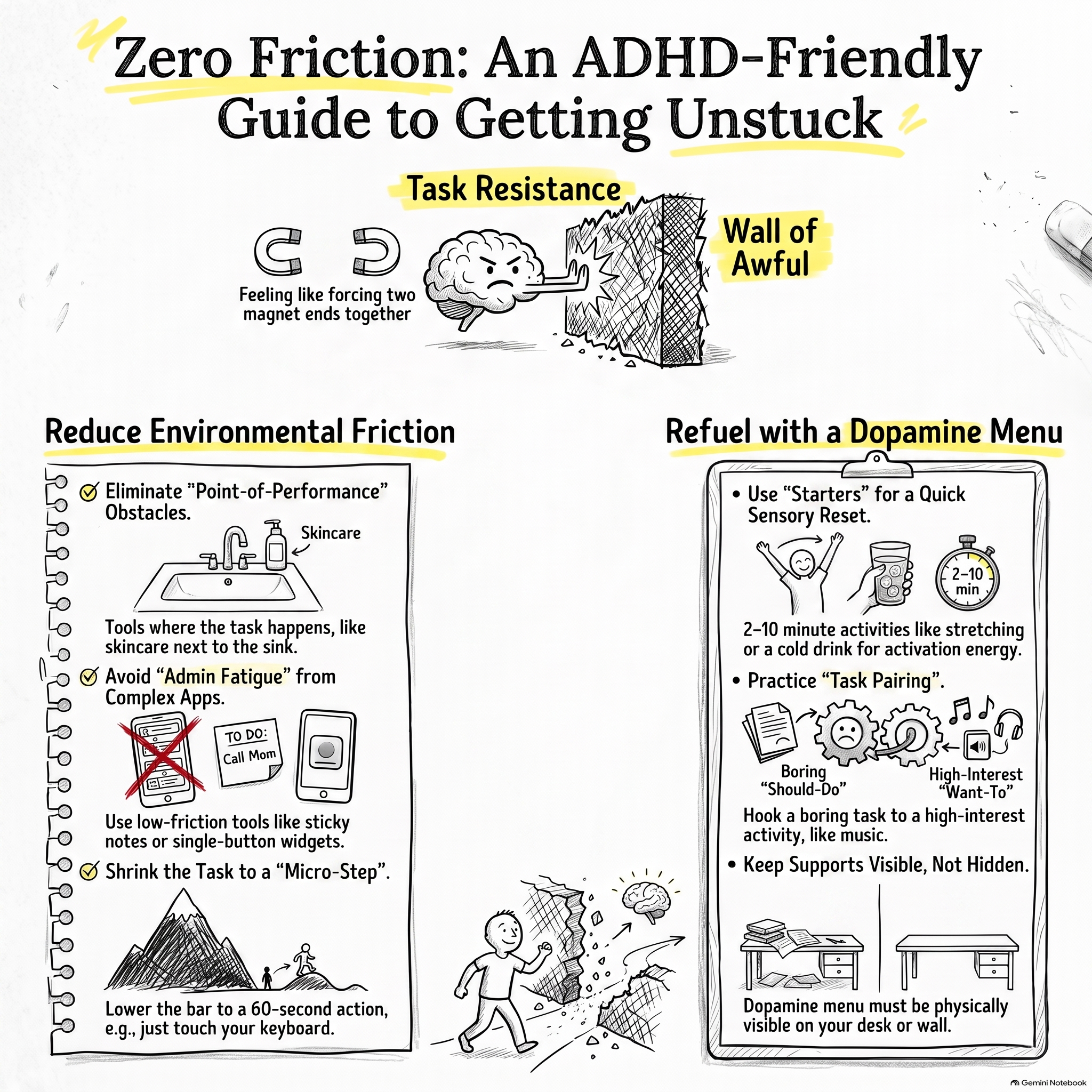
The problem You stand in the middle of your living room, staring at a basket of clean laundry. It has been sitting there for three days. You genuinely want to put it away, but the clothes are in one room, the hangers are tangled in a dark closet, and your dresser drawers are jammed shut with clutter. To do this simple task, you first have to untangle hangers, clear off the dresser, and force the drawers open. Your brain registers this sequence of micro-obstacles and immediately hits the brakes. The mental weight of all those preparatory steps feels exhausting. Instead of tackling the laundry, you feel a wave of physical fatigue, walk away, and escape into your phone. You end the day feeling deeply ashamed, asking yourself why a simple chore feels like climbing a mountain. ## Why it happens This paralyzing freeze state is not a moral failing. It is a direct result of how the **ADHD brain** processes executive function and task initiation. Your prefrontal cortex—the brain’s administrative center—relies on a steady supply of **dopamine** to plan and initiate tasks. Because you have an **interest-based nervous system**, your brain does not naturally release dopamine for routine, boring, or non-urgent chores. With ADHD, every single step required to start a task is an executive tax. Having to find a pen, open a cabinet, or clear a desk requires a **micro-decision** that drains your limited pool of executive energy. Furthermore, ADHD is deeply tied to challenges with **object permanence and working memory**. In the neurodivergent world, if something is out of your direct line of sight, it effectively ceases to exist. When your tools are hidden behind closed doors or inside opaque drawers, your prefrontal cortex has to work twice as hard to remember they are there. When the cognitive friction of initiating a task becomes too high, your threat-detecting **amygdala** becomes highly reactive. It perceives the task as an overwhelming threat, triggering a physical **freeze response** that locks you in task paralysis. ## How to fix it today To break this cycle, you must stop trying to change your brain and start changing your environment. You need to design your surroundings for **zero friction**—making the right choices the easiest possible paths. Here are four concrete steps you can apply today: - **Adopt the one-step rule:** Examine the daily habits you struggle with and count the physical steps required to do them. If you struggle to throw away trash, remove the lid from your trash can. If you struggle to hang up your coat, replace the hangers in your closet with open, heavy-duty wall hooks. Reduce the physical actions required to start any task to exactly one step. - **Use visual transparency:** Since "out of sight" means "out of mind," bring your tools into the light. Replace opaque storage bins with clear plastic containers. Remove cabinet doors from your pantry or workspace shelves. When your brain can physically see what it needs, the cognitive friction of starting drops significantly. - **Set up point-of-performance cues:** The point of performance is the exact physical spot where a task is supposed to happen. Place your tools exactly where you will use them. Put your morning vitamins directly on top of your coffee mug the night before. Place your notebook and pen open on your keyboard so you physically touch them when you sit down. By placing physical cues directly in your path, you eliminate the need to remember. - **Prepare a clear starting point in advance:** Transitioning from rest to action is the point of maximum cognitive friction. To bypass this, always set up your next step before you finish working. Open the exact tab you need, lay out your physical files, or clear off your desk tonight. When you approach your desk tomorrow, you will not have to think, organize, or plan—you can simply glide straight into motion. ## Common mistakes to avoid - **Prioritizing aesthetics over function:** Avoid highly organized, minimalist layouts with intricate filing cabinets, matching boxes, and hidden storage systems. These create immense administrative friction that eventually leads to system collapse. Instead, focus on systems that are highly visible and instantly accessible. - **Building complex tracking systems:** Do not download complicated habit-tracking apps or create detailed scheduling spreadsheets to manage your environment. If a system takes more than ten seconds to maintain, your executive function will quickly reject it. Keep your systems low-tech, physical, and immediate. - **Using self-criticism when a system fails:** If you find yourself avoiding a task again, do not call yourself lazy. Instead, treat the avoidance as valuable data. It means there is still too much friction in the physical setup. Ask yourself, "Where is the bottleneck?" and adjust the environment to make starting even easier. ## Takeaway Your environment is your external prefrontal cortex. When you struggle with executive dysfunction, trying to force yourself to work in a high-friction space is a losing battle. Stop trying to rely on sheer willpower to climb over the Wall of Awful. Instead, show yourself compassion by redesigning your physical world. By making your tools visible, placing cues at the point of performance, and preparing your starting points in advance, you work with your biology instead of fighting it. Lower the starting bar to absolute zero, and let physical momentum do the heavy lifting.