**Double Up: How to Outsmart ADHD Task Paralysis with Body Doubling**
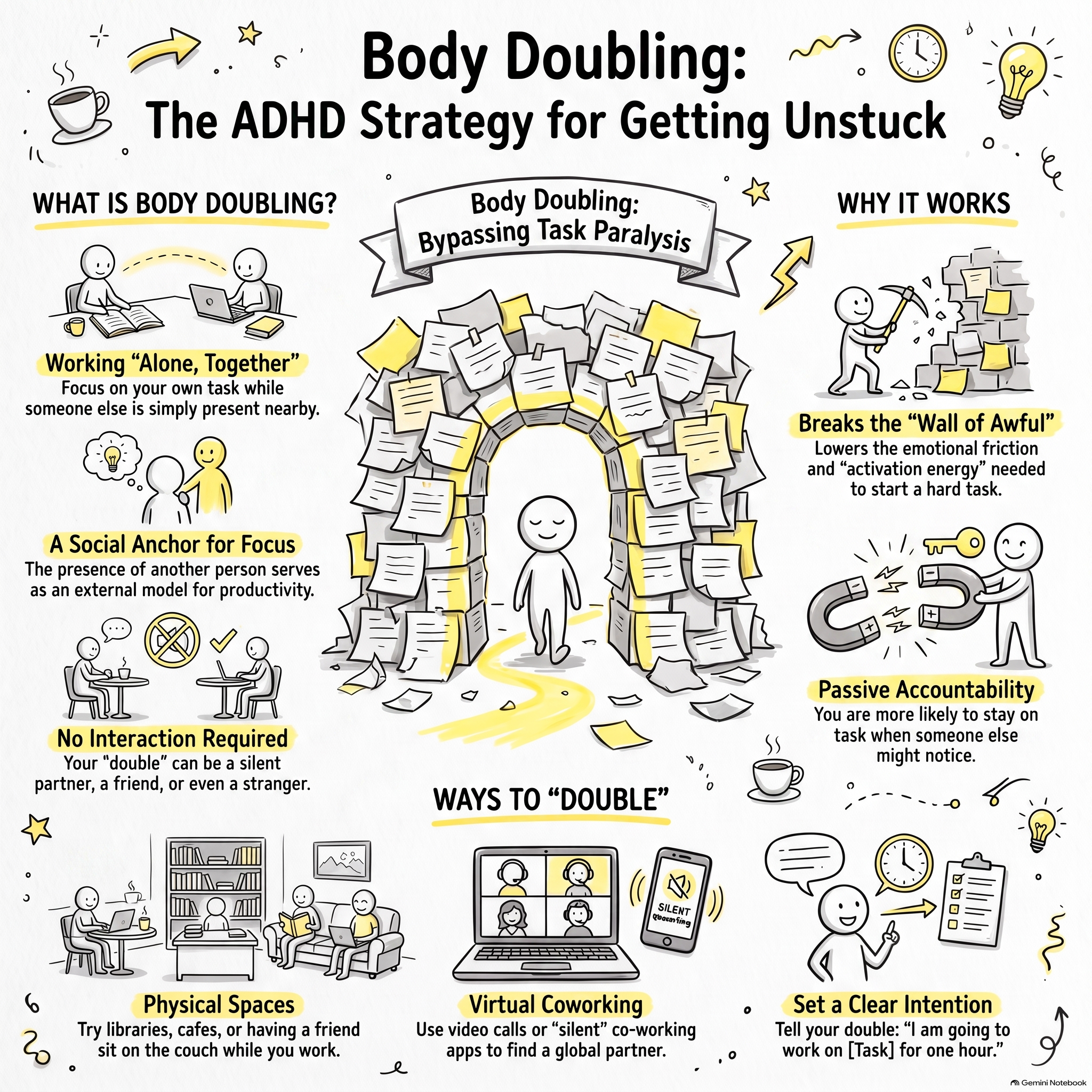
**Double Up: How to Outsmart ADHD Task Paralysis with Body Doubling** You are sitting at your desk, staring at a blank screen or a pile of paperwork. You know exactly what you need to do. You might even have a clear list of steps. Yet, your body feels physically heavy, almost glued to the chair. The minutes stretch into hours, and the quietness of the room begins to feel less like peace and more like a suffocating weight. You want to start, but you simply cannot make yourself move. If you have ADHD or struggle with executive dysfunction, this agonizing freeze state is all too familiar. It is a painful cycle of wanting to work, feeling unable to initiate, and then drowning in self-criticism. But the problem isn't a lack of willpower, laziness, or a defect in your character. The problem is that your brain is attempting to generate starting energy entirely on its own in a system that isn't built to run that way. Fortunately, there is a simple, highly effective neurological hack that doesn't require sheer force: body doubling. --- ### The Simple Science of the Solo Freeze To understand why body doubling works, we have to look at how a neurodivergent brain initiates action. A standard brain relies on an importance-based nervous system, releasing dopamine when a task is deemed critical or urgent. An ADHD brain, however, runs on an interest-based nervous system. It requires interest, novelty, challenge, or immediate urgency to release the dopamine needed to plan and start a task. When you sit down alone to tackle a boring, routine, or complex project, your brain experiences immense cognitive friction. Because there is no natural dopamine spark, your prefrontal cortex—the area responsible for planning and organizing—must work in overdrive just to figure out where to begin. This high mental load is perceived by your brain's threat detector, the amygdala, as an active danger. To protect you from this distress, your amygdala triggers a somatic freeze response, resulting in task paralysis. A body double acts as an external prefrontal cortex. When another person is in the room—or even on a video screen—their quiet presence acts as a stabilizer. It anchors your attention to the physical space, calms your reactive amygdala, and reduces the mental friction of being alone with your thoughts. You no longer have to manufacture your own focus out of thin air; you simply borrow theirs. --- ### How to Apply Body Doubling Today You don't need a professional productivity coach to use this technique. You can set up a highly effective body doubling session right now using these four simple steps: #### 1. Select Your Format Body doubling is incredibly flexible. You can use a physical double, such as a partner, friend, or coworker sitting in the same room. If you live or work alone, virtual body doubling is just as powerful. You can hop on a quiet video call with a friend, use dedicated online platforms, or even put on a "clean with me" or "work with me" video in the background. The key is that the other person is also engaged in their own quiet task. #### 2. Declare Your Intention Before you begin, state exactly what you are going to work on. If you are working with a partner, tell them: "I am going to spend the next thirty minutes writing this email." If you are using a virtual setup, write your goal in a chat box or on a sticky note placed on your screen. Declaring your intention aloud externalizes your commitment, which helps keep your interest-based nervous system accountable. #### 3. Prepare a Zero-Friction Starting Point Do not try to jump straight into a massive project. Instead, prepare a clear, low-friction starting point in advance. Open the exact document you need, clear off your desk, or lay out your physical tools before the session begins. By eliminating the need to search, plan, or make decisions when the session starts, you bypass the cognitive block that triggers task paralysis. #### 4. Practice Parallel Play Keep the interaction strictly non-interactive. The ideal body doubling session mimics "parallel play" in children—two people working side-by-side on completely unrelated tasks. Your double does not need to teach, supervise, or even understand your work. Their only job is to exist in your environment as a quiet anchor of focus. --- ### Common Pitfalls to Avoid While body doubling is incredibly simple, it is easy to accidentally turn a productive session into a distraction. Keep these common mistakes in mind: * **The Social Hour Trap:** If you pick a highly talkative friend or fail to set clear boundaries, your session can quickly devolve into a catch-up chat. Ensure both you and your double agree to work in silence, reserving conversation for scheduled breaks. * **Picking a Critical Partner:** Avoid choosing a body double who makes you feel judged, micromanaged, or ashamed. If your partner is constantly checking over your shoulder or criticizing your pace, your amygdala will become more reactive, triggering a defensive freeze response rather than focus. * **Overcomplicating the Setup:** You do not need the perfect environment or a complex app. If organizing the session begins to feel like a chore, you are adding administrative friction. Keep it as simple as sitting near someone who is reading a book or working on a laptop. --- ### The Takeaway Starting a task alone is the hardest part of executive dysfunction. Stop beating yourself up for being unable to find the motivation in an empty room. Your brain simply needs a gentle, supportive anchor to help it cross the starting line. By inviting a body double into your space—whether in person or virtually—you reduce the cognitive load, calm your physical nervous system, and make initiation feel natural rather than forced. Work with your biology, set up a low-friction start, and let the quiet presence of another person carry you past the freeze.