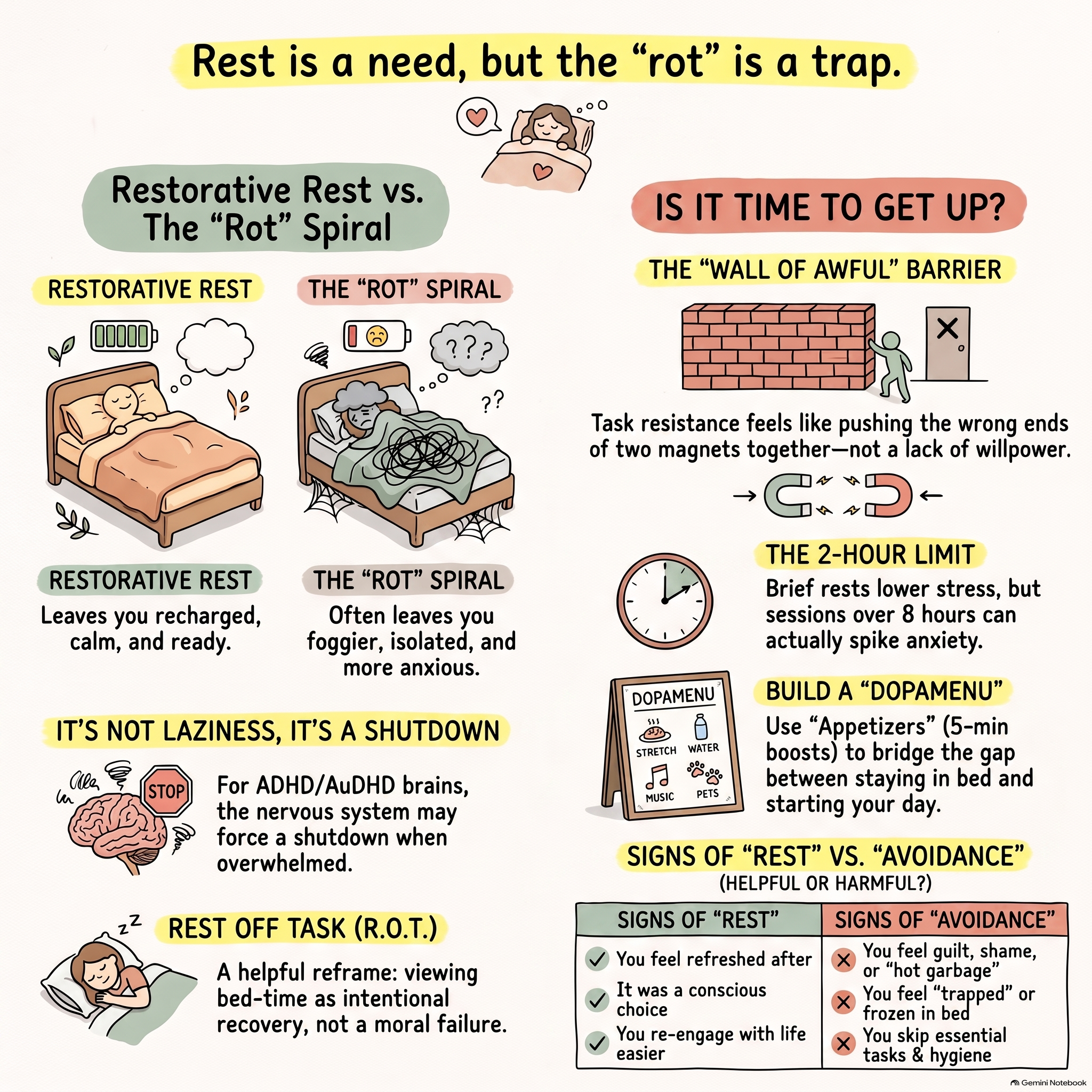
The problem You wake up tired on Saturday morning and decide to stay in bed "just for an hour." Fast forward to 4:00 PM. You are still under the covers, surrounded by snacks, with your phone practically glued to your hand. Your eyes burn from hours of scrolling social media, your neck is stiff, and a heavy cloud of guilt has settled over your chest. You want to get up—there is laundry to fold or messages to answer—but the thought of crossing the threshold of your bedroom feels like climbing a mountain. You tell yourself you are just "resting" because you are burned out, but deep down, you feel paralyzed. This viral trend is called **"bed rotting,"** and for adults with ADHD, it is a seductive trap that promises recovery but actually delivers avoidance and deeper exhaustion. ## Why it happens Why does your brain lock you in bed when you are already exhausted? To understand this, we must look at the **interest-based nervous system** of ADHD. Unlike neurotypical brains, which can initiate tasks based on abstract importance, your brain requires immediate interest, novelty, challenge, or urgency to release **dopamine**—the chemical spark plug needed for physical action. When you are chronically stressed or burned out, your prefrontal cortex is starved of **cellular energy (ATP)**. Your brain's threat detector, the **amygdala**, becomes highly reactive. When you contemplate your tasks, your brain doesn't see simple chores; it perceives a mountain of cognitive friction and emotional shame from past failures—the **"Wall of Awful."** To protect you from this perceived threat, your amygdala triggers a **physiological freeze response**, locking you in place. Retreating under the covers to scroll is a subconscious escape. It provides a steady drip of low-effort, cheap dopamine that temporarily soothes your anxious nervous system. But because your brain is constantly processing digital stimulation, your nervous system remains in a state of high alert. You aren't actually resting; you are in **somatic avoidance**, which disrupts your circadian rhythm and leaves you feeling even heavier and more paralyzed than before. ## How to fix it today To break a bed-rotting freeze, you must work with your biology. Here is how to transition to true recovery today: - **Trigger a 60-second somatic reset:** Since task paralysis is a physical freeze response, signal safety to your nervous system. Splash ice-cold water on your face to trigger the **mammalian dive reflex**, which slows your heart rate and dampens physical anxiety. Remember to check with a doctor first if you have underlying health conditions. Alternatively, perform a **physiological sigh**: take two quick inhales through your nose, followed by one long, slow exhale to activate your calming parasympathetic response. - **Differentiate rest from rotting:** Establish a physical boundary for your bed. True **restorative rest** is low-stimulation: sleeping, staring at the ceiling, listening to soft music, or meditating. If you are scrolling, playing games, or eating, your brain is working. Keep your bed strictly reserved for sleep and low-stimulation rest to protect your brain's sleep associations. - **Use the Two-Option Rule to exit:** Choice overload triggers freeze states. Do not look at your entire to-do list. Instead, choose between exactly two micro-tasks, such as drinking water or putting on your shoes. Limiting your choices removes the cognitive load of prioritizing. - **Commit to a 180-second micro-start:** Once out of bed, commit to doing any simple activity for just three minutes, such as washing one dish or opening one email. Lower your standard of performance to zero and give yourself full permission to stop when the timer rings. Often, simply overcoming the initial transition friction is enough to let natural momentum take over. - **Prepare your starting point in advance:** To prevent future freeze states, design your environment for low friction. Before sleep, lay out your clothes, place your notebook in your direct line of sight, or open the digital files you need. By removing the tiny administrative barriers that trigger task resistance, you make starting tomorrow feel effortless. ## Common mistakes to avoid - **Using shame as a motivator:** Self-criticism only makes your amygdala more reactive. Shame builds the Wall of Awful higher, reinforcing the biological freeze. Treat your freeze as a sign of an exhausted nervous system that needs safety, not punishment. - **Confusing scrolling with recovery:** Mindless scrolling is highly stimulating and keeps your brain's stress pathways active, draining dopamine without letting your mitochondria rebuild ATP. - **Trying to "Hulk smash" your way out:** Do not wait until a self-induced crisis or panic forces you out of bed. Relying on an adrenaline spike to break paralysis is biologically expensive and leads directly to chronic, long-term burnout. ## Takeaway Bed rotting is not a sign of laziness or a lack of discipline; it is a protective physical shutdown of an overwhelmed, under-stimulated nervous system. True recovery does not happen by escaping into a screen under your blankets. To heal your burnout and break the freeze, you must shift from passive avoidance to **active somatic recovery**. Calm your nervous system with physical resets, draw a firm boundary around your bed, and reduce your starting barriers to absolute zero. Work with your neurodivergent biology, show yourself compassion, and let tiny, low-friction steps guide you back into motion.