The 180-Second Rule: How to Outsmart ADHD Task Paralysis and Just Start
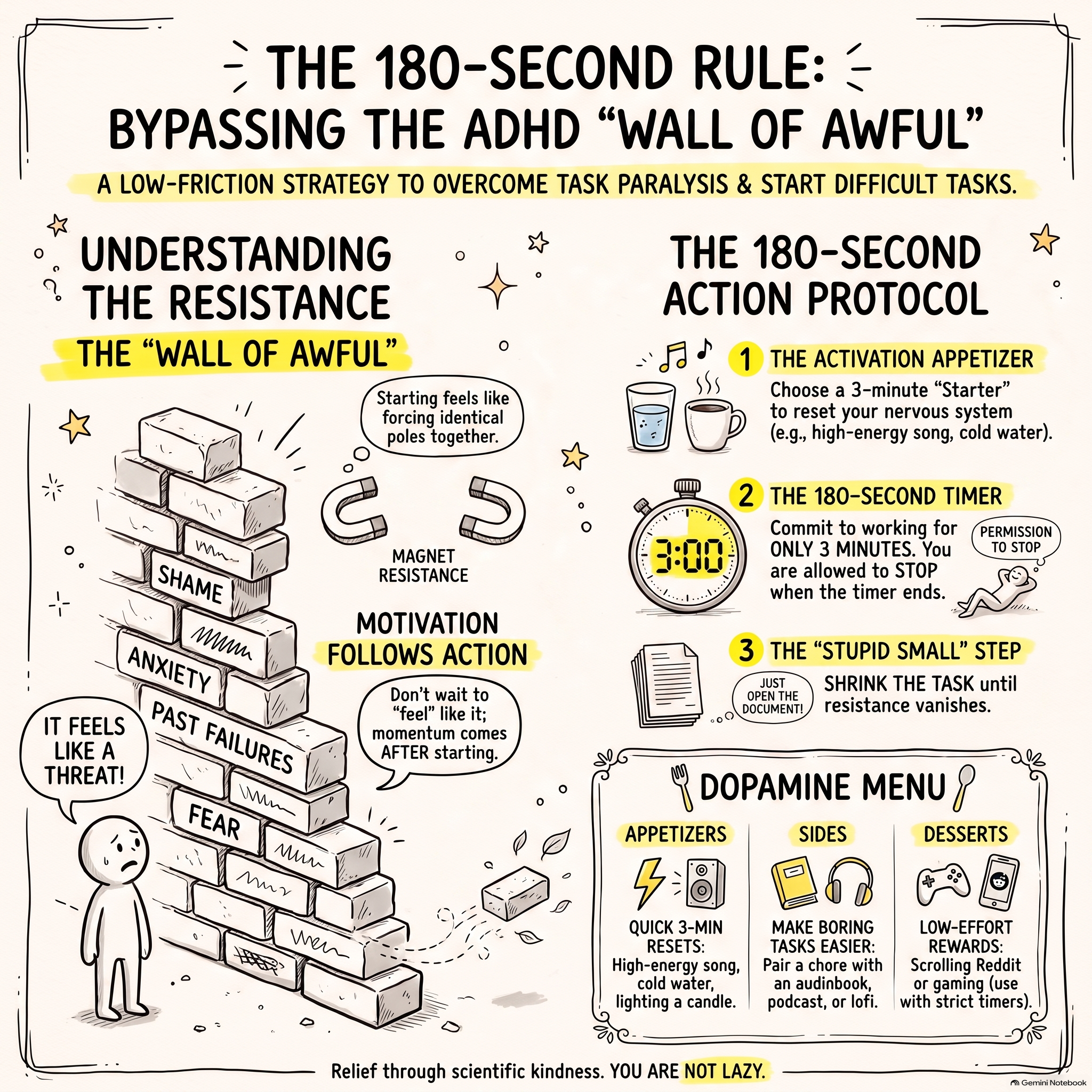
The 180-Second Rule: How to Outsmart ADHD Task Paralysis and Just Start You are sitting on the couch, staring at your computer screen or looking at a stack of dishes in the sink. You know exactly what you need to do, and you know it needs to be done today. Yet, you feel physically locked in place, as if an invisible force field is holding you back. The minutes tick by, and the guilt starts to build. You ask yourself, "Why am I like this? Why can't I just get up and do it?" If you have ADHD or struggle with executive dysfunction, this agonizing state is not laziness. It is task paralysis—a real, physiological freeze state where your body's motor initiation simply goes offline. Trying to push through this barrier with sheer willpower or self-criticism is like trying to drive a car with a locked transmission. To break the freeze, you need to understand the biological lock and use a simple, science-backed bypass: the 180-second rule. Why This Happens: The Neuroscience of the Freeze In a standard brain, a high-priority task naturally triggers a steady release of dopamine, which acts as the chemical fuel needed to plan, organize, and initiate action. However, the neurodivergent brain is biologically wired with an interest-based nervous system. It relies heavily on immediate novelty, interest, challenge, or urgency to release that vital starting spark. When you attempt to start a task that feels boring, routine, or overwhelming, your prefrontal cortex—the administrative center of your brain—reaches for dopamine but finds empty reserves. At the same time, your brain retrieves memories of past struggles, missed deadlines, and criticism associated with similar tasks. In the ADHD community, this accumulated emotional friction is called the Wall of Awful. When you look at the task, your amygdala, which acts as your brain’s threat detector, becomes more reactive. It associates the chore with emotional distress, perceives it as an active threat, and triggers a primitive freeze response to protect you. Your body physically halts task initiation because your nervous system is in survival mode. The Solution: How to Apply It Today The 180-second rule works by lowering the starting barrier to a level that your reactive amygdala no longer perceives as a threat. Instead of trying to force yourself to finish a massive, intimidating project, you commit to taking action for exactly three minutes. Here is how to put this protocol into practice today: First, calm your physical body. Since task paralysis is a physiological freeze response, you cannot simply think your way out of it. You must signal safety to your nervous system. Try a quick somatic reset, such as a physiological sigh—taking two quick, deep inhales through your nose followed by one long, slow exhale—to activate your calming parasympathetic response. You can also splash cold water on your face to trigger the mammalian dive reflex, which instantly slows your heart rate. If you have underlying health conditions, check with a doctor before using cold water exposure. Second, prepare a zero-friction starting point. Before you even start your timer, remove every physical obstacle between you and the task. If you need to write an article, open the document and place your laptop in your direct line of sight. If you need to clean, place the vacuum cleaner in the middle of the room. Removing the administrative friction of finding your tools saves your limited executive energy. Third, make the three-minute pact. Set a physical visual timer for exactly 180 seconds. Tell yourself, "I am only going to work on this for three minutes. Once the timer rings, I have full, unconditional permission to stop and walk away." This is not a trick; you must truly give yourself the freedom to quit if the friction remains unbearable. Fourth, lower the standard to zero. Give yourself permission to do a terrible job. Write absolute nonsense, wash only one cup, or fold a single shirt. By stripping away the fear of failure, you dismantle the Wall of Awful and allow your brain to glide into motion without anxiety. Common Mistakes to Avoid While the 180-second rule is incredibly simple, it is easy to accidentally sabotage its effectiveness. The most common mistake is using a pattern called Hulk smashing. This is when you intentionally generate self-induced panic, shame, or anger to create a massive stress response to force yourself over the wall. While this adrenaline surge might help you start, relying on stress as executive fuel is unsustainable and leads directly to deep mental burnout. Another pitfall is trying to organize your entire life before you begin. Spending an hour choosing the perfect playlist or cleaning your entire desk is just another form of task avoidance. Keep your preparation limited to a single, zero-friction starting point. Finally, do not make a habit of leaving your tasks half-completed when you actually have momentum. The goal of the 180-second rule is to help you cross the starting line. Once you begin, you will often find that the friction disappears, and you naturally want to keep going. However, if you truly need to stop after three minutes, honor your pact, rest, and prepare a clear starting point for next time. The Takeaway Task paralysis is a biological hurdle, not a moral failing. Your brain is not broken; it is simply trying to protect itself from emotional distress. Motivation does not create action; action builds motivation. By shortening your starting line to just 180 seconds and preparing your environment in advance, you bypass your brain's alarm system and let natural momentum do the heavy lifting. Stop waiting for the perfect wave of energy, set a timer for three minutes, and let yourself begin messily.